
Acumen Pharmaceuticals Advances Alzheimer's Therapy with Highlight on Sabirnetug Phase 2 Progress
Recent quarterly disclosures highlight pivotal clinical milestones and delivery innovations as Acumen advances its lead candidate sabirnetug in Alzheimer’s disease treatment.
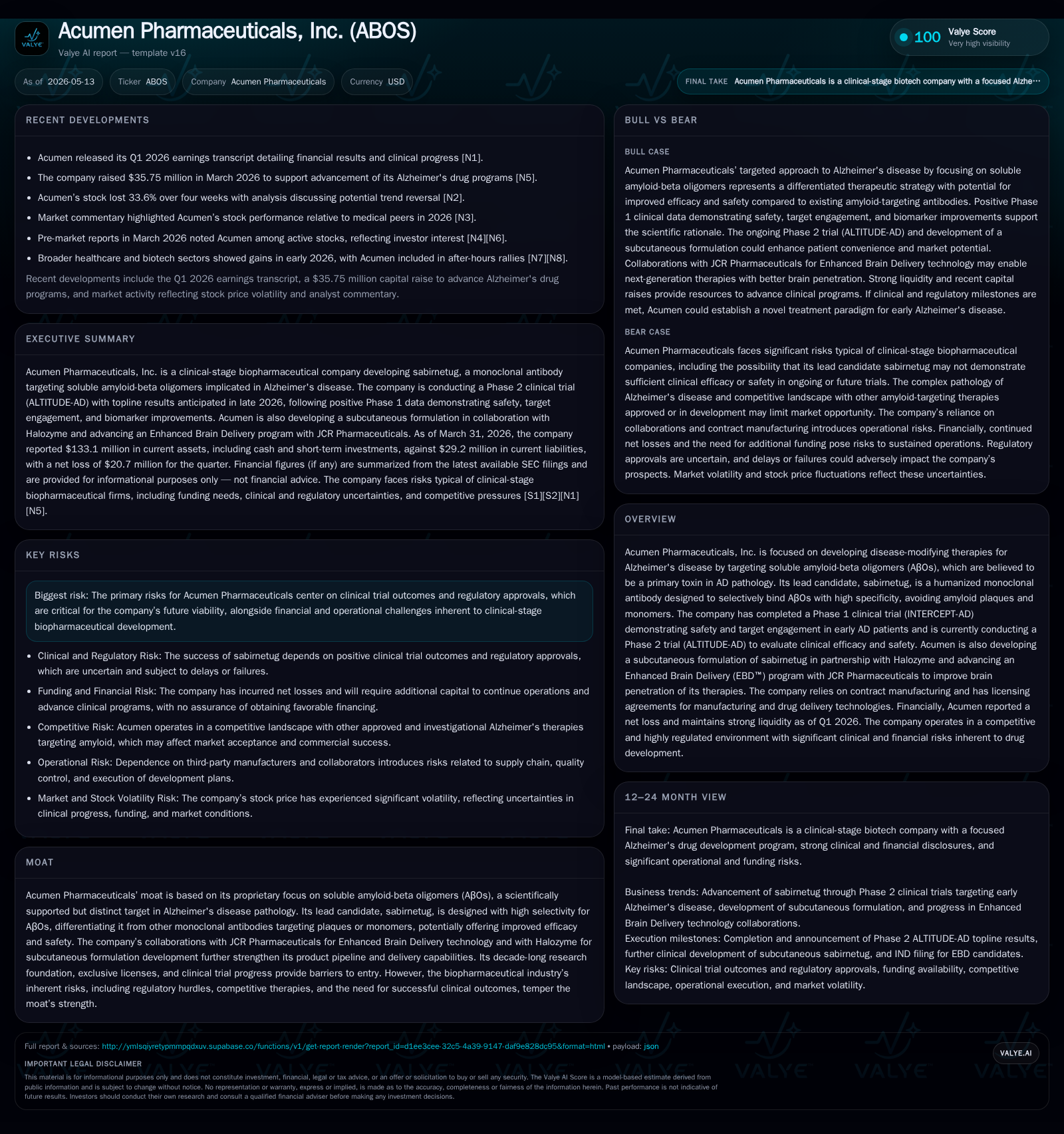
Acumen Pharmaceuticals reported on May 12, 2026, reinforcing progress in its Phase 2 ALTITUDE-AD trial of sabirnetug, a humanized monoclonal antibody selectively targeting neurotoxic amyloid-beta oligomers (AβOs) implicated in Alzheimer’s disease. The company anticipates topline data in late 2026 and is advancing complementary programs including subcutaneous formulation development with Halozyme and enhanced brain delivery technology with JCR Pharmaceuticals. These efforts underscore Acumen’s focused strategy to address limitations of existing amyloid therapies and position it distinctively within a challenging AD therapeutic landscape. Financially, Acumen maintains adequate liquidity and modest leverage to fund near-term milestones while managing operational risks tied to clinical outcomes and regulatory scrutiny.
Latest Quarterly Operating Update: Milestones and Clinical Progress
Acumen Pharmaceuticals’ most recent quarterly filing dated May 12, 2026 [S2], supported by the concurrent 8-K update [S3], anchors the company’s current narrative firmly on nearing completion of its pivotal Phase 2 clinical trial called ALTITUDE-AD. This randomized, double-blind, placebo-controlled study enrolled approximately 542 participants diagnosed with early-stage Alzheimer's disease (mild cognitive impairment or mild dementia due to AD), divided evenly across three arms — two active dosing cohorts at 35 mg/kg and 50 mg/kg administered intravenously every four weeks versus placebo.
Of particular note is that enrollment for ALTITUDE-AD was completed by March 2025 [S1], allowing for an expected top-line readout late in calendar year 2026 [S2]. Results from this trial represent a critical inflection point for Acumen's lead product candidate sabirnetug (ACU193), as positive efficacy data would provide proof of concept validating its selective targeting approach against soluble amyloid-beta oligomers (AβOs). Additionally, the company continues advancing ancillary programs that enhance its drug's practical usability—most prominently the subcutaneous formulation developed alongside Halozyme Therapeutics designed to facilitate outpatient dosing convenience.
Complementing these efforts is a collaboration with JCR Pharmaceuticals for an Enhanced Brain Delivery (EBD™) platform aimed at improving blood-brain barrier penetration—a longstanding bottleneck for central nervous system drug efficacy. Together, these delivery-focused projects signify strategic attempts to tackle patient adherence challenges typical in long-duration neurological treatment regimens.
Importantly, the latest filings report no material changes or new risk factors during the quarter beyond those outlined in the annual report [S2], reflecting stability albeit within an inherently high-risk R&D environment.
Company Business Model: Therapeutic Focus and Innovation Edge
Acumen’s business model is narrowly centered on development and eventual commercialization of sabirnetug, a recombinant humanized IgG2 monoclonal antibody engineered with unique molecular specificity for soluble amyloid-beta oligomers (AβOs) rather than plaques or monomers [S1]. This exclusivity derives from intellectual property previously licensed from Merck and foundational research by Acumen’s scientific founders dating back decades.
Revenue streams are currently non-existent as Acumen remains a clinical-stage entity without any approved products; all operating expenses are R&D-related, primarily clinical trials management and manufacturing outsourcing. Contract manufacturing partners handle production scale-up activities while internal teams oversee regulatory interactions and key partnerships related to formulation enhancements.
This focused model carries inherent strengths: by concentrating investment into one high-potential mechanism—targeting what preclinical evidence implicates as the primary neuronal toxin in AD—the company aligns research resource allocation efficiently. Moreover, collaborations with Halozyme (for enzymatic subcutaneous delivery facilitation) and JCR Pharmaceuticals (for nanoparticle-enabled brain delivery) bolster pipeline robustness without necessitating heavy capital expenditures internally.
However, the absence of diversification increases reliance on successful clinical outcomes for sabirnetug alone. The dependence on contract manufacturers introduces scale-up risks particularly if regulatory approvals mandate manufacturing process adjustments later.
Competitive Positioning in Alzheimer's Disease Therapeutics
Within the AD therapeutics field—a notoriously difficult landscape with few disease-modifying success stories—Acumen offers a distinct competitive proposition through its selective binding to soluble AβOs [S1]. This contrasts sharply with incumbent monoclonal antibodies like aducanumab or lecanemab which primarily bind aggregated plaques or monomeric forms of amyloid beta but have faced questions over their clinical effectiveness and safety profiles.
Scientific rationale underpinning this strategy is anchored in evolving neuropathological consensus emphasizing oligomers’ toxicity as early instigators of synaptic dysfunction driving cognitive decline. By avoiding plaque binding — which may cause inflammatory side effects — sabirnetug aims at achieving superior tolerability alongside efficacy.
Regulatory pathways are complicated further by shifting standards following the FDA’s initial controversial approvals of amyloid-targeting therapies. Nonetheless, decade-spanning IP exclusivity surrounding AβO-targeted technology combined with ongoing collaborations supporting novel brain-targeting mechanisms erect meaningful barriers against competitors entering this niche quickly.
Notwithstanding these strengths, major pharmaceutical companies continue robust activity developing alternative approaches including tau protein targeting agents and gene therapies. Market acceptance hinges heavily on credible endpoint improvements demonstrated via rigorous Phase 3 trials following positive Phase 2 signals.
Growth Opportunities Driven by Clinical Trial Outcomes and Delivery Innovations
The primary near-term growth catalyst is unequivocal: topline results from ALTITUDE-AD slated for late 2026 offer empirical validation that could move sabirnetug closer toward pivotal registration trials [S1],[S2]. Success there could significantly de-risk commercialization efforts given historical skepticism around amyloid-targeted treatments’ impact.
Beyond clear clinical efficacy signals, ongoing advancement of patient-friendly drug delivery further enhances growth prospects. The subcutaneous formulation under development facilitated by Halozyme’s ENHANZE® technology offers simpler administration routes avoiding intravenous infusion drawbacks—potentially broadening patient accessibility especially in outpatient settings.
Similarly, Enhanced Brain Delivery efforts with JCR Pharmaceuticals intend to boost CNS bioavailability overcoming classical blood-brain barrier limitations commonplace in neurotherapeutics—a powerful differentiator if clinically substantiated.
Together these programmatic expansions support strategic optionality not only within Alzheimer's but potentially other CNS indications where targeted delivery matters critically.
Key Risks Including Clinical, Regulatory, and Financial Challenges
Despite encouraging developments, Acumen remains exposed to significant risks typical for clinical-stage biopharmaceuticals [S1],[S2],[S4],[S5],[S6],[S7]. Foremost among these are:
- Clinical Execution Risk: Past site activation delays experienced during INTERCEPT-AD Phase 1 caution that similar operational hurdles could emerge affecting timeline certainty around ALTITUDE-AD completion or future trials impacting valuation sentiment.
- Regulatory Uncertainty: Given evolving FDA AD approval guidelines especially post-Loper Bright decision altering deference norms towards agency interpretations [S25], there exists uncertainty regarding required evidence thresholds potentially affecting approval timelines or labeling.
- Financial Constraints: Although currently liquid ($51.8M cash & equivalents) vs moderate debt (~$16.9M), loan covenants embedded in existing debt agreements limit operational flexibility [F1],[S4],[S6]. Variable interest rates introduce exposure to rising servicing costs which may compound financial strain amidst prolonged R&D spending without revenue inflows.
- Market Access & Reimbursement Complexities: Even if approved commercially, lack of uniform coverage policies across payors raises adoption risk amid potential pricing pressures confirmed by regulatory scrutiny outlined [S10],[S22].
- Intellectual Property & Litigation Risks: Dependence on licensing arrangements introduces termination risk or competitive encroachments if patents fail enforcement or expire prematurely weakening exclusivity advantages [S19],[S20].
Upcoming Catalysts and Indicators to Monitor
Investors should prioritize monitoring several tangible events poised for material impact:
- Expect announcement of ALTITUDE-AD top-line efficacy/safety results late Q4-2026 or shortly thereafter [S2].
- Updates from ongoing subcutaneous dosing studies reflecting pharmacokinetics/pharmacodynamics/safety needed to validate outpatient profile improvements [N1].
- Milestones relating to collaboration progress with JCR Pharmaceuticals including preclinical assessments or early clinical validation signals for Enhanced Brain Delivery technology implementation [N1].
- Any public disclosures concerning financing activities or modifications/new waivers related to loan agreement covenants given macroeconomic credit conditions remain relevant to capital sustainability.
Each event carries implications either reinforcing confidence around sabirnetug’s commercial viability or triggering reassessment depending on data clarity and regulatory feedback mechanisms observed post-release.
Current Financial Position and Capital Structure
Latest financial snapshot
| Metric | Value | Period |
|---|---|---|
| Cash & equivalents | $52mm | |
| 2026-03-31 | ||
| Total debt | $17mm | |
| 2026-03-31 | ||
| Net debt | $-35mm | |
| 2026-03-31 | ||
| Current assets | $133mm | |
| 2026-03-31 | ||
| Current liabilities | $29mm | |
| 2026-03-31 | ||
| Current ratio | 4.55x | |
| 2026-03-31 |
Source: SEC companyfacts cache [F1].
As per the latest publicly available data ending March 31, 2026 [F1]:
| Metric | Amount (USD) |
|---|---|
| Cash & Equivalents | $51,796,000 |
| Total Debt | $16,924,000 |
| Net Debt (Debt - Cash) | -$34,872,000 |
| Current Assets | $133,094,000 |
| Current Liabilities | $29,229,000 |
| Current Ratio | 4.55 |
The balance sheet depicts a solid liquidity buffer capable of funding intensive upcoming trial milestones without imminent refinancing pressures. The negative net debt figure reflects cash reserves exceeding short-term borrowings granting operational runway through anticipated data announcements. Notwithstanding this liquidity cushion, the variable rate debt facility exposes Acumen to interest rate risk alongside contractual restrictions embedded within lender covenants constraining financial maneuverability if clinical outcomes delay revenue generation absence [S4],[S6].
This analysis synthesizes publicly available SEC filings supplemented by recent earnings commentary without providing investment advice. Forward-looking statements herein are subject to change based on emerging data consistent with typical biopharmaceutical developmental uncertainties.
Disclaimer: This is research-only, informational analysis and not investment advice. It may include AI-generated interpretation and general industry context. Always verify important details using primary sources.

Comments