
SUIC Worldwide Holdings Advances Fintech and Supply Chain Integration Despite Liquidity Challenges
Latest quarterly filings reveal intensified focus on fintech patents and strategic partnerships amid ongoing financial strain.
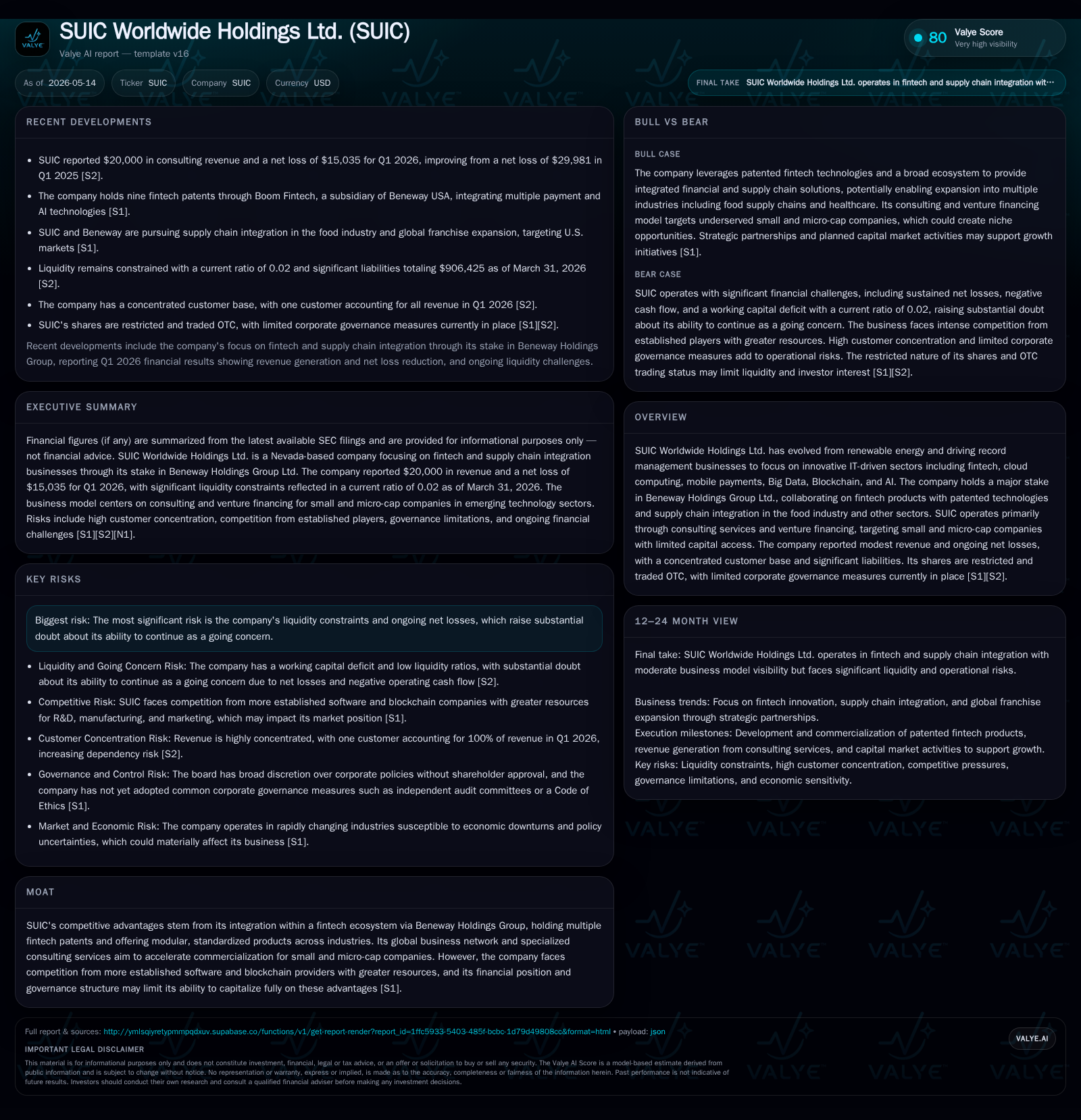
SUIC Worldwide Holdings Ltd. continues to pivot its business model toward fintech innovation and supply chain integration through its stake in Beneway Holdings Group. The company leverages patented technologies and holistic financial ecosystems to serve diverse industries, particularly in food supply chains between the U.S. and Asia. However, SUIC remains financially constrained with substantial working capital deficits and a net loss, raising concerns about its viability without new capital infusion. Growth hinges on successful capital raises, scaling of consulting revenues, and executing expansion plans within competitive and resource-intensive fintech markets.
As detailed in the 10-Q filing [S2], SUIC reported a working capital deficit of $(615,230) while holding current assets worth merely $12,195—primarily cash.
The company recorded a net loss of $(15,035) for the quarter alongside negative cash flow from operations totaling $(7,270), reflecting ongoing difficulties in generating positive cash inflows without relying on external financing or related party loans. Current liabilities stand at $627,425 comprising short-term debt ($125K), loan payables ($259K), accrued expenses ($134K), credit card payables ($31K), among others [S2]. Long-term liabilities include convertible promissory notes totaling $279,000 bearing 5% interest due to a related party creditor [S2]. Management explicitly acknowledges "substantial doubt about the Company's ability to continue as a going concern" absent new sales growth or capital injections [S2].
Simultaneously, SUIC continues business development initiatives centered around its partnership with Beneway Holdings Group Ltd., where it holds major creditor and stakeholder status via promissory notes [S2][S3].
Business Model
Historically involved in renewable energy and driving record systems through subsidiaries spun off by 2017, SUIC refocused since 2018 on emerging technology-driven sectors: fintech, cloud computing, mobile payments, Big Data analytics, Blockchain technology, and AI [S1]. Its revenues stem mainly from consulting services that leverage patented fintech integrations developed by Beneway's subsidiary Boom Fintech.
Boom Fintech offers standardized all-in-one products combining payment gateways, electronic invoicing devices, mobile cash registers, point-of-sale (POS) systems, and ERP solutions — extending modularly across diverse industries ranging from large retail chains to informal vendors like night market sellers [S1]. These innovations are protected by nine fintech patents aiming for robust intellectual property moats.
Beneway Holdings operates as a strategic ecosystem connector between borrowers and lenders worldwide. By integrating financial delivery frameworks with advanced technological platforms, it provides supply chain financing tailored primarily to global merchants and franchisees within food supply chains linking the U.S. to Asian markets [S2][S3]. This includes planned cooperation with international trade financiers targeting raw material import/export demand.
Consulting is conducted on fixed-fee contracts where SUIC bills based on scoped professional services delivered or outcomes achieved — mostly concentrated currently in Taiwan through single customers such as Yu Xun Catering Co., which accounted for all reported Q1 revenues (~$20K) [S12][S18]. The revenue model emphasizes service volume scaling but faces seasonality influences given the client concentration.
Industry Structure and Competitive Position
The fintech segment targeted by SUIC is characterized by rapid evolution coupled with intense competition from better-funded incumbents possessing mature product portfolios in blockchain-enabled financial platforms. SUIC's key strategic assets reside in proprietary patents held by Boom Fintech offering modular solutions that simplify complex payment and ERP reconciliations across multiple industries.
Integration of trade finance into supply chain workflows elevates barriers for pure software providers lacking domain-specific expertise or global merchant networks. Beneway's role in bridging lenders with borrowers attempts to capture value across multiple stakeholder groups beyond mere software provision.
However, SUIC’s competitive position is constrained by several key factors: limited resources for deep R&D investment relative to large fintech players; a small corporate footprint reflected in just seven employees spread across Taiwan, Malaysia, and the U.S.; very concentrated customer exposure; restricted share liquidity trading OTC without extensive public market support; plus relatively thin governance provisions with board control decisions highly centralized [S1]. These factors hamper rapid scaling or broad commercial acceptance despite patented advantages.
Growth Drivers
SUIC’s growth strategy revolves around:
- Capital Raising Initiatives: Pursuit of IPOs or other equity/debt financings intended to fuel mergers & acquisitions primarily targeting mid- to upper-stream suppliers in the U.S. food industry; this would expand operational scale coupled with franchise rollouts via I.Hart catering group collaborations [S3].
- Patent Commercialization: Leveraging Boom Fintech’s nine patented technologies to augment product offerings deployed across industry verticals supports scalable licensing or direct adoption models.
- Supply Chain Integration Expansion: Extending beyond food to medical/health care supplies and high-tech AI systems broadens addressable markets tied tightly to real trade flows supported by international financiers [S4].
- Franchise & Market Penetration: Accelerating network effects through partnerships with top-tier U.S. real estate firms enables faster adoption of multi-brand franchises across all 50 states.
- Consulting Services Revenue Growth: Expanding consulting client base with enhanced utilization rates mitigates reliance on single customers while building recurring contractual relationships.
Risks / Watchpoints / Growth Constraints
Key risks include:
- Severe Liquidity Constraints: The company's working capital position evidences limited runway without immediate funding; consistent operating losses compound going concern risks [S2].
- Customer Concentration: Current revenue entirely driven by one client increases revenue volatility risk and heightens dependency for sustainability [S18].
- Competitive Dynamics: Entrenched fintech players may erode pricing power forcing lower margins or obstruct uptake due to QoS or brand preference switching costs.
- Governance & Shareholder Control: Concentrated board power limits minority shareholder influence on strategic shifts potentially critical for turnaround maneuvers or restructuring options [S1].
- Execution Risks: Scaling cross-border supply chain finance requires navigating complex regulatory regimes alongside establishing new financing partnerships possibly delaying timelines.
- Capital Markets Access Uncertainty: Dependence on IPOs or equitable transactions for expansion carries dilution risk plus timing uncertainty linked to broader market conditions.
What To Watch Next
Investors and stakeholders should monitor:
- Progress toward planned IPO or other significant equity/debt fundraisings enabling working capital improvement.
- Expansion indicators from franchise deals executed via I.Hart catering group or other network partners.
- New client wins beyond singular major customers signaling consulting revenue diversification.
- Updates on commercialization success of Boom Fintech patented technologies including new product launches or licensing agreements.
- Changes in short-term debt levels or renegotiations amid rising interest costs impacting liquidity outlook.
- Any revisions to guidance or management commentary addressing resolution of going concern disclosure concerns in future SEC filings.
Financial Profile (Brief)
Latest financial snapshot
| Metric | Value | Period |
|---|---|---|
| Current assets | $12,195 | |
| 2026-03-31 | ||
| Current liabilities | $627,425 | |
| 2026-03-31 | ||
| Current ratio | 0.02x | |
| 2026-03-31 |
Source: SEC companyfacts cache [F1].
As of March 31, 2026, SUIC Worldwide Holdings Ltd. reported a working capital deficit of $(615,230) with current assets primarily consisting of cash totaling $12,195 and current liabilities of $627,425, including short-term debt and loan payables [S2][F1]. The company carries convertible promissory notes of $279,000 bearing 5% interest due to a related party creditor [S2]. Management has expressed substantial doubt about the company's ability to continue as a going concern without additional sales growth or capital infusion [S2].
Disclaimer: This analysis is prepared solely for informational purposes based on publicly available SEC filings as of May 14, 2026. It does not constitute investment advice or recommendations regarding securities of SUIC Worldwide Holdings Ltd. Readers should conduct further due diligence before making any investment decisions.
Disclaimer: This is research-only, informational analysis and not investment advice. It may include AI-generated interpretation and general industry context. Always verify important details using primary sources.

Comments