
GIVBUX Strengthens Fintech Mobile Wallet Network While Facing Liquidity and Competitive Pressures
GIVBUX's Q1 2026 update highlights ongoing platform enhancements and merchant expansion amid persistent financial and market challenges.
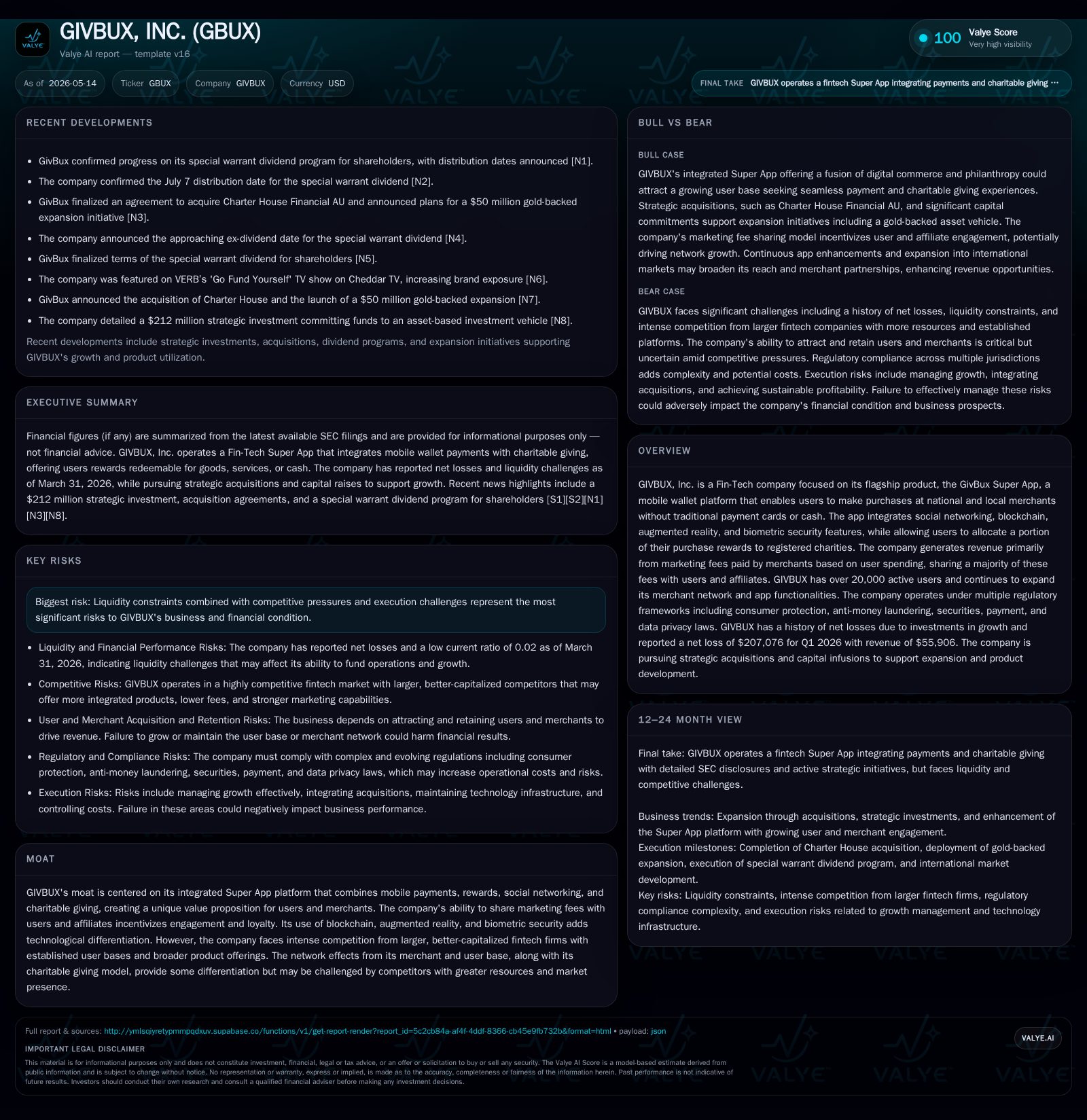
GIVBUX, Inc. reported no material changes in legal or risk factors in its latest Q1 2026 filing, continuing to focus on advancing its GivBux Super App. The app integrates payment processing, social networking, blockchain, and charitable giving to differentiate itself in the competitive fintech mobile wallet space. Despite innovative multi-functionality and a growing user base, the company faces severe liquidity constraints with a current ratio near 0.02 and net losses from previous periods. Growth hinges on expanding merchant partnerships, increasing user engagement, and successful execution of planned app improvements, while key risks include intense competition from better-capitalized players and operational scaling challenges.
Recent Operating Update
GIVBUX’s Q1 2026 10-Q filing dated May 14 confirms a stable legal environment with no ongoing litigation or material changes in risk factors since the prior annual report [S2][S5]. The filing reiterates intense liquidity constraints: current assets approximated $117K against current liabilities exceeding $5 million at quarter-end, yielding a razor-thin current ratio of roughly 0.02—a red flag for short-term solvency [F1]. This acute imbalance emphasizes continuing financial pressure that may challenge operational continuity if unaddressed.
On the business front, no explicit revenue details were disclosed in the Q1 release beyond historical figures; however, the company continues focused investment in its flagship GivBux Super App initiative aimed at solidifying its market niche in fintech mobile payments coupled with social philanthropy.
Business Model
GIVBUX generates revenue primarily through marketing fees paid by merchants based on user spending within the GivBux Super App ecosystem [S1]. This fee is shared with users and affiliate partners as cash-back rewards or digital currency (GivBux), establishing a symbiotic incentive model designed to drive app engagement and transaction volume. Users pay nothing directly for app usage; rather their loyalty and increased use translate into deeper merchant marketing penetration.
The core offering blends mobile wallet payments free of traditional cards or cash with integrated social networking allowing communication via chat/video/voice among users. Blockchain underpins secure ledgering of transactions and reward allocations while augmented reality features aim to enhance shopping immersion. Biometric cloud security safeguards account access. Furthermore, users can direct a portion of their rewards automatically toward registered charities that receive real funds from GIVBUX.
This multi-faceted product development reflects strategic strength by creating differentiated value beyond simple payment processing—to an ecosystem where commerce interlinks with community participation and social good. However, this complexity also requires robust technological infrastructure and ongoing R&D investment.
Industry Structure and Competitive Position
The fintech mobile wallet sector has matured into a fiercely competitive landscape dominated by large technology incumbents (Apple Pay, Google Pay), specialized payments firms (Square/SBlock), banks’ digital wallets, and emerging super apps integrating multiple financial services.
GIVBUX’s principal advantage arises from its ‘Super App’ design that unifies payments, rewards sharing with charitable giving components, social media interaction features, augmented reality experiences for consumer engagement, plus biometric protections—tailoring a compelling platform for socially conscious buyers [S26].
Nonetheless, competitors benefit from significantly larger capital resources enabling rapid product innovation cycles and expansive user acquisitions. Established players boast broader merchant acceptance networks minimizing switching costs for consumers.
GIVBUX’s reliance so far on approximately 20,000 active users pales beside large-scale competitors boasting millions of monthly transactors. The company’s merchant roster includes over 200 national brands but still depends heavily on these groups; ongoing focus lies on adding local merchants to diversify offering breadth and reduce concentration risk [S18]. The network effect across merchants and users is nascent comparatively but critical to developing defensibility.
Growth Drivers
User Base Expansion: Successful penetration in underserved or niche markets seeking integrated social-charity fintech solutions could accelerate customer acquisition. Referral incentives embedded in rewards sharing seek to catalyze organic growth.
Merchant Network Diversification: Increasing local merchant adoption will broaden goods/service availability options within the app—vital for daily utility—and lower dependence on national chains vulnerable to competitive pricing pressures.
Product Adoption Enhancement: By encouraging full-suite feature uptake—payments plus social messaging plus charitable donations—the company aims to deepen user engagement metrics which should translate into higher transaction volumes driving marketing fee revenue.
Technological Innovation: Planned early-2026 release of an upgraded version of the Super App incorporating enhanced AR experiences aims to raise stickiness among younger tech-savvy demographics who prioritize interactive shopping environments [S18]. Additionally cloud biometric upgrades improve security perception attracting risk-conscious users.
Strategic Partnerships: Alliances with nonprofits widen appeal among socially motivated consumers while partnerships with fintech platforms could accelerate scalability.
Risks / Watchpoints / Growth Constraints
Liquidity Pressure: The extremely low current ratio (~0.02) juxtaposed against sizable short-term liabilities signals risk of operational disruption absent timely financing or improved cash flow generation [F1]. Existing convertible notes add dilution risk if further equity conversion occurs [S16].
Competitive Intensity: Larger rivals possess superior funding for marketing spend and swift adaptation to evolving standards or customer trends [S26]. Price competition may erode margins while the company’s smaller scale limits bargaining power with merchants.
Execution Risk: Managing growth effectively requires balancing sales & marketing investments against infrastructure scale-up without compromising user experience or corporate culture of innovation noted as central by management [S1]. Failure here could impair customer retention.
Regulatory Compliance Complexity: Operating across heterogeneous jurisdictions subjects GIVBUX to layered regulations—data privacy laws (e.g., GDPR/CCPA analogs), anti-money laundering statutes covering payment systems—as well as consumer protection standards increasing compliance cost load [S20][S21]. Non-compliance risks fines or enforcement actions.
Technology Development: Dependence on open source software increases exposure to license compliance risks which could precipitate litigation or restrict technology deployment if not carefully monitored [S25][S28]. Moreover failure to keep pace technologically would blunt differentiation.
Brand Recognition: Despite distinct positioning through charitable giving integration, limited brand equity compared to entrenched fintech giants means costly marketing efforts are necessary just to maintain awareness levels vital for long-term sustainability [S12].
What to Watch Next
Key milestones include:
- Successful rollout of the new Super App version slated for early 2026 enhancing UX through AR improvements,
- Progress in expanding local merchant acceptance reported in quarterly disclosures,
- User base growth rate updates alongside engagement depth metrics,
- Signs of improving financial runway through possible capital raises mitigating acute liquidity constraints,
- Regulatory developments impacting payment platform compliance or data privacy regulations affecting operational scope,
- Management commentary addressing competitive strategy adjustments or technological innovation plans.
Monitoring these indicators will clarify whether GIVBUX can leverage its multi-dimensional platform innovation into scale economies sufficient for commercial viability.
Financial Profile (Latest Snapshot)
Latest financial snapshot
| Metric | Value | Period |
|---|---|---|
| Total debt | $434,500 | |
| Net debt | $434,500 | |
| Current assets | $117,734 | |
| Current liabilities | $5,011,645 | |
| Current ratio | 0.02x |
Source: SEC companyfacts cache [F1].
The financials reveal substantial operating losses reflecting ongoing investment phases prioritizing growth over near-term profitability [F1]. Net income deficits highlight burn rate concerns requiring close capital management. High liabilities relative to liquid assets underpin significant solvency risk necessitating potential equity/debt infusion imminently.
Disclaimer
This analysis is based exclusively on published SEC filings up to May 14, 2026 ([S2],[S1]) combined with structured financial data snapshots ([F1]). It is intended solely as an industry-informed company assessment without any investment advice or recommendation concerning GIVBUX stock or securities.
Disclaimer: This is research-only, informational analysis and not investment advice. It may include AI-generated interpretation and general industry context. Always verify important details using primary sources.

Comments