
FS Bancorp's Q1 2026 Operational Insights and Risk Management Fortification
A detailed look at FS Bancorp’s stable Q1 earnings, evolving deposit structure, and robust cybersecurity governance underpinnings.
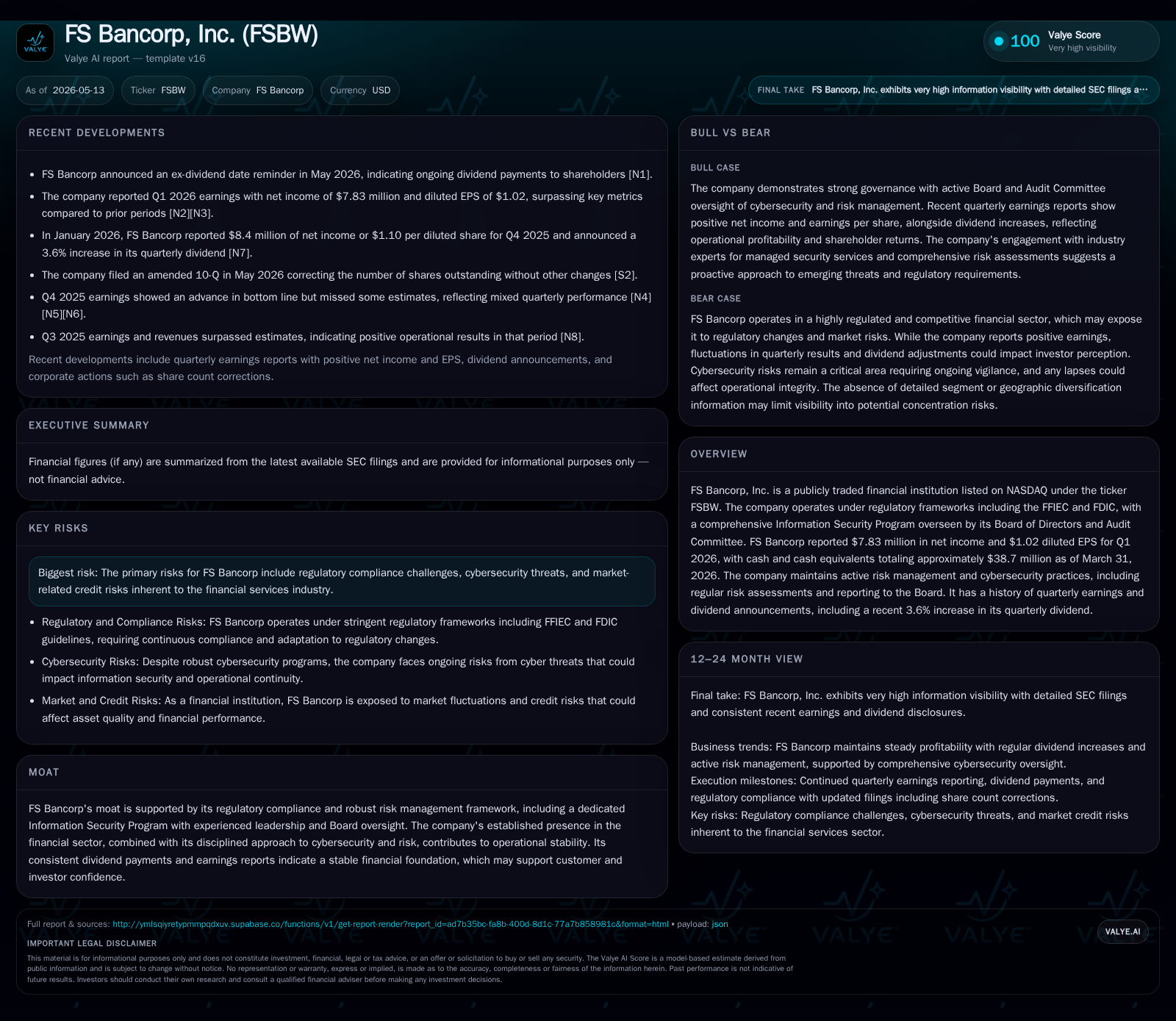
FS Bancorp reported solid Q1 2026 results with net income reaching $7.83 million and diluted EPS near $1.02, reflecting operational consistency. The bank's elevated use of brokered certificates of deposit and deposits highlights a strategic shift in funding, while its hedging portfolio remains stable in amortized cost basis. FS Bancorp’s comprehensive cybersecurity program continues to receive dedicated board-level oversight, underpinning firm risk management in a competitive regional banking environment. Potential growth drivers include disciplined loan expansion supported by prudent deposit management, while risks center on regulatory compliance, cyber threats, and credit sensitivities.
Q1 2026 Operating Highlights and Significance
In the first quarter of 2026, FS Bancorp, Inc. delivered net income of $7.83 million alongside a diluted EPS of approximately $1.02 [S2][N2]. These figures surpassed market expectations as noted in recent earnings reviews [N1], underscoring steady operational execution within its core banking activities. A key development observable in the latest filing is the pronounced increase in brokered deposit instruments; specifically, brokered certificates of deposit (CDs) grew markedly to $202.1 million as of December 31, 2025 compared with $143.1 million at year-end 2024 [S2]. This substantial rise reflects a strategic pivot toward flexible funding sources enabling liquidity optimization.
Concurrently, the amortized cost basis for closed portfolios used in the company’s designated hedging relationships evidenced stability at about $178.1 million as of March 31, 2026—from $179.4 million three months prior—while cumulative basis adjustments modestly improved to a positive $2.4 million [S2]. Such stability in hedged assets manages interest rate risk effectively amid fluctuating capital markets.
The company continued to announce a progressive dividend policy with a recent increase approximating 3.6% per quarter [N3], interpreted as confidence in consistent cash flow generation underpinning shareholder returns.
Business Model and Core Product Offering
FS Bancorp operates primarily as a regional financial institution focusing on broad-spectrum lending products including commercial real estate (CRE), residential mortgages—comprising single-family loans, home equity products—and specialized loan segments like indirect home improvement financing [S1][S2]. The bank supplements interest income through mortgage servicing rights (MSRs), managing these assets with discipline indicated by recent recoveries minimizing impairments [S2].
Revenue mechanics revolve around net interest margin derived from lending activities funded by customer deposits and brokered CDs. Brokered certificate growth elevates funding costs but offers adjustable balances that anchor liquidity during episodic loan pipeline fluctuations [S2]. Noninterest income stems from service charges and loan-related fees complemented by MSR servicing revenue.
Stringent underwriting standards supported by comprehensive risk controls are embedded across origination and servicing stages—evidenced by low levels of delinquencies and modest provisions for loan losses [S2][S18]. The deposit base is structurally balanced between noninterest-bearing accounts, money markets, time deposits, and increasingly brokered CDs which offer yield advantages but require careful pricing to avoid margin erosion.
Regulatory Compliance and Cybersecurity Framework
FS Bancorp’s Information Security Program adheres strictly to regulatory mandates from the FFIEC and FDIC frameworks, commencing annually with extensive information security risk assessments aligned with authoritative guidelines such as the FFIEC Cybersecurity Assessment Tool (FFIEC CAT) [S1]. This includes targeted cybersecurity risk evaluations beyond general IT audits.
Cyber risk oversight is robustly governed at the Board level through its Audit Committee which maintains an articulated risk appetite statement reviewed yearly to calibrate permissible exposure [S1]. The Chief Risk Officer oversees enterprise-wide risk management programs while both the CIO—with more than 25 years’ industry experience and CISSP certification—and the Information Security Manager directly report cybersecurity status to this committee quarterly.
Complementing internal expertise are external managed security services engaged for vulnerability scans, penetration testing, social engineering simulations, and onsite security audits executed regularly [S1]. This layered defense approach ensures resilience against evolving cyber threats preserving confidentiality, integrity, and system availability.
Competitive Positioning Within Regional Banking Sector
Within its peer group of regional financial institutions, FS Bancorp differentiates through disciplined deposit management notably leveraging brokered CDs which provide liquidity flexibility uncommon among similarly sized banks constrained primarily to core retail deposits [S2][N4]. While brokered deposits subject the bank to pricing pressures due to competition for rate-sensitive funds sector-wide, FS Bancorp’s cautious deployment mitigates excessive cost impact.
Competitive strength also resides in measured loan portfolio quality controls—manifested by stable allowance levels for MSR impairments despite industry-wide turbulence—and professional fees tightly related to targeted process improvements rather than reactive expense spikes [S2][N4]. The bank sustains pricing power in CRE lending via relationships coupled with localized market knowledge that buffers broader rate-related loan demand elasticity.
Growth Catalysts and Market Expansion Opportunities
Expansion potential lies primarily in scaling brokered certificates of deposit further as interest rates remain elevated relative to prior cycles—offering superior returns on surplus capital while funding growing loan commitments efficiently [S2][S3]. Technological advancements supporting underwriting automation promise enhanced borrower segmentation accuracy leading to more profitable credit originations without sacrificing asset quality.
Regional economic growth trends influence both demand for CRE financing as businesses expand or reposition space requirements—and residential loans driven by demographic shifts favoring suburban home ownership [S3]. The company's retention of key executives attending major financial conferences signals active pursuit of market intelligence and networking conducive to opportunity capture [S3].
Risks Including Regulatory, Cybersecurity, and Credit Exposures
Key risks encompass tightening regulatory scrutiny mandating expanded compliance investments potentially pressuring operating expenses; the dynamic nature of cyber threats requiring continued vigilance doubling down on protective investments; and credit concentrations particularly within localized CRE portfolios that may be vulnerable to economic downturns or valuation corrections [S1][N4].
Though current filings do not highlight acute asset quality deterioration or debt covenant issues [S2], systemic risks from interest rate volatility persist given significant hedging activities balanced against changing macro conditions.
Upcoming Catalysts and What to Monitor Next
Investors should track upcoming quarterly earnings releases for trajectories in dividend payments which serve as barometers for operational cash flow health [N3]. Any disclosures from the Audit Committee regarding alterations in cybersecurity postures or emerging vulnerabilities will signal whether FS Bancorp’s layered defenses remain fit for purpose given evolving threat vectors.
Additionally, shifts in aggregate brokered CD balances vis-à-vis interest rate changes will reveal management tolerance for deposit cost versus liquidity trade-offs juxtaposed against loan book growth momentum [S3][N3]. Monitoring mark-to-market impacts on hedging instruments could further indicate balance sheet risk exposure dynamics ahead.
Concise Financial Overview Supporting Operational Narrative
FS Bancorp closed Q1 2026 with $38.7 million in cash and equivalents providing liquidity cushioning day-to-day operations while net income was robustly positive at $7.83 million alongside approximately $1.02 diluted EPS representing solid profitability given scale [F1][S2]. Although total debt data referenced lags (last available December 31, 2022), previous figures indicate debt totaled near $186 million implying prudent leverage when considered against asset base expansion since then [F1].
This financial foundation supports ongoing dividend hikes reflective of sustainable cash flow generation capabilities balancing shareholder returns with capital adequacy commitments.
This analysis synthesizes FS Bancorp's publicly filed disclosures focusing on verified operational metrics without speculative extrapolation. It aims to delineate current business dynamics grounded strictly upon documented data points consistent with buy-side research rigor.
Disclaimer: This is research-only, informational analysis and not investment advice. It may include AI-generated interpretation and general industry context. Always verify important details using primary sources.

Comments