
Fifth District Bancorp Reports Stable Q1 as Residential Loans Anchor Growth
Stable first-quarter results for Fifth District Bancorp underscore the central role of its residential mortgage portfolio amidst competitive regional banking dynamics.
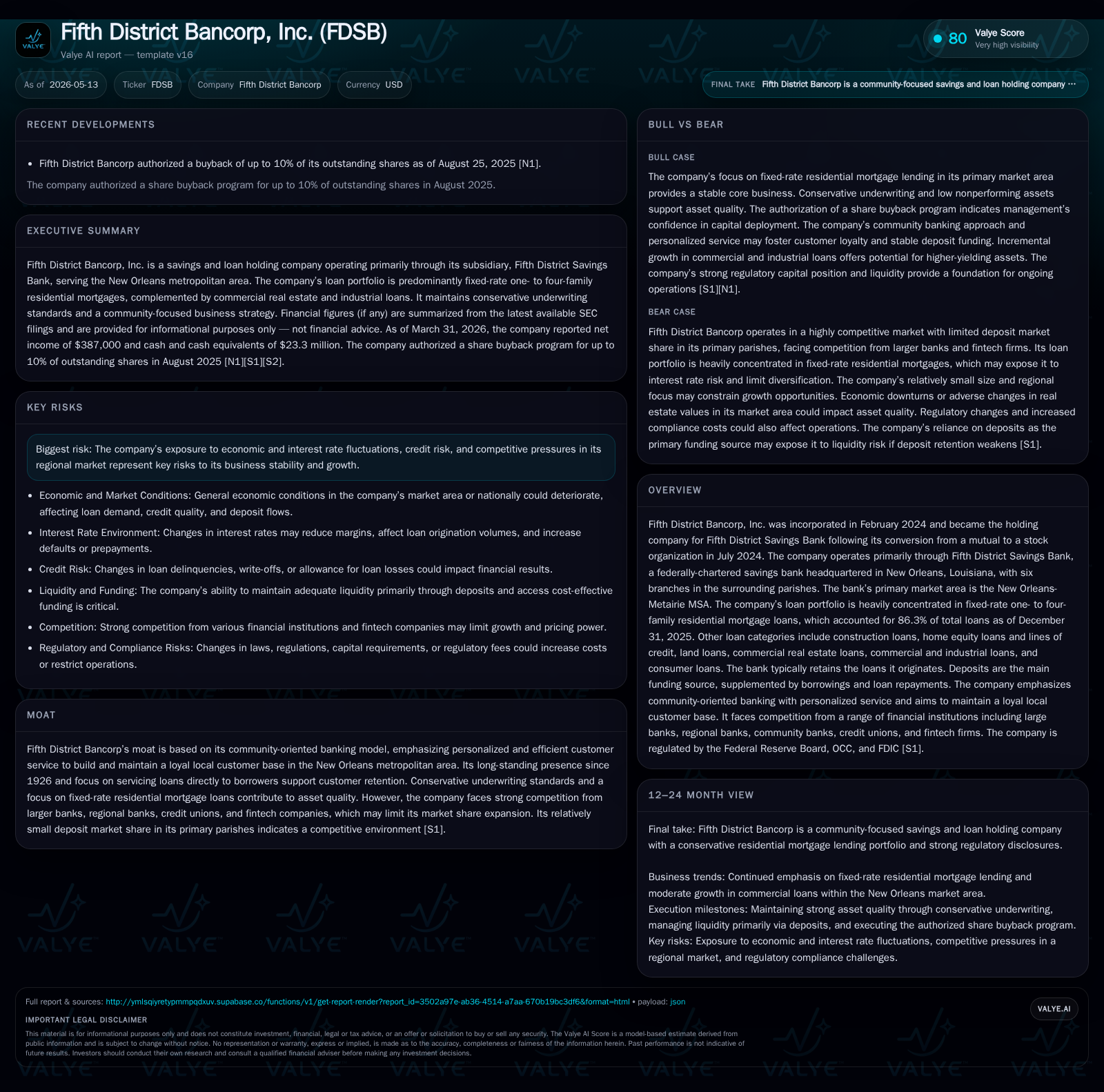
Fifth District Bancorp’s latest quarterly filing reveals steady operating performance driven by its concentrated fixed-rate residential mortgage book, which comprises over 86% of total loans. The bank's community-focused model and loan retention strategy continue to foster asset quality and deposit stability, despite intense competition in the New Orleans metropolitan area. While growth opportunities remain anchored in organic loan expansions and deposit building, risks from interest rate fluctuations and regional economic conditions warrant monitoring. The company maintains a conservative balance sheet with a strong liquidity position as of March 2026.
Latest Quarterly Operating Update
Fifth District Bancorp’s 10-Q filing dated May 12, 2026 [S2] confirms operating stability in the first quarter, anchored by consistent net interest income generation. The company reported no significant shifts in loan portfolio composition; fixed-rate one- to four-family residential mortgage loans remain overwhelmingly dominant at approximately 86% of total loans [S1]. The firm’s approach to retaining these loans rather than selling them sustains direct borrower relationships and supports stable income streams.
Deposit flows show relative steadiness with ongoing efforts to grow low-cost core deposits—comprising savings, checking accounts, and other non-time deposits—which constituted roughly 39% of total deposits as of year-end 2025 [S24]. This deposit mix helps maintain lower cost funding amid a competitive local market.
The provision for credit losses remains minimal reflecting conservative underwriting policies and strong asset quality metrics [S2; S1]. There is no indication of material asset quality deterioration, which aligns with management's long-standing focus on prudent credit standards primarily focused on local residential real estate dynamics.
Business Model and Core Product Insights
Fifth District Bancorp’s business model centers on community banking principles with a strategic concentration on originating and holding fixed-rate residential mortgages primarily serving the New Orleans-Metairie metropolitan statistical area (MSA) [S1]. Since its conversion from a mutual to stock organization in July 2024, it has focused on cultivating durable borrower relationships through direct servicing—eschewing secondary market participation.
This lends itself to steady net interest income driven by both volume growth and pricing discipline on both loans and deposits. Loan originations are sourced largely from walk-ins, existing customers, employee marketing initiatives, and referrals—reflecting a traditional relationship-driven pipeline [S27]. The bank complements mortgage lending with smaller portfolios of construction loans, HELOCs (home equity lines of credit), commercial real estate, commercial & industrial loans, and selective consumer loans.
Retaining loans internally enables control over loan servicing quality but concentrates credit risk exposure on localized collateral values. Asset quality is managed via independent appraisal requirements and routine monitoring protocols [S27]. Non-interest income streams are modest but supported by service charges on deposit accounts and fees related to third-party loan referrals [S1].
Position Within Regional Banking Landscape
Operating predominantly within six branches in the New Orleans area parishes situates Fifth District Bancorp as a small yet community-anchored player. It competes against large national banks offering broader product suites, regional banks with enhanced scale advantages, nimble credit unions, and increasingly active fintech companies providing alternative digital lending avenues [S1].
The company’s local footprint imparts certain strengths: personalized service fosters loyalty among retail borrowers who may prefer face-to-face interactions for mortgage servicing matters. However, the limited geographic scope confines growth potential compared to competitors with multi-MSA or statewide presence.
Deposit market share remains modest within its primary counties implying fierce competition for stable funding sources. Efforts to expand core deposits leverage the bank’s reputation but must contend with pressure on deposit pricing due to competitor capital availability [S6]. Regulatory context further penalizes missteps as capital adequacy standards under OCC supervision necessitate disciplined growth pacing under "source of strength" doctrine extended by the Federal Reserve to savings & loan holding companies [S11].
Key Growth Drivers and Expansion Opportunities
Growth prospects rest largely on organically increasing loan originations—particularly in the one- to four-family residential mortgage segment—and continuing expansion into complementary products such as HELOCs and higher-yielding commercial loans with shorter terms [S24]. Rising home prices or favorable local economic conditions would bolster demand for mortgage financing.
Successful renewal or replacement at competitive rates can improve net interest margin trajectories amid recent margin pressures seen in broader banking markets.
Cross-selling financial services beyond lending—fee-based activities—could incrementally diversify revenue but currently appear limited per disclosures. Maintaining conservative underwriting while seizing opportunistic branch expansion or acquisitions within contiguous regions represents possible longer-term strategic paths [S24].
KPIs signaling forward momentum include loan pipeline size metrics (not publicly disclosed), deposit retention percentages post-certificate maturity cycles, net interest spread improvements, and asset quality indicators such as nonperforming asset ratios remaining below historical averages.
Risks and Potential Growth Constraints
Risks are multifaceted: robust dependence on regional housing market conditions exposes the bank to valuation fluctuations impacting collateral coverage ratios for mortgages. An adverse economic environment locally could elevate delinquency levels or foreclosures [S1; S17]. Interest rate volatility remains a key concern affecting both asset yields via prepayment speeds and liability costs through deposit repricing demands.
Concentration risk due to retention of originated loans limits geographic diversification benefits found in larger institutions selling participations or securitizing exposure. Regulatory frameworks impose capital conservation buffers necessitating maintenance of well-capitalized status or else facing constrained distribution capabilities [S11].
Competition for deposits from larger institutions offering digital access at scale or fintech lenders offering streamlined application experiences threatens customer acquisition/retention efficacy. Moreover, evolving cybersecurity threats require ongoing investment in operational defenses—a point underscored by industry-wide trends though not explicitly detailed recently by Fifth District Bancorp [S1].
Upcoming Catalysts and What to Watch Next
Investors should monitor the upcoming quarterly earnings releases—particularly any updated guidance concerning loan originations volumes, net interest margins trajectory amid fluctuating rates, and changes in credit loss provisions that indicate early stress signals [S2; S21]. Tracking renewal rates on certificates of deposit maturing through late 2026 is crucial as this impacts funding cost structures.
Management commentary regarding cost control measures or strategic initiatives aimed at technological enhancements or branch optimization can provide insight into medium-term efficiency improvements impacting operating leverage.
Additionally, local housing market statistics such as home sales volumes and price trends serve as bellwethers for loan demand outlooks given the dominant mortgage portfolio composition.
Regulatory feedback during periodic exams relating to capital adequacy or compliance programs may also act as event triggers influencing operational flexibility.
Brief Financial Profile and Balance Sheet Overview
As of March 31, 2026, Fifth District Bancorp held approximately $23.3 million in cash and equivalents per the latest available quarterly snapshot data [F1], underpinning solid liquidity reserves relative to its size without reliance on external wholesale funding sources reported up to December 31, 2025 [S3; S6].
The firm maintains a "well-capitalized" classification under OCC guidelines reflecting regulatory confidence in its capital buffers despite its smaller scale nature [S19]. Off-balance sheet commitments stood at roughly $35.9 million at year-end with concentrations primarily in HELOCs and construction loans providing some diversification beyond residential mortgages [S12].
Profitability showed marked improvement through full-year 2025 activity with net income at $4.09 million reported for calendar year-end December 31 [F1], after recovering from prior losses driven by provision adjustments earlier. Operating expense ratios remained elevated but showed favorable efficiency ratio improvements compared to prior periods reflecting disciplined expense management strategies [S21].
Overall balance sheet features conservative asset-liability matching philosophy supporting manageable interest rate risk while prioritizing stable core deposit funding as a foundation for measured growth ambitions.
This analysis is based solely on publicly filed SEC disclosures including the latest quarterly (10-Q) filing dated May 12, 2026 [S2] alongside annual (10-K) documents dated March 24, 2026 [S1] supplemented by current financial snapshots available as of March 31, 2026 [F1]. Information presented is intended for informational purposes without constituting investment advice.
Disclaimer: This is research-only, informational analysis and not investment advice. It may include AI-generated interpretation and general industry context. Always verify important details using primary sources.

Comments