
Voip-pal.com’s Patent Litigation Drives Strategic Positioning in VoIP Technology
The latest quarterly report reveals critical developments in Voip-pal.com's patent litigation and operational status, reflecting its evolving IP-centric business approach.
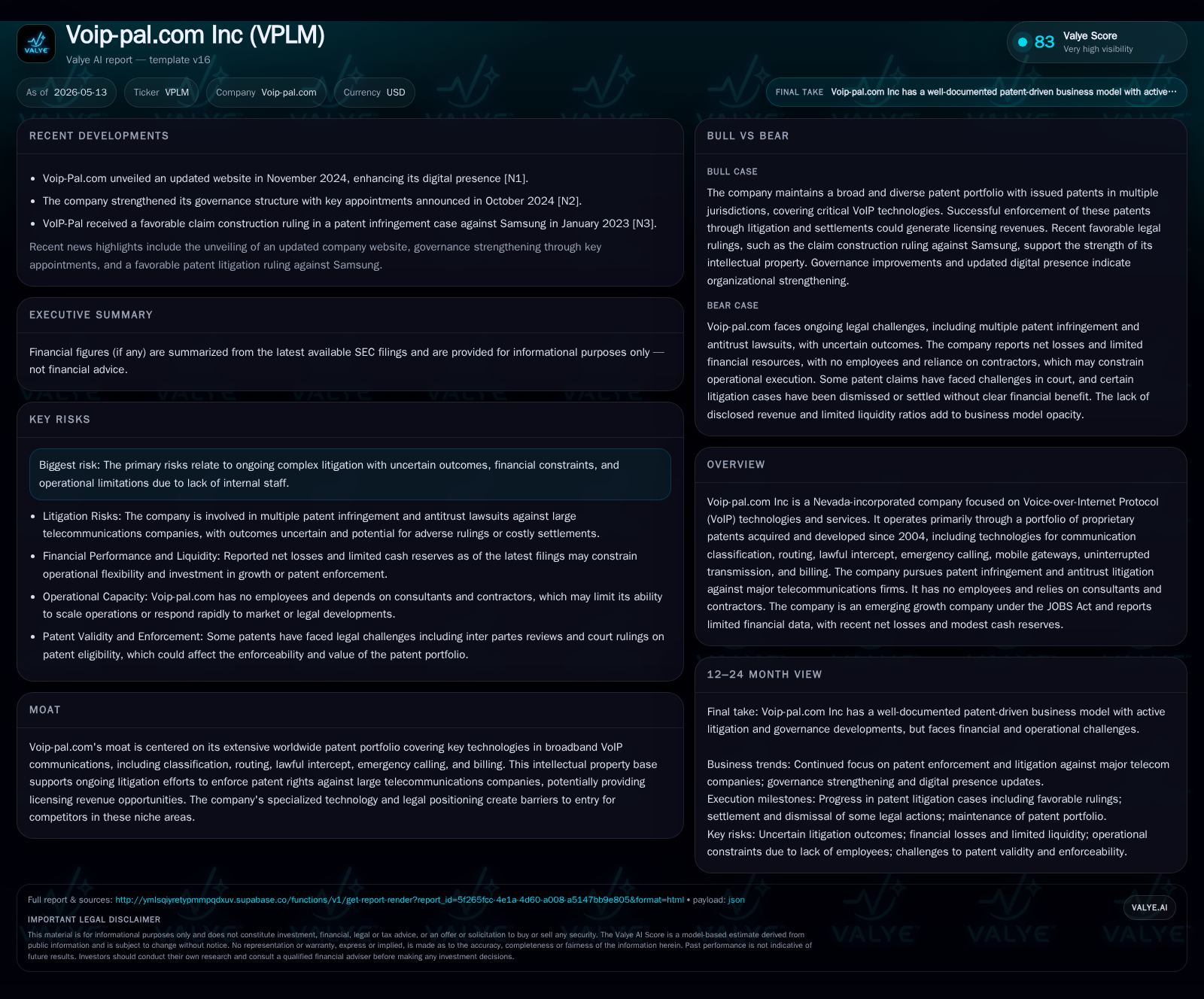
Voip-pal.com Inc's 10-Q filing dated May 12, 2026, highlights the resolution of several patent cases against major telecom defendants alongside ongoing antitrust litigation. The company's business model revolves around monetizing a comprehensive portfolio of broadband VoIP patents through enforcement and licensing efforts. These legal actions shape its competitive stance in a niche IP-driven sector of the telecommunications industry. While growth hinges on positive litigation outcomes and potential settlements, risks remain high due to inherent uncertainties in patent enforcement and limited internal resources. Maintaining sufficient liquidity amid recurring operational losses represents an ongoing challenge for the patent holding firm.
Recent Quarterly Filing Update: Litigation Status and Operational Highlights
The May 12, 2026, Form 10-Q filed by Voip-pal.com Inc ([S2]) presents a snapshot dominated by legal activity concluding several long-running patent infringement cases while actively maintaining significant antitrust litigation proceedings. Notably, two prominent lawsuits targeting Amazon.com and Verizon Communications were dismissed with prejudice in late 2025 ([S7], [S9]). Voip-pal also resolved litigations against T-Mobile following summary judgments of non-infringement granted in mid-2024; these proceedings culminated in mutual stipulations of dismissal and closure by October 2025 ([S7], [S9]). These case resolutions reflect contraction in active patent litigation portfolios but do not mark an exit from litigation strategy altogether.
Concurrently, the company is embroiled in ongoing antitrust suits filed mostly during late 2024 through 2025 against telecommunications giants including AT&T and Apple ([S7], [S4]). These cases allege anti-competitive practices perceived to impede fair market dynamics in the telecom space. Several motions—such as motions to dismiss filed by defendants—remain under judicial consideration as of the latest filing date ([S7]). The progression or adverse rulings in these proceedings could either accelerate licensing discussions or heighten operational uncertainty.
Business Model Centered on Intellectual Property Monetization
Voip-pal.com's business model fundamentally depends on its extensive portfolio of proprietary patents focused on broadband Voice-over-Internet Protocol (VoIP) communications technologies ([S1], [S6]). The genesis of this portfolio traces back to the acquisition of Digifonica International Limited in 2013, whose engineers developed core inventions around internet telephony infrastructure nodes deployed across Canada, UK, and Denmark before securing U.S. patents ([S1], [S6]).
Today, Voip-pal does not operate traditional telecom services or products but instead pursues enforcement of its intellectual property via infringement lawsuits and antitrust complaints primarily aimed at Fortune 500 telecommunications firms ([S1]). This entails asserting patents covering specialized technical domains: communication classification/routing over distributed networks; lawful intercept systems compliant with regulatory mandates; enhanced emergency calling including E911 protocols; mobile gateway technology enabling roaming device communication; uninterrupted session handoffs; transaction-level metering; and billing mechanisms for service reselling ([S1], [S12]).
Notably absent is any internal employee base; rather, the company orchestrates its activities exclusively through consultants and contractors ([S11], [S13]), highlighting an operational footprint designed to minimize fixed overhead while concentrating resources towards litigating and monetizing IP assets.
Competitive Landscape and Industry Positioning in VoIP Technologies
Within the broader telecom ecosystem managing or utilizing VoIP technologies, patent holders like Voip-pal occupy a niche but strategically impactful role. Their enterprises lean heavily on defensive and offensive intellectual property positions given high barriers to entry fostered by technical complexity and established incumbent control over network infrastructures.
Voip-pal's patents encompass core enabling technologies that integrate into carrier-grade voice routing and billing systems — critical components enabling lawful intercept compliance as mandated by regulatory authorities—a functionality difficult for newer entrants without similar IP or licensing arrangements (, [S1]).
This positions Voip-pal primarily as a patent assertion entity rather than a direct competitor providing commercial telephony services or devices. Its competitive edge lies in exerting pressure through litigation leverage rather than product innovation or marketing channels. However, this also constrains its ability to diversify revenue streams absent favorable licensing outcomes.
Growth Drivers: Licensing Potential and Litigation Outcomes
Potential growth for Voip-pal flows mainly from successful litigation leading either to favorable judgments enforcing licensing fees or negotiated settlements that yield recurring royalty streams ([S6], ). Past resolutions with parties like Amazon and Verizon reduce legal encumbrances potentially opening room for new licensing arrangements.
Additionally, ongoing antitrust suits might create leverage points beyond traditional patent claims by potentially reshaping competitive behaviors facilitating openings for negotiated contracts. Execution around these complex multi-year litigations constitutes a primary avenue for value creation.
Incrementally expanding the underlying patent portfolio or asserting emerging patented technologies related to future broadband innovations remains hypothetical but could augment enforceability clout if realized ([S1]).
Risks and Constraints: Litigation Uncertainty and Operating Limitations
Nevertheless, Voip-pal's business model embeds significant risks predominantly stemming from legal uncertainties inherent in complex patent infringement cases where outcomes depend heavily on evolving judicial interpretations ([S3], ). The recent dismissal of high-profile cases reflects both risk realization and limits on sustained revenue influx from settled claims.
Operationally, the absence of employees presents challenges in scalability, continuous development of new technologies, or diversified business activities outside legal pursuits. This reliance on external contractors may affect timeliness or strategic agility.
Financially, recurring net operating losses accentuate sustainability concerns given limited cash reserves reported approximately $1.9 million as of June 2023 per available company facts data [F1]. Continued dependence on infusion from external financing or sporadic licensing receipts underpin survival beyond short-term horizons.
Future Catalysts: Key Legal Milestones and Potential Licensing Deals
Critical forthcoming catalysts reside in court decisions regarding outstanding motions particularly connected to antitrust litigation initiated in late 2024 through 2025 ([S7]). Outcomes from these could influence not only direct monetary awards but also set precedents impacting company leverage.
Closely monitoring appeal timelines—or new filings—and settlement discussions will be pivotal pointers towards tangible shifts in operating momentum. Any announcements regarding new licensing agreements informed by adjudicated findings would materially affect strategic positioning.
Supplementary Financial Overview: Cash Reserves and Operating Losses
From a financial perspective rooted in recent data [F1], Voip-pal maintained cash & equivalents close to $1.9 million as per mid-2023 records alongside current assets near $1.87 million as of end-2024 year-end. However, operating income showed a loss approximating $1.92 million by March 2026 quarter-end indicating persistent negative cash flow dynamics.
Net income remained deeply negative nearing $6.2 million by September 2025 period-end base figures [F1]. Such results underscore continuing challenges balancing costly legal engagements without corresponding sustainable revenue gains.
Disclaimer: This analysis is based exclusively on publicly filed SEC documents available as of May 13, 2026, data from recognized companyfacts sources through quarter-end March 2026, and Valye News investigative synthesis intended solely for informational purposes without offering investment advice.
Disclaimer: This is research-only, informational analysis and not investment advice. It may include AI-generated interpretation and general industry context. Always verify important details using primary sources.

Comments