
BuzzFeed’s $120M Stock Sale Reflects Capital Pressures Amid AI Content Shift
BuzzFeed’s latest quarter shows ongoing operational losses and liquidity challenges, offset by a significant equity infusion as the company pivots towards AI-driven content strategies.
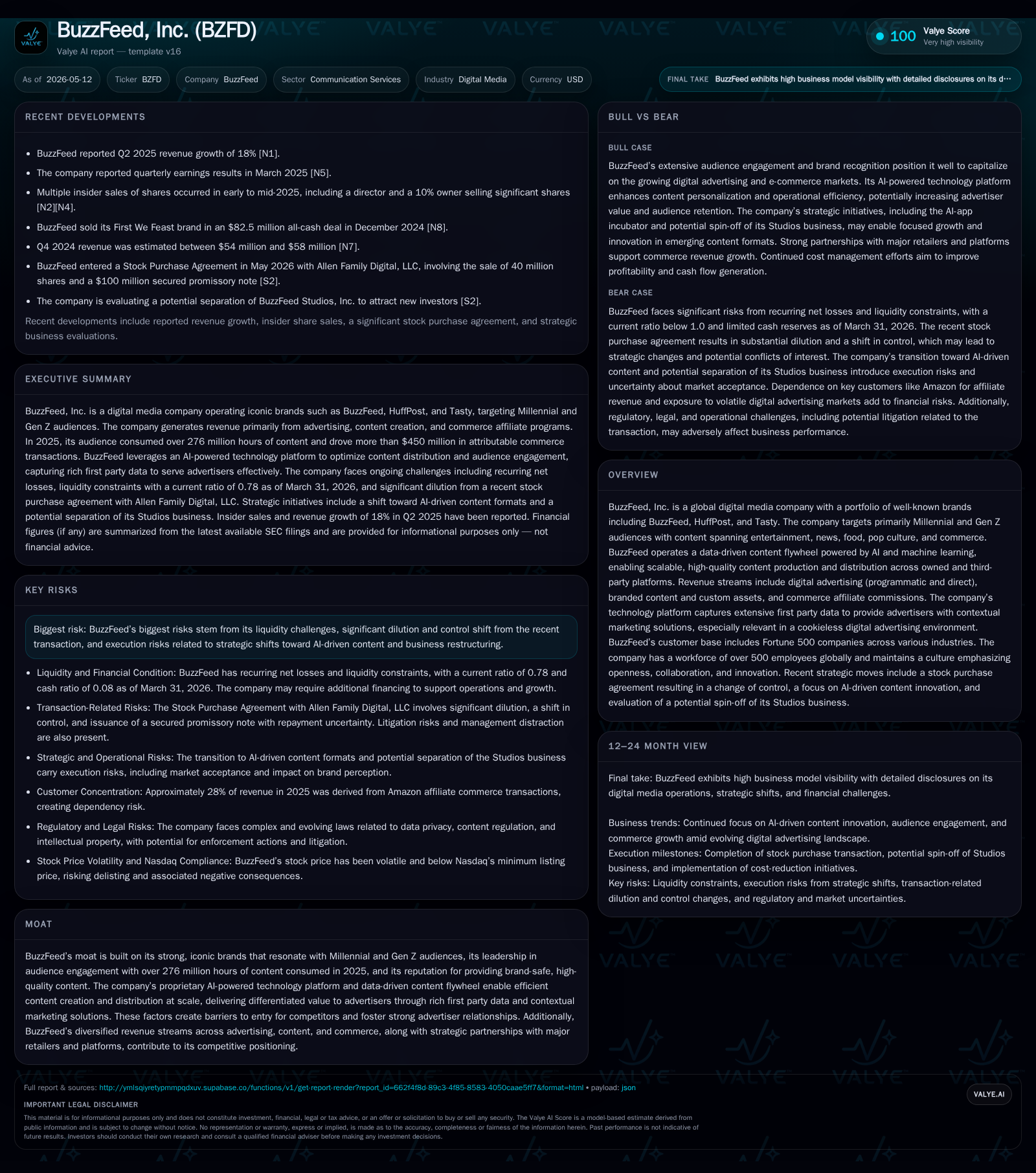
In Q1 2026, BuzzFeed, Inc. continued to report operating losses with sustained liquidity constraints, prompting a $120 million capital raise through a stock sale agreement with Allen Family Digital. The transaction, combining cash and a promissory note, aims to bolster financial flexibility amid restructuring and AI-driven content initiatives. BuzzFeed’s business model leverages proprietary AI-powered content flywheels and diversified revenues across advertising, branded content, and commerce. Despite strong Millennial and Gen Z brand engagement, ongoing execution risks and capital needs represent key constraints on growth visibility.
Recent Operating Update
BuzzFeed filed its latest quarterly report on May 11, 2026 ([S2]), revealing sustained operational challenges despite ongoing investment in AI-driven content innovation. The company reported an operating loss of approximately $47.9 million for Q1 2026 with a net loss of about $57.7 million through year-end 2025 ([F1]). Liquidity remains tight: as of March 31, 2026, cash and equivalents stand at roughly $6.8 million against total debt near $60.4 million resulting in an adjusted current ratio of 0.78 ([F1]). In this context, BuzzFeed entered into a material definitive Stock Purchase Agreement dated May 11 with Allen Family Digital LLC ([S3]), which involves issuing 40 million shares at $3 per share for aggregate proceeds totaling $120 million. Notably, only $20 million will be received in cash upfront; the remaining $100 million will be delivered via a secured promissory note payable over five years ([S3]). The arrangement reflects both an urgent need to shore up balance sheet flexibility and preserve ongoing operations during persistent losses.
Management indicated the transaction is expected to close shortly after shareholder notification later in May but cautioned that delays or failure could exacerbate liquidity risk requiring alternative financings potentially on less favorable terms ([S2]). The company also disclosed potential distractions or litigation risks arising from the transaction process.
Business Model
BuzzFeed operates as a global digital media company specializing in owned-and-operated brands iconic among Millennial and Gen Z audiences—principally BuzzFeed itself, HuffPost for news/politics/lifestyle content, and Tasty for food-related entertainment ([S1],[S9],[S21]). The firm’s unique value proposition lies in its proprietary AI-powered technology platform enabling a data-driven content flywheel: fresh insights fed from audience engagement continuously refine content production targeting top consumer interests across platforms—all while optimizing advertiser reach through contextual marketing solutions particularly suited for the evolving cookieless digital ad ecosystem.
Revenue is derived from three primary streams:
- Advertising: Digital ads placed programmatically or via direct sales across owned sites plus third-party platforms form the backbone of revenue; video pre-rolls/mid-rolls plus homepage takeover packages augment monetization.[S9]
- Content: Custom branded-content services ranging from short-form Instagram takeovers to long-form videos including micro-dramas and licensing deals provide high-margin client revenue.[S9]
- Commerce: Affiliated transactions generated via audience inspiration create considerable ancillary income; partnerships yield over $450 million in attributable transactions annually as of 2025.[S21]
This multi-pronged revenue strategy leverages extensive first-party data to offer advertisers brand-safe environments where broader social networks face reputational challenges due to unchecked user-generated content ([S21]).
Industry Structure and Competitive Position
Digital media remains fragmented but fiercely competitive with players such as Condé Nast Digital, Vox Media, People Inc., and Bustle vying for Millennial/Gen Z attention ([S21]). BuzzFeed’s strong positioning stems from:
- Iconic Brands: Its well-established IP commands loyalty among younger demographics resistant to legacy media formats.
- Technology Leadership: Proprietary AI tools lower content costs while enhancing quality/scalability.
- Data Assets: Unique audience insights fuel precision targeting uncommon among peers.
- Brand Safety: Increasing advertiser sensitivity benefits BuzzFeed versus open social channels.
This moat helps lock in large Fortune 500 clients seeking measurable ROI with trusted inventory.[S1,S21] However the market’s rapid evolution—with entrants exploiting generative AI-enabled search disruption—poses both opportunity and risk.[S22]
Growth Drivers
Key growth avenues include:
- AI-Driven Content Innovation: BuzzFeed has launched an incubator (Branch Office) focused on interactive storytelling leveraging cutting-edge generative AI tools empowering self-expression to deepen engagement.[S21]
- Expanded Commerce Partnerships: Driving transaction volume through affiliate integrations enhances monetization beyond traditional ad dollars.[S21]
- Programmatic Advertising Scale: Growing automation allows efficient yield management across channels combined with direct sales maintaining premium client relations.[S9]
- Cross Platform Distribution: Strong multi-platform presence ensures audience reach wherever consumption occurs maximizing time spent metrics—more than 276M hours consumed in 2025.[S21]
- First Party Data Utilization: Precise contextual marketing solutions gain importance as privacy regulations hinder cookie-based targeting across the industry.[S9]
These drivers are structurally supportive but reliant on sensitive execution given marketplace volatility.
Risks / Watchpoints / Growth Constraints
Heightened risks temper growth optimism:
- Liquidity Risk: Sub-$10M cash balances versus material debt obligations highlight refinancing needs; failure to consummate recent stock deal timely could force dilutive or costlier alternatives ([F1],[S2],[S3]).
- Dilution & Control Shift: The equity sale significantly dilutes existing shareholders; governance changes may affect strategic direction ([S2],[S3]).
- Execution Uncertainty Around AI Strategy: Scaling innovative technologies while managing legacy content costs entails operational hazards subject to competitive disruption ([S22]).
- Stock Listing Compliance: Continued sub-$1 share prices risk Nasdaq delisting with attendant reputational/capital repercussions ([S16]).
- Advertising Spend Cyclicality & Competition: Macroeconomic shifts especially potential recessions may depress advertiser budgets impacting core revenues ([S22]).
- Legal/Regulatory Exposure: Evolving data privacy laws plus intellectual property rights enforcement create ongoing compliance burdens ([S22]).
Careful monitoring of these factors is needed alongside establishing sustainable profitability paths.
What to Watch Next
Key upcoming areas include:
- Closing Progress on Equity Transaction: Completion expected late May represents critical near-term liquidity milestone [S2,S3].
- AI Incubator Developments: Advances within Branch Office projects may signal ability to capture new growth niches.[S21]
- Audience Engagement Trends: Improvements beyond the recent high-watermark hours consumed would confirm enduring brand relevance.[F1,S21]
- Cash Flow & Debt Management Updates: Subsequent filings will detail how capital proceeds affect leverage ratios and operating runway.[F1,S2]
- Nasdaq Compliance Pathway: Efforts to restore share price above listing minimum remain vital for long-term financing options.[S16]
Monitoring these markers will clarify BuzzFeed's trajectory through its present transformation phase.
Financial Profile Snapshot
Latest financial snapshot
| Metric | Value | Period |
|---|---|---|
| Cash & equivalents | $7mm | |
| 2026-03-31 | ||
| Total debt | $60mm | |
| 2026-03-31 | ||
| Net debt | $54mm | |
| 2026-03-31 | ||
| Current assets | $71mm | |
| 2026-03-31 | ||
| Current liabilities | $91mm | |
| 2026-03-31 | ||
| Current ratio | 0.78x | |
| 2026-03-31 |
Source: SEC companyfacts cache [F1].
Operating losses remain substantial with operating income at -$47.9M (Q4/2025) and net loss -$57.7M (year-end) highlighting ongoing turnaround pressures [F1].
This analysis is based strictly on publicly available SEC filings as referenced without speculative assumptions or investment recommendations.
Disclaimer: This is research-only, informational analysis and not investment advice. It may include AI-generated interpretation and general industry context. Always verify important details using primary sources.

Comments