
CID Holdco Advances AI-Enhanced Asset Tracking Amid Liquidity and Dilution Challenges
Latest operational and financing updates highlight CID Holdco's push for growth through product innovation and channel expansion while navigating capital constraints.
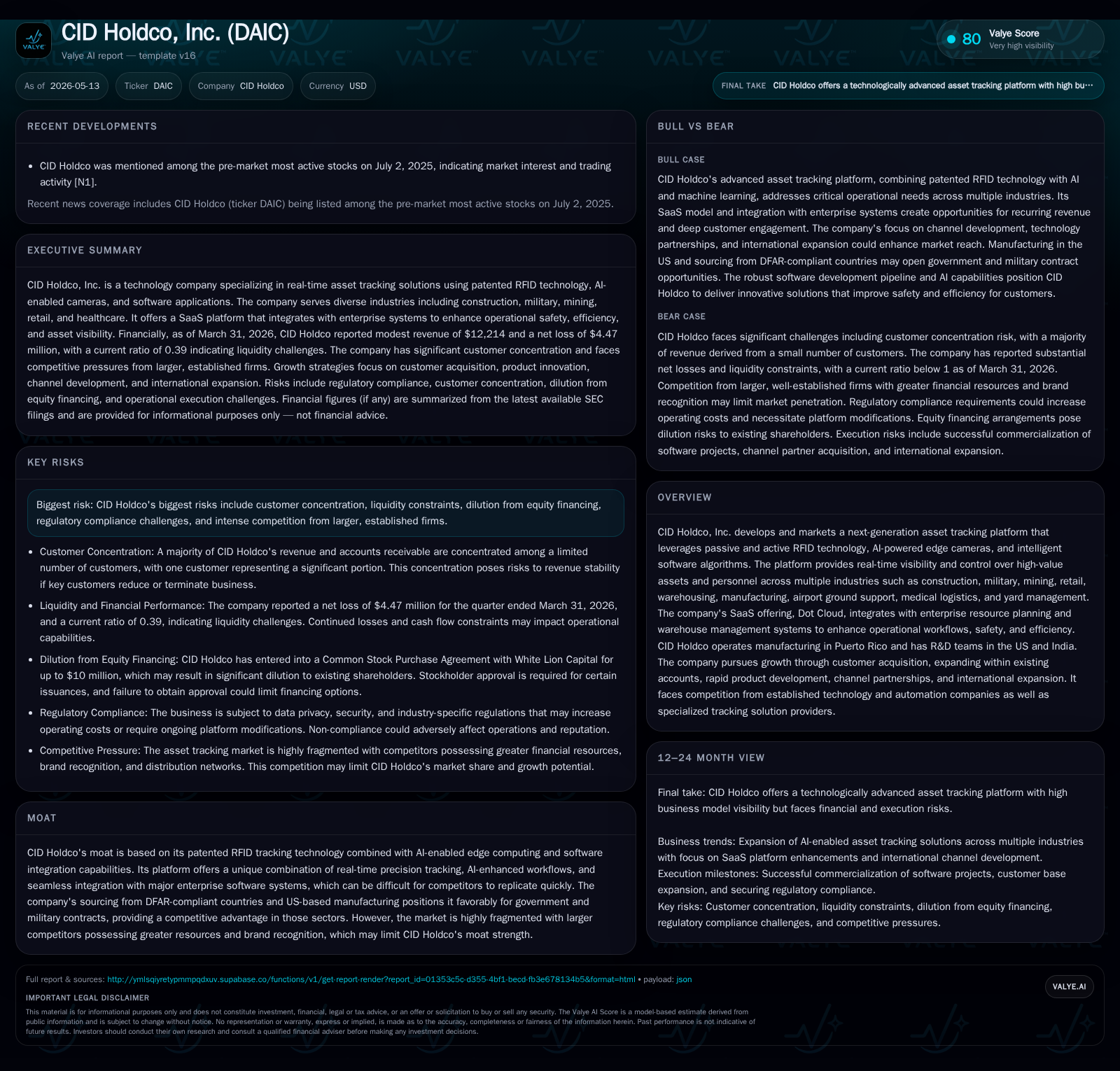
CID Holdco, Inc. reported continued product development progress and strategic moves toward channel expansion and international growth in its latest quarter. The company’s AI-powered RFID asset tracking platform addresses diverse industries with a focus on safety, operational efficiency, and regulatory compliance. However, CID faces significant financial pressure marked by a negative working capital position, ongoing operating losses, and reliance on dilutive equity financing, including a $10 million equity line of credit approved by shareholders. Competitive dynamics remain challenging given larger incumbents, but CID’s US-based manufacturing and DFAR-compliant sourcing provide differentiation particularly in government and military sectors.
Recent Operating Update
CID Holdco, Inc.'s latest quarterly report filed May 12, 2026 [S2] affirms its commitment to advancing the Dot Cloud platform—an AI-enhanced asset tracking SaaS solution integrating passive/active RFID and edge AI cameras for real-time visibility across high-value assets. Key near-term developments include shareholder approval of an equity line of credit agreement with White Lion Capital allowing issuance of up to $10 million of common stock at a discount [S3]. This facility is intended chiefly to repay prior loans including the J.J. Astor senior secured convertible loan and to fund ongoing operations.
This financing move reflects persistent liquidity challenges as evidenced by the March 31 balance sheet showing current assets of approximately $3.7 million against current liabilities near $9.5 million—a current ratio of only 0.39 [F1]. Operating losses continue at scale: fiscal year-end December 31, 2025 showed an operating income loss exceeding $10 million despite revenue growth driven by increased hardware sales [F1][S1]. These dynamics underscore the company's dependence on dilutive financing to sustain R&D investment and market expansion.
Business Model Overview
CID Holdco's business model revolves around a subscription-based SaaS platform complemented by hardware sales integral to system deployment. Customers pay for access to Dot Cloud subscriptions billed monthly or annually with fees tiered by functionalities chosen [S1]. The implementation phase often involves substantial upfront hardware purchases—active/passive RFID devices plus proprietary AI-enabled edge cameras—and integration services impacting initial revenue recognition.
Revenue mechanics blend hardware sales (a significant portion of recent top-line growth) with recurring cloud subscription fees that drive higher long-term margins if customer retention scales successfully. Margins have been pressured by revenue mix shifts toward hardware sales which carry lower gross margins versus software subscriptions [S21]. Ongoing R&D investments targeting rapid feature enhancements emphasize developing new applications responsive to customer needs across diverse verticals.
Embedded software algorithms incorporating machine learning differentiate CID's offering by improving tracking accuracy and operational intelligence. Seamless interoperation with major ERP and warehouse management systems enhances switching costs while broadening potential partner ecosystems.
Industry Structure & Competitive Position
The asset tracking landscape addressed by CID Holdco is highly fragmented featuring incumbents ranging from legacy RFID vendors to emerging IoT SaaS providers. Larger competitors possess deeper treasury reserves, expansive sales forces, established brands, extensive channel networks, and comprehensive product suites bundling hardware-software-cloud capabilities.
CID’s moat crystallizes around several pillars:
- Patented RFID technology married with AI-enhanced edge compute platforms enabling precision tracking even in challenging environments.
- Manufacturing localized in Puerto Rico alongside sourcing from Defense Federal Acquisition Regulation (DFAR) compliant countries enhancing eligibility for U.S. government/military contracts—a strategic edge given tightening supply chain scrutiny.
- Platform designed for interoperability fostering partnerships and easing integration hurdles faced by corporate buyers switching providers.
However, this moat is circumscribed by competitive intensity. CID’s smaller scale relative to multinational suppliers limits marketing reach and distribution scale [S11]. Moreover, continuous innovation cycles are necessitated to keep pace with evolving wireless standards (Bluetooth/5G) alongside stringent regulatory regimes governing RF emissions and data privacy [S10].
Growth Drivers
Customer Acquisition & Expansion
CID prioritizes aggressive acquisition through both direct sales efforts and a growing network of channel partners worldwide [S20]. The SaaS subscription model offers scalability once hardware is deployed—encouraging expansions within existing accounts as new workflows are digitized. Notably, vertical specialization into markets demanding high security such as military logistics creates opportunities for multi-site rollouts.
Product Innovation & Rapid Release Cadence
The modular software architecture allows parallel development paths accelerating time-to-market for value-added features aligned with customer feedback [S20]. This agility aims to outpace competitors slower to adapt or launch next-generation functions addressing asset lifecycle management complexities.
Geographic & Channel Expansion
Strategic formation of subsidiaries in Europe (Southern Germany/Northern Switzerland) aimed at penetrating European markets complements offshore engineering talent additions planned via an Indian subsidiary by year-end 2026 [S20]. This international footprint seeks to leverage early adoption trends abroad while diversifying revenue sources.
Data Monetization Potential
CID also recognizes the commercial value latent in aggregated non-personally identifiable data streaming from deployments—offering potential future revenue streams via analytics services sold to insurers, equipment OEMs, regulators or financial analysts [S20].
Risks & Growth Constraints
Several constraints temper growth optimism:
- Significant customer concentration risk persists due to reliance on a small cluster of large clients contributing major portions of accounts receivable balances [S22]. Loss or delay from one could disrupt cash flows materially.
- Dilution risk looms as new share issuance under the White Lion equity line may exceed 20% of existing float causing potential downward pressure on trading price [S2][S3].
- Regulatory compliance costs related to wireless communication rules (FCC), export controls especially relating to defense-related components (ITAR/DFAR), data privacy laws (GDPR/CCPA), and emerging AI governance frameworks add complexity and capex demands [S10].
- Cybersecurity incidents or disruptions affecting platform availability could damage reputation impacting retention rates despite embedded security protocols.
- Limited historical operating track record amplifies execution risk; internal control weaknesses flagged remain unremediated potentially hindering scalability efforts [S1].
- Capital markets conditions directly impact accessibility to additional financing beyond present equity facilities crucial for sustaining innovation pace.
What To Watch Next
Key near-term milestones will indicate CID’s trajectory:
- Execution progress on expanding European channel partnerships alongside establishment timelines for regional offices/subsidiaries.
- Release schedule adherence for incremental Dot Cloud capability enhancements evidencing sustained innovation momentum.
- Utilization patterns against the $10 million White Lion equity credit line - scale & timing of stock issuances will signal liquidity health vs dilution tradeoffs.
- New contract wins or expansions within government/military sector aided by “friendly country” sourcing credibility that differentiate procurement decisions.
- Any updates addressing internal control weaknesses will be important signals for operational maturity necessary before scaling significantly.
- Customer concentration trends: proportionate revenue contribution shifts reflecting broadening client base would mitigate concentration risk over time.
Financial Profile Summary
Latest financial snapshot
| Metric | Value | Period |
|---|---|---|
| Total debt | $1127289 | |
| 2026-03-31 | ||
| Net debt | $1127289 | |
| 2026-03-31 | ||
| Current assets | $4mm | |
| 2026-03-31 | ||
| Current liabilities | $10mm | |
| 2026-03-31 | ||
| Current ratio | 0.39x | |
| 2026-03-31 |
Source: SEC companyfacts cache [F1].
As of March 31, 2026, CID Holdco reported approximately $3.7 million in current assets against $9.5 million current liabilities leading to a current ratio around 0.39 reflecting tight short-term liquidity [F1]. Total debt stood marginally above $1.1 million suggesting restrained leverage but indicating dependence on external financing alternatives.
Negative operating cash flow persisted consistent with historical trends reflecting developmental stage expenses partially offset by financing activities raising proceeds through PIPE investments totaling over $10 million alongside bridge loans repayments [S19][S13]. The recently approved shareholder-authorized issuance under the White Lion Common Stock Purchase Agreement provides an essential funding avenue albeit subject to dilution concerns [S2][S3].
Overall financial condition emphasizes urgent need for capital infusion paired with disciplined expense management in order to unlock long-term scalability benefits embedded within their technology roadmap.
This analysis is based exclusively on public SEC filings up to May 12, 2026 ([S1], [S2], [S3]) supplemented with structured financial data ([F1]). It does not contain investment advice but aims to provide a comprehensive industry-focused evaluation.
Disclaimer: This is research-only, informational analysis and not investment advice. It may include AI-generated interpretation and general industry context. Always verify important details using primary sources.

Comments