
GameSquare Holdings Advances Integrated Esports and Creator Economy Platform Despite Financial Challenges
Latest quarter highlights organic growth and strategic positioning in digital media and esports marketing while cash flows remain negative.
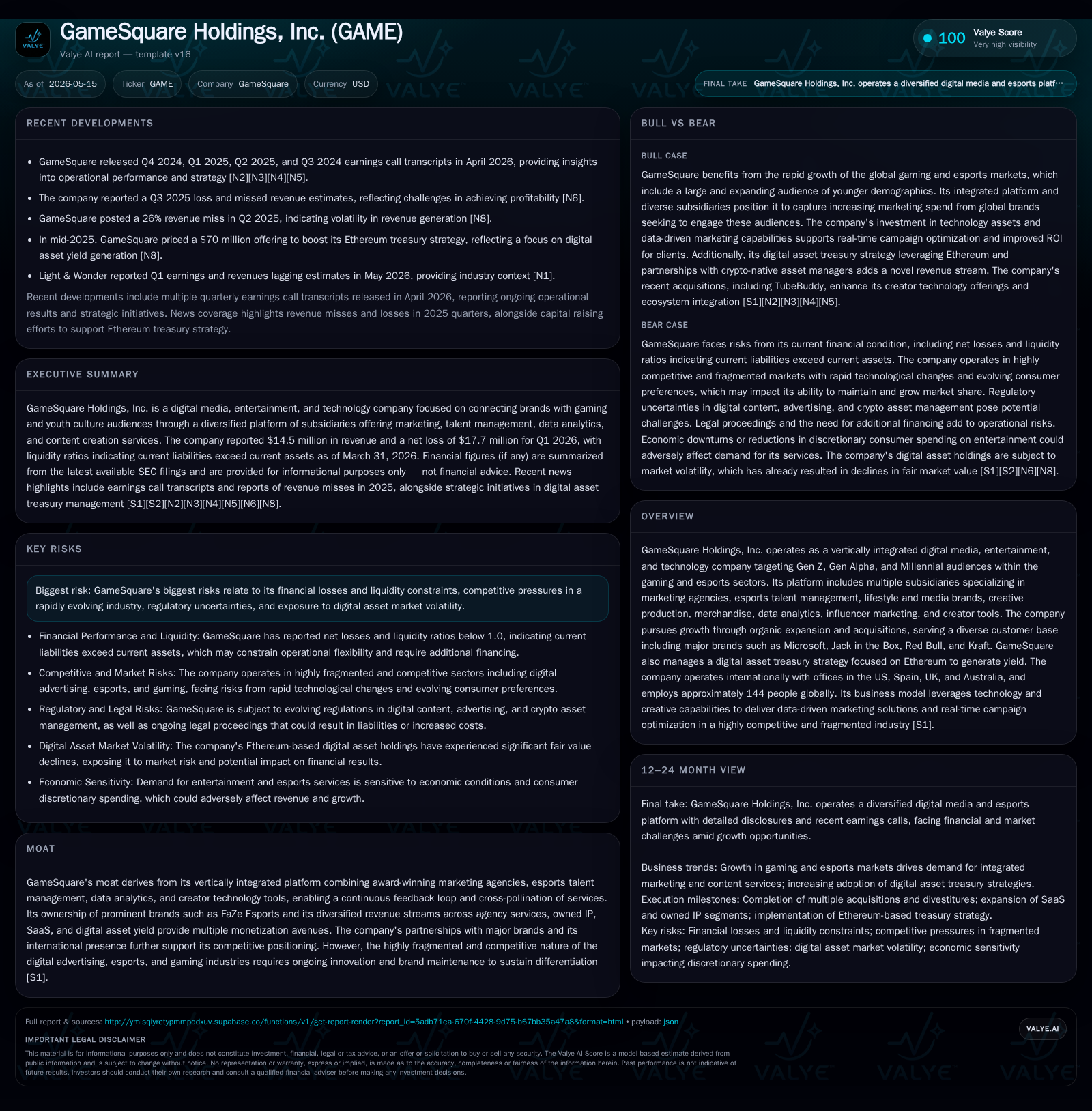
GameSquare Holdings, Inc. reported its Q1 2026 results underscoring continued expansion of its vertically integrated digital media ecosystem targeting Gen Z and Millennial gamers. The company’s multipronged approach combining agency services, owned IPs including FaZe Esports, SaaS platforms, and a crypto yield strategy leverages the booming global esports and creator economy. While revenue growth remains promising from large brand partnerships and a growing client base, GameSquare faces headwinds with ongoing operating losses and liquidity constraints amid industry competition.
Recent Operating Update: Q1 2026 Highlights
In its latest SEC Form 10-Q filed May 14, 2026 [S2], GameSquare Holdings reported no material changes to previously identified risk factors but emphasized ongoing investments in expanding its multi-brand digital platform targeting youth gaming audiences. An accompanying contemporaneous 8-K filing [S3] reinforced that the company continues executing on its growth strategy focused on organic audience expansion and acquisition synergies without disclosing fresh financial figures.
The prior quarterly press release referenced in the filings highlighted promising traction within its agency businesses with increased requests for proposals (RFPs) from prominent brands—indicative of growing demand for gaming-centric marketing solutions. Notably, GameSquare’s platform ecosystem benefits from integrating creative production studios with data analytics tools to deliver real-time campaign effectiveness—an increasingly critical capability given marketers’ need to optimize spend rapidly within the dynamic esports landscape.
Business Model Overview
GameSquare operates a vertically integrated entertainment and technology platform specializing in connecting global brands with Gen Z, Gen Alpha, and Millennial audiences immersed in gaming culture [S1]. Its business model generates revenue primarily from four pillars:
Agency Services: Operating through subsidiaries such as Zoned (US), Code Red (UK), Click (Australia), these agencies represent esports players, influencers, gaming personalities while brokering brand activations. This segment accounted for $26.5 million revenue in FY2025—more than doubling from the prior year—underscoring strong market demand for influencer-driven marketing campaigns [S11].
Owned & Operated IP: The company owns high-value lifestyle and media brands like FaZe Clan—one of the leading esports organizations globally. Such assets produce content, merchandise (Mission Supply), and leverage fan engagement to monetize a loyal community base that spans streaming to live events. Owned IP revenue was approximately $12.8 million in FY2025 with continued growth prospects [S9].
SaaS & Managed Services: Through products like SideQik (social influencer marketing) and TubeBuddy (creator productivity tools enhanced by AI), GameSquare offers subscription-based platforms to creators and brands alike. These services generated around $4.6 million revenue in FY2025 [S9].
Digital Asset Yield Generation: GameSquare employs an ETH-based treasury investment strategy via a partnership with Dialectic’s machine learning-driven Medici platform. With board approval for up to $250 million investment capacity over time, the company has deployed about $63 million into Ethereum-related assets aimed at generating crypto yield to supplement cash reserves [S9].
These complementary segments create multiple monetization pathways while facilitating cross-selling opportunities across technology-enabled influencer networks and data insights.
Industry Structure and Competitive Positioning
GameSquare operates at the intersection of esports marketing services, creator economy SaaS tools, content production, and digital asset management—markets characterized by rapid innovation but intense fragmentation.
The global gaming industry boasts an estimated 2.6 billion gamers worldwide with esports emerging as a critical driver fueled by community engagement rather than mere gameplay consumption [S11]. This spectator focus creates unique advertising opportunities as esports commands sponsorship deals rivaling traditional sports.
The fragmented nature of digital advertising agencies specializing in gaming necessitates differentiation through technological integration and scale. GameSquare's strategic moat lies in combining award-winning creative agencies with proprietary data analytics (Stream Hatchet) and influencer relationship platforms to offer real-time campaign optimization—a capability few competitors replicate across the full value chain [S1]. Moreover, owning marquee brands like FaZe Esports provides proprietary access to coveted fanbases critical for brand partner ROI.
Competition arises not only from other esports agencies but also large generalist advertising firms pivoting into gaming alongside pure-play tech companies offering influencer SaaS solutions. Maintaining relevance demands consistent innovation in offerings plus brand management to sustain fan loyalty amid shifting consumer preferences.
Growth Drivers
Several structural factors underpin GameSquare’s growth prospects:
Expanding Audiences: Global esports viewers are forecasted to reach approximately 925 million by 2030 with live streaming capturing more than a quarter of internet users—a testament to scale-up potential for content-driven marketing activations directed at younger demographics who consume media differently than traditional TV viewers [S11].
Brand Partnership Momentum: The company’s ability to secure marquee clients such as Microsoft, Red Bull, Jack in the Box, and Kraft highlights confidence among major advertisers seeking authentic engagement via integrated influencer ecosystems rather than traditional ad placements alone [S17]. Increasing RFP volume further suggests pipeline acceleration.
Diversification Across Segments: Combining SaaS subscriptions targeting creators with agency services servicing large advertisers enables a dual-sided platform effect fostering synergy between supply (creators/talent) and demand (brands).
Digital Asset Strategy: Crypto treasury deployment supports financial flexibility though it carries market price volatility risks; nevertheless the adoption of machine learning-based yield optimization represents innovative treasury management uncommon among peers [S9].
Geographic Expansion: Operations span North America (US headquarters), Europe (Spain headquarters for Stream Hatchet; UK for Code Red), Australia (Click Management). Growing presence enhances local market penetration though introduces cross-jurisdiction complexity [S17].
Risks / Watchpoints / Growth Constraints
Despite strategic advantages several notable risks merit attention:
Negative Cash Flow & Liquidity Pressures: GameSquare has operated with consistent negative operating cash flow since inception constraining reinvestment abilities without additional financing which may dilute shareholders or impose covenants on operating flexibility [S4]. Its current ratio below 1.0 at Q1 end signals near-term liquidity tightness requiring close monitoring ([F1]).
Competitive Intensity & Client Retention Challenges: The agency segment depends heavily on talent representation plus securing events/sponsorships; failure here could materially affect revenues given client concentration risks around marquee endorsements [S1].
Regulatory Uncertainties: The evolving legal frameworks around digital content rights management, influencer disclosures/privacy laws across jurisdictions could increase compliance costs or restrict operational models especially overseas where regulatory standards vary significantly [S13].
Inflationary Cost Pressures: Increased expenses related to talent compensation, content creation budgets, professional services pose margin compression risks if pricing power is limited by competitive forces or client budget constraints amid macroeconomic headwinds [S18].
Crypto Market Volatility: Ethereum price swings affect valuation of digital assets on balance sheet adding volatility risk; adverse crypto cycles could impair yield generation plans or require impairments impacting earnings [S9].
What to Watch Next
Investors should monitor several key execution milestones:
- Detailed quarterly financial disclosures clarifying revenue segmentation trends particularly agency bookings versus SaaS renewals.
- Progress on integrating SaaS platforms into a cohesive sales offering increasing enterprise customer wallet share.
- Updates on digital asset treasury deployment scale versus performance benchmarks within ETH yield initiatives.
- Any changes or noteworthy activity related to marquee brand partnerships confirming pipeline strength.
- Management commentary on narrowing operational losses or pathway toward positive operating cash flow.
- Developments around regulatory compliance efforts especially new jurisdictional requirements potentially impacting international expansions.
Latest Financial Context
Latest financial snapshot
These figures indicate a modest debt footprint with net cash position as of 2025-end and a current ratio below 1.0 at quarter-end, reflecting liquidity tightness that warrants monitoring of working capital management ([F1]).
This analysis synthesizes publicly filed disclosures focusing primarily on the company's most recent quarterly update complemented by annual context. It does not constitute investment advice but aims to provide thorough insight into GameSquare Holdings’ business model standing within the fast-evolving esports ecosystem alongside attendant opportunities and challenges.
Disclaimer: This is research-only, informational analysis and not investment advice. It may include AI-generated interpretation and general industry context. Always verify important details using primary sources.

Comments