
Vivos Inc Advances Yttrium-90 Therapies with Clinic Licensing and Global Expansion Amid Capital Needs
Vivos Inc focuses on expanding veterinary and human radionuclide therapies, scaling commercialization via clinic licensing and global partnerships while managing ongoing capital constraints.
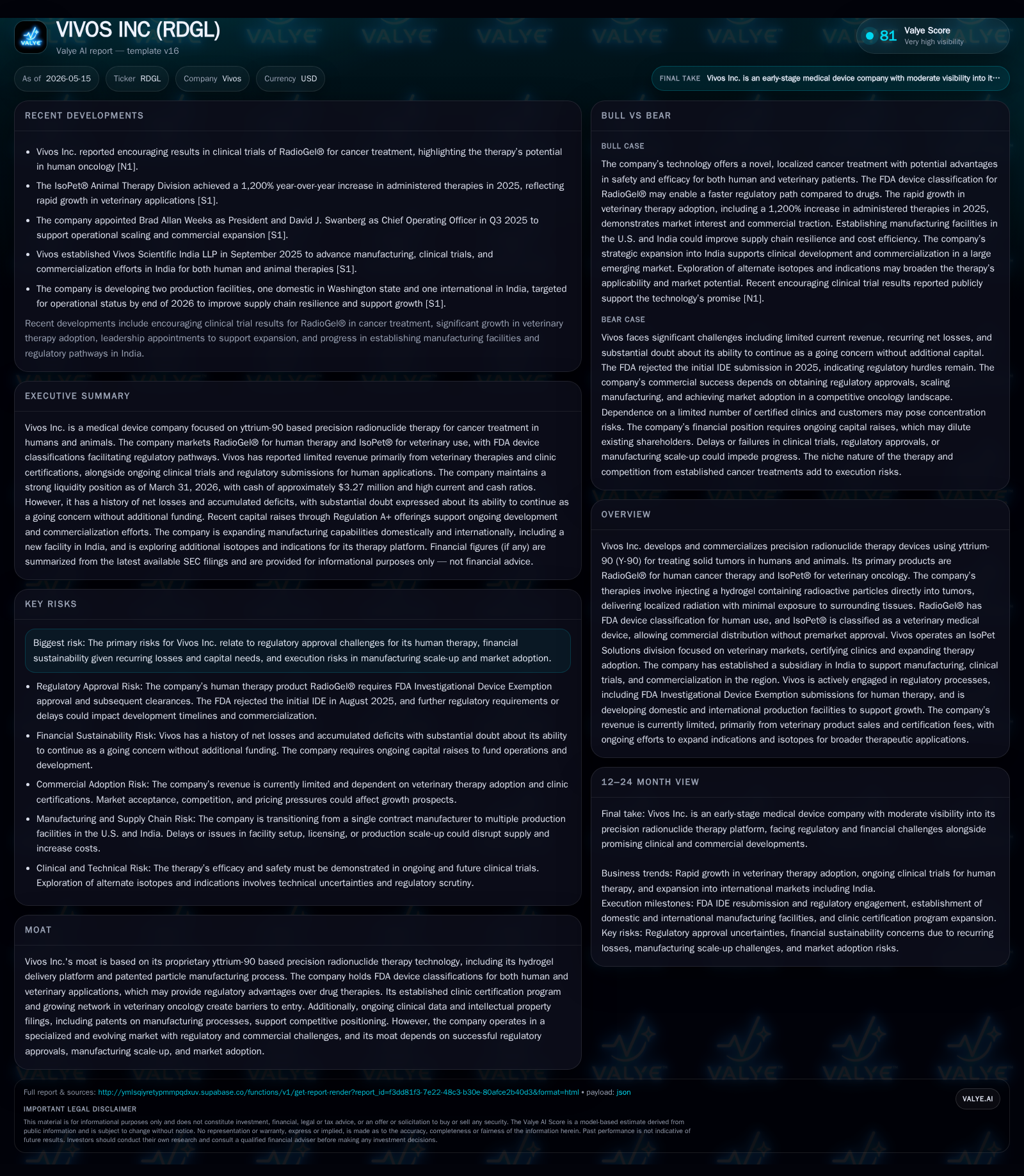
In its latest quarterly filing, Vivos Inc outlined operational progress in regulatory approvals, clinic certification revenue growth, and global commercialization plans including India expansion. The company’s business model centers on proprietary yttrium-90 hydrogel therapies for solid tumors in humans and animals with distinct FDA device classifications facilitating market entry. The veterinary IsoPet® product gains traction through a certification program that clinics pay to complete, offering an early revenue stream amid ongoing human therapy FDA trials. Growth is driven by expanding certified clinics, international licensing strategies, and gradual clinical validation of RadioGel®. Challenges persist around financing needs, regulatory timelines, manufacturing scale-up, and maintaining momentum in early-stage markets.
Recent Operating Update: Outsourcing & Clinic Licensing Propel Commercialization
Vivos Inc’s most recent 10-Q filing dated May 14, 2026, provides a focused update on its operational strategy after securing necessary regulatory approvals and financing. The company plans to outsource key aspects of manufacturing, distribution, sales, and marketing within the U.S., reflecting a shift toward leveraging external expertise for scaling. Internationally, Vivos intends to forge licensing agreements or partnerships to drive global commercialization [S2].
Since 2024, the company has implemented a license program whereby veterinary clinics pay fees for certification to administer its IsoPet® precision radionuclide therapy. Revenues from this program are recognized upon certification completion. This represents a pivotal development as it diversifies income beyond product sales—previously discounted vial sales to two customers creating non-repeatable revenue were noted as exceptions unlikely to continue [S2].
Business Model: Proprietary Yttrium-90 Hydrogel Therapy Devices Target Human and Veterinary Oncology
Vivos develops yttrium-90 (Y-90) based precision radionuclide therapies delivered via a hydrogel matrix injected directly into solid tumors. Key products include:
RadioGel®: Designed for human patients with non-resectable solid tumors; classified by FDA as a medical device rather than a drug. This classification establishes an expedited regulatory pathway with fewer barriers than pharmaceutical agents.
IsoPet®: The veterinary counterpart marketed following the FDA’s Center for Veterinary Medicine labeling it as a medical device applicable broadly across animal solid tumors beyond initially targeted feline and canine sarcomas [S1],[S24]. Unlike drugs, veterinary devices do not require premarket approval but rely on manufacturer compliance with safety and labeling requirements.
Revenue generation depends predominantly on three streams:
- Clinic certification fees: Clinics seeking to administer IsoPet® therapy pay for training and certification.
- Product sales: Hydrogel vials containing radioactive particles sold primarily through certified clinics.
- Related services: Including licensing arrangements, support protocols, training, and future anticipated human therapy sales pending regulatory clearance.
Licensing enables control over quality and usage protocols while establishing switching costs that create entry barriers for competitors. The patented particle manufacturing process further strengthens intellectual property differentiation [S1],[S21].
Industry Structure & Competitive Positioning
Operating at the intersection of oncology therapeutics and medical device innovation, Vivos occupies a niche focused on localized brachytherapy utilizing radioactive isotopes. Its dual-market model — human cancer care complemented by veterinary oncology — leverages unique regulatory classifications allowing faster go-to-market especially in animals.
Few competitors offer similar yttrium-90 hydrogel injection devices approved as medical devices rather than drug therapies. However, the space remains highly specialized with ongoing evolution in both regulatory landscapes (FDA device classifications) and clinical adoption standards.
Veterinary market penetration benefits from the company's concerted efforts through the IsoPet Solutions division established since 2016 to certify clinics incrementally adopting the technology [S1],[S22]. This creates a scalable network effect enhancing treatment awareness among veterinarians.
The establishment of Vivos Scientific India LLP as a variable interest entity focused on manufacturing setup and local trial approvals signals strategic international market entry via cost-effective operations and emerging market demand [S11],[S22].
Growth Drivers
Clinic Certification Program Expansion: Scaling clinic numbers licensed to administer IsoPet® directly increases treatment volumes and recurring revenue from certification renewals or additional training.
Regulatory Progress on Human Therapy: Advancement of RadioGel® through FDA’s device classification system towards Investigational Device Exemption (IDE) clearance would unlock human clinical trials essential for broader commercial adoption.
Global Licensing Partnerships: Outside the U.S., leveraging third-party collaborations avoids high upfront costs while penetrating diverse regional markets including India — where regulatory approval processes are underway.
Manufacturing Capacity Build-Out: Planned construction and validation of production facilities underpin supply scalability crucial for clinical trial support and commercial demand.
Ongoing Clinical Data Generation: Accumulating trial results demonstrating safety and efficacy underpins clinician confidence impacting adoption curves both in veterinary and potential human scenarios.
Risks & Watchpoints
Financial Sustainability & Capital Dependence: Recurring net losses have accumulated an $88+ million deficit by end-2025; ~$3 million annual cash burn necessitates continuous fundraising primarily through Regulation A+ stock offerings [S1],[S5],[S7].
FDA Approval Uncertainty: Timing and requirements for classification as Class II vs Class III medical device remain pivotal variables impacting clinical trial initiation timing and subsequent market launch [S7].
Manufacturing & Operational Scaling Execution: Transitioning to outsourced manufacturing demands robust quality controls; failure here could delay supply or increase costs.
Market Adoption Pace: Veterinary market expansion relies heavily on clinic willingness to pay certification fees while convincing practitioners of therapeutic value amid competition from established oncologic treatments.
International Regulatory Hurdles: India operations await pending local approvals; success is not assured given country-specific medical device regulations and infrastructure challenges [S11],[S22].
What To Watch Next
- FDA’s decision regarding RadioGel® classification level expected within next 12–24 months directly influencing trial start dates.
- Growth trajectory of certified IsoPet® clinics within U.S., monitored via revenue recognition from certification fees.
- Progress updates on Indian clinic regulatory approvals alongside commencement of local manufacturing activities.
- Additional capital raises through Regulation A+ offerings supporting operations beyond mid-2026 horizon.
- Clinical trial outcomes including pilot Phase I data impacting long-term human therapy prospects.
Financial Profile Summary
Latest financial snapshot
| Metric | Value | Period |
|---|---|---|
| Current assets | $3mm | |
| 2026-03-31 | ||
| Current liabilities | $171737 | |
| 2026-03-31 | ||
| Current ratio | 15.14x | |
| 2026-03-31 |
Source: SEC companyfacts cache [F1].
As of March 31, 2026, Vivos reported approximately $2.53 million in cash alongside $7.7K accounts receivable; total current assets stand at nearly $2.6 million against current liabilities of about $171K yielding a strong current ratio near 15. Performance still reflects early-stage investment with limited top-line revenue around $5K reported in prior periods [F1],[S25]. Ongoing operating expenses outpace revenues contributing to incremental net loss trends reported at over $3 million annually into 2025 [F1],[S1]. The balance sheet shows nominal debt levels under $36K dating back years indicating low leverage but underscores dependence on fresh equity injections for sustainability [F1].
Recent capital raises via multiple Regulation A+ offerings raised several million dollars cumulatively over recent years supporting R&D expense outlays relating to product development, clinical trials preparation, facility enhancements, and marketing initiatives [S3],[S7].
Overall liquidity appears sufficient for near-term operational continuity though longer-term viability hinges critically on successful product approval progress combined with effective scaling of commercial initiatives.
This analysis is based solely on public SEC filings dated up to May 14, 2026, combined with operational insights grounded in industry-domain understanding. It does not constitute investment advice or recommendations but aims to provide structured insight into Vivos Inc’s evolving business model dynamics within precision radionuclide therapy markets.
Disclaimer: This is research-only, informational analysis and not investment advice. It may include AI-generated interpretation and general industry context. Always verify important details using primary sources.

Comments