
Solarius Capital Acquisition’s Path to Value Creation in Financial Services M&A
Solarius Capital Acquisition remains a pure-play SPAC with strong liquidity, leveraging industry expertise to secure a business combination in financial services.
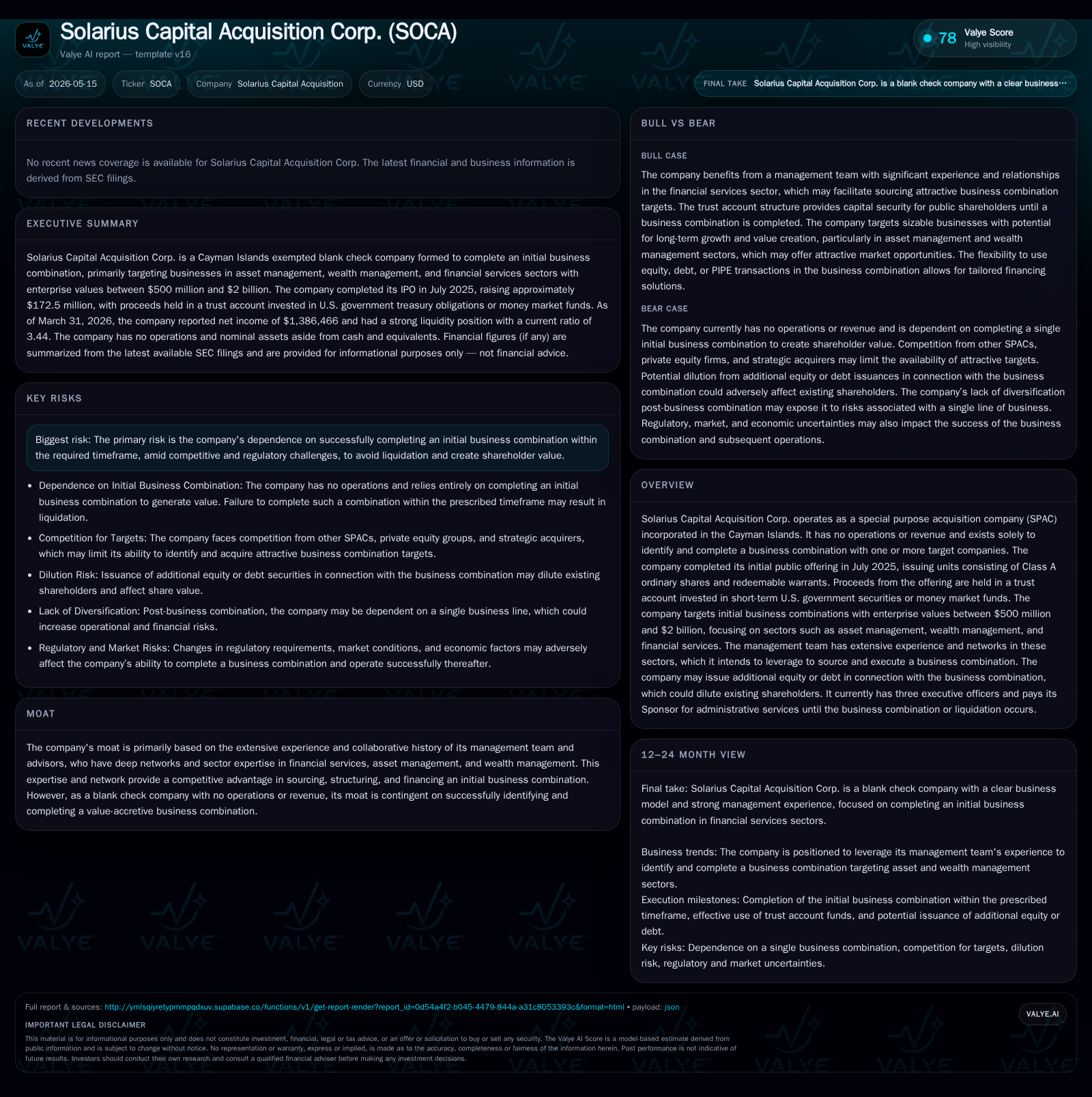
As of its latest quarterly filing dated May 14, 2026, Solarius Capital Acquisition Corp. continues operating as a blank check company with no revenue or operations, holding IPO proceeds securely in trust while preparing for its initial business combination. The company targets financial services sectors such as asset management and wealth management for deals valued between $500 million and $2 billion. Its management team's deep industry experience forms the core competitive advantage, providing access to proprietary deal flow. However, the narrowing timeline to complete a business combination by April 17, 2027, coupled with shareholder redemption rights and sector competition, poses significant execution risks. Monitoring deal announcements and redemption activity will be key milestones in judging Solarius’ progression toward value creation.
Latest Quarterly Update: Current State and Operational Highlights
Solarius Capital Acquisition Corp.'s Q1 2026 Form 10-Q filing dated May 14 confirmed that the company remains a pure special purpose acquisition company (SPAC) with no operating revenues or business activities beyond seeking an initial business combination [S2]. There were no material changes in risk factors or legal proceedings reported relative to the company’s prior annual filing. The IPO proceeds continue to be safely maintained in a trust account invested predominantly in short-term U.S. government securities or qualifying money market funds [S2][S11]. This conservative capital stewardship maintains liquidity and regulatory compliance as the company positions itself for an eventual merger or asset acquisition.
The absence of operational distractions underscores Solarius' focus on deal execution within its statutory Completion Window ending April 17, 2027 [S1]. No new developments suggest shifts in strategic posture; rather, the firm is poised for transaction sourcing leveraging its considerable cash runway and governance readiness.
SPAC Business Model: Capital Structure and Deal Focus
Formed as a Cayman Islands exempted company specifically for effecting mergers or similar business combinations that take companies public more expeditiously than traditional IPOs, Solarius targets acquisitions primarily within the asset management, wealth management, and broader financial services sectors [S1][S4]. Its mandate limits the size of deals sought to enterprise values roughly between $500 million and $2 billion—sizeable enough to command market attention yet appropriate for its capital resources.
The company's capital structure originated from an initial public offering in July 2025 of approximately 17.25 million units at $10 each, each unit comprising one Class A ordinary share plus half a redeemable warrant exercisable at $11.50 post-business combination [S1][S6][S9]. Proceeds net of underwriting fees totaling about $173 million are segregated in a trust account which accrues modest interest distributed for corporate taxes if any [S11]. The contractual structure prohibits merging solely into other blank check companies to preserve transaction quality [S4].
This setup facilitates flexible deal structuring using various combinations of cash from the trust account, equity issuance post-combination, forward purchase agreements, or debt facilities that could be raised alongside or after the merger [S1]. Such flexibility is vital given the spectrum of potential targets’ needs in capital raising or liquidity events.
Management Team’s Experience as Competitive Advantage
Despite lacking operational assets or revenues themselves, Solarius' intrinsic moat derives from its seasoned management team’s extensive track record spanning asset management, private equity investments, and strategic advisory roles [S1][S26]. This collective expertise has been cultivated over several years through active collaboration among team members, creating deep industry relationships that serve as proprietary deal origination channels.
This network extends across traditional investment managers as well as alternative asset classes including hedge funds, private debt vehicles, infrastructure funds, and real estate platforms. The ability to leverage this ecosystem allows the company preferential access to high-quality targets often shielded from broader SPAC competition.
Themes such as scale-induced margin improvements, technology-driven client enrichment platforms, evolving regulatory frameworks on fiduciary obligations and transparency contribute to both challenges and opportunities within targets’ operating models [S13].
The strategic rationale for deploying a SPAC vehicle here rests on offering mid-sized private firms quicker paths to liquidity and access to broad U.S. public capital markets without enduring the longer timeline uncertainty typically associated with IPOs [S8]. With many European-based firms eyeing cross-border listings for growth funding amid low organic growth backdrops domestically, Solarius can capitalize on geographic arbitrage advantages through its investor base.
Competition from other SPACs targeting similarly sized transactions is notable but tempered by Solarius’ differentiated access credentials and willingness to negotiate bespoke deal terms informed by its knowledge base [S27]. Pricing power for attractive deals remains dependent on balancing seller expectations with investor appetite given potential dilution from warrant exercises or redemption volumes.
Growth Drivers: Deal Pipeline, Market Trends, and Deal Structuring Flexibility
Growth for Solarius hinges firmly on successfully consummating at least one initial business combination within the statutory Completion Window—currently set to expire April 17, 2027 [S1][S2]. The company's flexibility to deploy capital through cash in trust combined with supplemental financing mechanisms such as forward purchase agreements accommodates varying target capital structures which can expedite deal closure while preserving valuation accretion.
Market trends supporting this approach include renewed institutional interest in financial services consolidations post-pandemic volatility phases and growing demand for scale-enabled product innovation particularly around ESG investing integration or wealth personalization technology suites.
Management's proactive expansion of advisory networks continually feeds pipeline opportunities originating from investment bankers, private equity firms, boutique advisory practices alongside direct proprietor introductions facilitated by regime-contextual contacts [S26]. While no specific pipeline details have been publicly disclosed yet — standard practice for SPAC lifecycle stages pre-announcement — these qualitative factors bolster prospects for securing target(s) aligned with stated criteria.
Risks and Constraints: Timeline, Redemption Rights, and Regulatory Environment
The defining risk around Solarius revolves around its finite window to complete an initial business combination: failure obligates liquidation returning pro-rata funds held in trust minus costs—effectively rendering warrants worthless while ending investor exposure absent gain [S1][S2]. Approaching this deadline also compresses due diligence timelines possibly diluting negotiating strength vis-à-vis targets aware of urgency.
Redemption rights afforded to public shareholders introduce further negotiation complexity since significant redemptions reduce available cash consideration potentially forcing reliance on dilutive equity issuances or debt increments impacting post-merger valuations negatively [S1][S17]. Managing these dynamics requires sophisticated investor relations execution ensuring shareholder alignment without triggering unfavorable vote outcomes or excessive redemptions.
Regulatory aspects include Nasdaq listing requirements mandating certain governance thresholds tied to transaction completion; failure risks delisting creating secondary market illiquidity concerns detrimental to investors should combination delays occur [S1].
Further operational risks are relatively muted given lack of ongoing commercial activities; rather risk profile centers entirely on execution efficiency against structural constraints imposed by contract terms governing redemptions and timing.
Key Milestones: What to Monitor Next on the Deal Execution Timeline
Critical near-term catalysts revolve around announcements regarding:
- Identification of a definitive target candidate ideally aligned within stated market segments,
- Scheduling of shareholder meetings detailing voting windows or initiation of tender offer processes affording investors choice,
- Public disclosure regarding proportionate redemption levels providing insight into shareholder sentiment,
- Any announced forward purchase agreements or backstop financing commitments that demonstrate sponsor confidence supporting deal terms,
- Proxy materials filings revealing valuation rationales including audited financial statements from prospective targets illustrating compliance readiness under SEC standards [S15].
Tracking such milestones will be essential for assessing tangible progress toward meaningful value creation transforming Solarius from shell entity status into operating public entity anchored around sustainable financial services franchises.
Financial Snapshot: Liquidity, Debt, and Capital Allocation
Latest financial snapshot
| Metric | Value | Period |
|---|---|---|
| Cash & equivalents | $1,097,917 | |
| 2026-03-31 | ||
| Current assets | $1,234,167 | |
| 2026-03-31 | ||
| Current liabilities | $358,325 | |
| 2026-03-31 | ||
| Current ratio | 3.44x | |
| 2026-03-31 |
Source: SEC companyfacts cache [F1].
As per the latest March 31, 2026 balance sheet data coordinated with SEC filings:
| Metric | Value (USD) | Period End Date |
|---|---|---|
| Cash & Equivalents | 1,097,917 | |
| 2026-03-31 | ||
| Total Debt | 147,343 | |
| 2025-06-30 | ||
| Current Assets | 1,234,167 | |
| 2026-03-31 | ||
| Current Liabilities | 358,325 | |
| 2026-03-31 | ||
| Current Ratio | 3.44 | |
| 2026-03-31 |
The company's net debt position is comfortably negative due to high cash holdings exceeding outstanding debt levels measured at previous quarter-end dates — underscoring ample runway for transactional costs associated with business combinations absent additional financing pressures [F1][S2].
Borrowing remains limited consistent with SPAC norms; capital allocation remains tightly controlled centering on preserving trust funds integrity until deployment upon definitive merger closure. This prudent financial discipline aligns with governance best practices pivotal given shareholder sensitivities inherent within blank check structures.
Disclaimer: This is research-only, informational analysis and not investment advice. It may include AI-generated interpretation and general industry context. Always verify important details using primary sources.

Comments