
Boot Barn’s Growth Strategy Tests Geographic Diversification and Inventory Execution
Boot Barn’s strong fiscal 2026 expansion highlights both the promise and challenges of scaling in a niche western and workwear retail market.
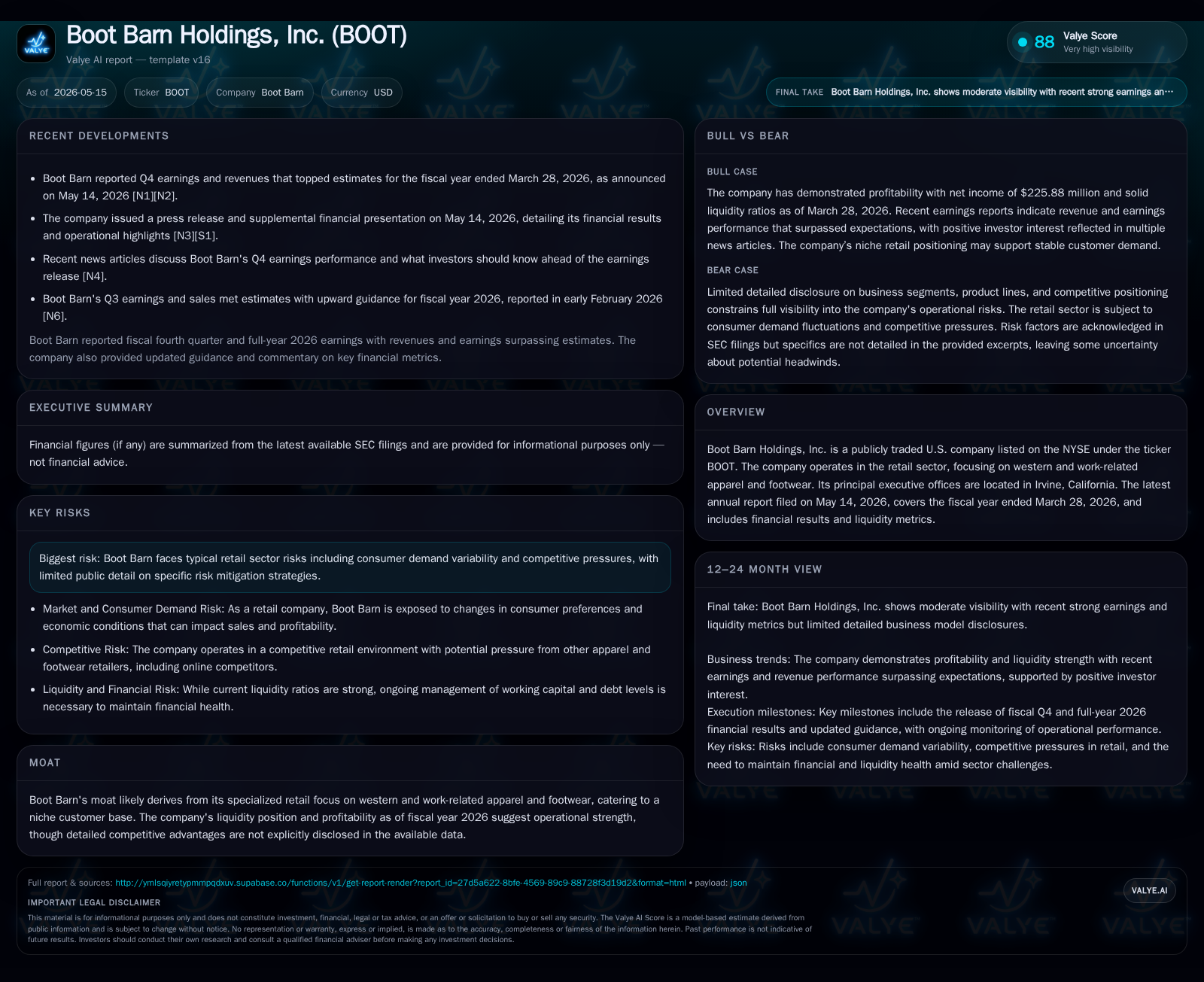
Boot Barn reported a robust fiscal year ended March 28, 2026, characterized by aggressive store expansion, exceeding earnings estimates, and solid liquidity. This growth underscores its deepening footprint in specialized western and work-related apparel, supported by exclusive product lines and an evolving omnichannel approach. However, concentrated geographic exposure and supply chain challenges pose operational risks as the company tests new markets and scales inventory management. Monitoring absorption rates of new stores and inventory turns will be crucial to validate sustainable growth.
Key Highlights from Boot Barn’s Latest Operating Update
On May 14, 2026, Boot Barn Holdings disclosed fiscal fourth quarter and full-year results ending March 28, revealing notable performance metrics that translate recent strategic efforts into tangible outcomes [S3]. The company opened 80 new stores during fiscal 2026 — a material step up compared to previous years (60 stores in fiscal 2025; 55 stores in fiscal 2024) — signaling aggressive retail footprint growth [S1]. This expansion was paired with earnings that beat market expectations for both Q4 and full-year periods [N1][N2], underscoring operational gains from scaling while maintaining discipline over merchandise costs.
Liquidity remains robust with cash and equivalents at approximately $141 million as of quarter-end [F1], complemented by a healthy current ratio of 2.65 reflecting solid short-term financial flexibility [F1]. This financial footing is critical given ongoing investments needed to integrate the surge of new stores successfully and support enhanced e-commerce initiatives. Nevertheless, management flagged risks tied to regional dependencies—especially regarding natural disaster exposures in states like California—and potential complications arising from supply chain disruptions affecting distribution centers [S1].
Business Model and Product Offering: Core Strengths in Western and Workwear Retail
Boot Barn operates as a specialty retailer targeting customers who embrace western-style apparel alongside work-related footwear and gear — an enduring niche that combines lifestyle affinity with practical utility [S1]. Revenue streams predominantly come from direct consumer sales through their extensive physical store network complemented by growing e-commerce channels. The company emphasizes proprietary product lines and exclusives which help differentiate it from broadline competitors, fostering customer loyalty through unique merchandise not readily found elsewhere.
Its business model hinges on a multi-channel approach integrating traditional retail with digital touchpoints that cater to both seasoned western enthusiasts and workers requiring durable gear. Supplier partnerships enable Boot Barn to curate quality goods aligning with brand identity, while private label expansions bolster margins by reducing dependence on third-party brands. The seasonal nature of apparel coupled with regional demand variability necessitates tight inventory management—a recognized challenge given rapid store additions.
Competitive Positioning and Industry Dynamics in Specialized Apparel Retail
Boot Barn competes within the specialized apparel segment against generalist mass-market retailers as well as smaller local operators focused on similar lifestyle niches [S1]. While moderate pricing power exists due to product differentiation and exclusivity, competition pressures manifest through overlaps in category offerings from department stores or outdoor retailers aiming to capture parts of the western/workwear demographic.
Supply chain agility remains a critical competitive factor. The volatility in raw material costs combined with downstream logistics challenges influences inventory availability; Boot Barn’s ability to timely stock exclusive items affects customer retention directly. Regulatory factors have limited visibility but could impact sourcing or labor dynamics subtly over longer horizons. Overall, the company must balance maintaining its niche credence against the risk of commoditization via broader apparel entrants.
Growth Drivers: Store Expansion, E-Commerce Penetration, and Exclusive Products
The foundational growth engine remains physical store openings — with Boot Barn adding 80 stores in fiscal 2026 alone [S3]. Despite risks of geographic saturation particularly in its core Southwest US markets, this direct-to-consumer footprint enhances brand visibility while capturing incremental demand outside existing catchment zones. That said, the integration pace of these locations is pivotal: only well-executed openings that achieve target sales volumes without eroding overall margins will substantiate growth claims.
E-commerce is an increasingly significant contributor, benefiting from ongoing investment into digital platforms that enhance user experience and conversion rates [S3]. Online sales complement brick-and-mortar outlets by offering broader assortments including exclusive lines unavailable in stores. These private labels raise switching costs by creating differentiated consumer preferences tied closely to Boot Barn’s curated brand ethos.
Risks and Constraints: Geographic Concentration, Supply Chain, and Market Saturation
Boot Barn’s concentration of over one-third of its ~539 stores across California, Arizona, and Texas tightens exposure to region-specific risks such as wildfires or earthquakes prominently affecting southern California operations including key distribution centers [S1]. These facilities represent critical nodes for both physical retail inventory replenishment and e-commerce fulfillment; any disruption could materially hamper sales capabilities.
Economically sensitive regions reliant on oil & gas industries—like North Dakota or Wyoming—pose risk through potential downturns impacting discretionary spending on lifestyle apparel [S1]. Moreover, escalating store counts introduce saturation threats whereby overlapping locations may cannibalize same-store sales or intensify lease cost burdens. Supplier restrictions in new markets further complicate merchandise provisioning as competitors saturate those channels first.
From an operational standpoint, executing large-scale expansions demands overcoming hurdles like securing prime retail spaces under favorable leases, hiring skilled staff attuned to brand culture, managing construction timelines amid inflationary pressures, ensuring marketing effectiveness for new demographics, and seamless IT/logistics integration—all simultaneously essential for sustained success [S1]. Failure here would translate into impaired financial results or tarnished brand positioning.
Looking Ahead: Important Upcoming Milestones and Investor Watchpoints
Investors should closely monitor several key performance indicators over coming quarters that will illuminate the sustainability of Boot Barn’s growth strategy [N4]. These include same-store sales trends which reflect organic consumer demand stability post rapid expansion; profitability trajectories among newly opened stores which indicate operational scalability; inventory turnover ratios signifying supply chain efficiency amid cost pressures; plus gross margin developments influenced by product mix shifts toward proprietary lines.
Guidance updates—if provided—will be equally informative especially regarding expected store count targets beyond fiscal 2026 or incremental digital sales penetration objectives highlighted in investor presentations [S3]. Absorption rates of new locations serve as leading signals for whether the geographic diversification strategy is weathering competitive encroachments or demographic mismatches effectively.
Financial Snapshot Supporting Boot Barn’s Recent Execution
Latest financial snapshot
| Metric | Value | Period |
|---|---|---|
| Cash & equivalents | $141mm | |
| 2026-03-28 | ||
| Current assets | $1034mm | |
| 2026-03-28 | ||
| Current liabilities | $391mm | |
| 2026-03-28 | ||
| Current ratio | 2.65x | |
| 2026-03-28 |
Source: SEC companyfacts cache [F1].
| Metric | Value (USD) |
|---|---|
| Cash & Equivalents | $141,036,000 |
| Current Ratio | 2.65 |
| Operating Income | $299,145,000 |
| Net Income | $225,880,000 |
Boot Barn closed fiscal year 2026 with operating income near $299 million supported by efficient cost management alongside revenue scale gains [F1]. Net income stood robust at nearly $226 million underscoring profitable expansion execution [F1]. Its liquidity position—with $141 million cash reserves—combined with a strong current ratio above 2.5 reflects ample cushioning against short-term obligations or investment needs [F1]. Conversely, total debt levels reported at $196.5 million are manageable given cash holdings resulting in moderate net leverage encouraging financial flexibility for continued growth initiatives [F1].
This analysis summarizes publicly available information from SEC filings through May 14-15, 2026 ([S1],[S2],[S3]) combined with companyfacts snapshot data ([F1]) alongside corroborative news sources ([N1],[N2],[N4]). It aims to provide an informed perspective on Boot Barn Holdings’ strategic positioning without expressing investment recommendations.
Disclaimer: This is research-only, informational analysis and not investment advice. It may include AI-generated interpretation and general industry context. Always verify important details using primary sources.

Comments