
ACP Holdings Acquisition Corp. Advances IPO with $215.7 Million Trust as SPAC Search Begins
As a newly public SPAC, ACP Holdings Acquisition Corp. holds significant cash reserves but faces execution risk in identifying and closing its initial business combination.
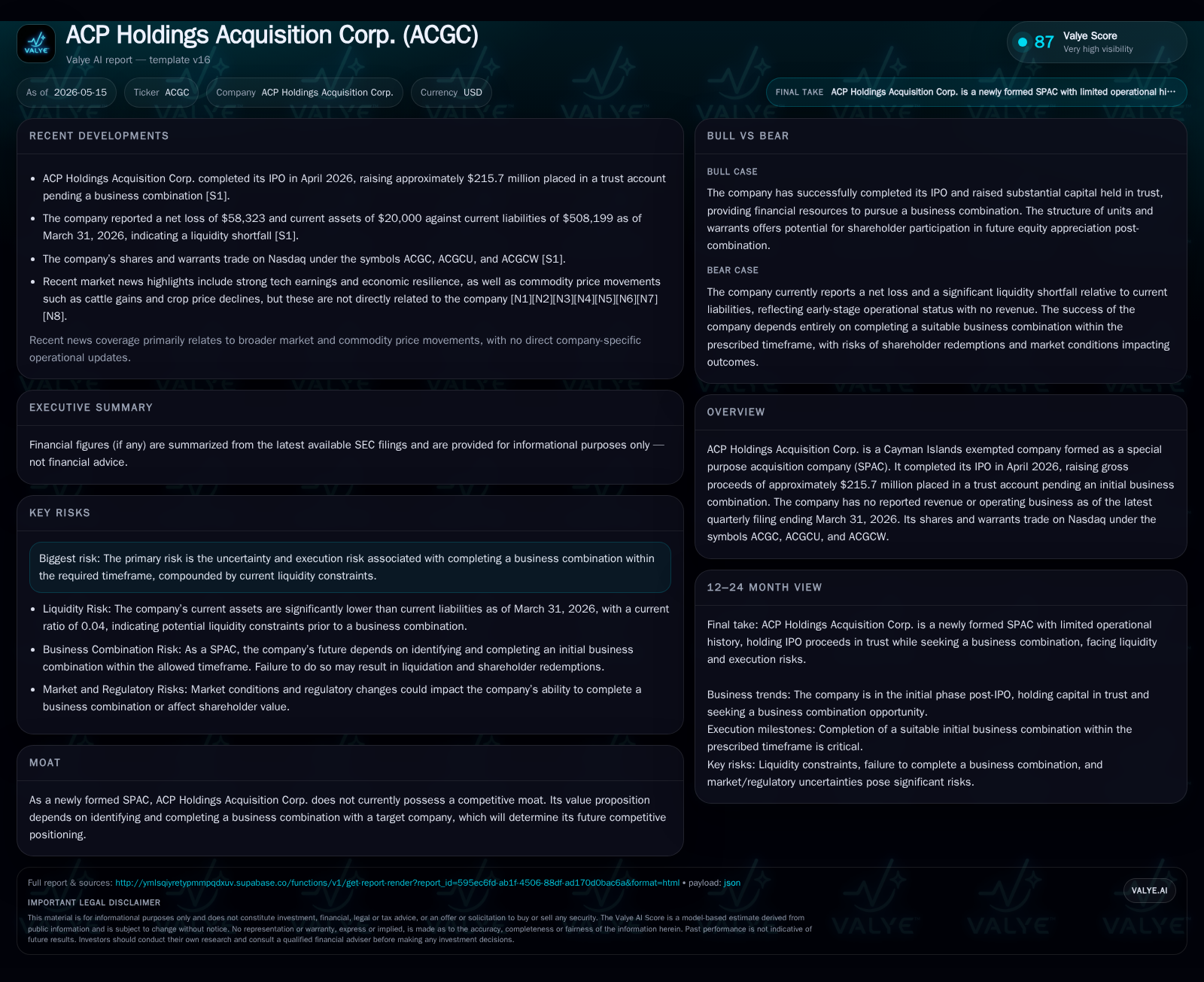
ACP Holdings Acquisition Corp. (ACGC) completed its initial public offering in April 2026, raising approximately $215.7 million placed into a trust account, reflecting the core SPAC business model of capital aggregation for future acquisition. The company reported no operating revenue or business activities as of the quarter ended March 31, 2026, consistent with its status as a blank-check entity. Key risks remain tied to the inherent uncertainty in executing a successful merger within the stipulated timeframe, compounded by liquidity considerations as reflected in the current balance sheet. The SPAC’s growth trajectory and strategic relevance will entirely depend on identifying a target company with substantial market potential.
Recent Operating Update: Post-IPO Status and Financial Snapshot
ACP Holdings Acquisition Corp., trading under ticker ACGC on Nasdaq along with its units (ACGCU) and warrants (ACGCW), completed its initial public offering (IPO) in April 2026 [S3]. The IPO generated gross proceeds of approximately $215.7 million that were placed into a trust account to finance a future business combination—a foundational step for any Special Purpose Acquisition Company (SPAC) [S3]. The latest quarterly filing dated May 14, 2026, confirms that ACP Holdings has not commenced any operating activities and reported no revenues for the quarter ended March 31, 2026 [S2]. Its net loss of $58,323 during this period primarily reflects administrative expenses typical of early-stage SPACs before acquisition target identification [F1].
Balance sheet figures reflect the nascent stage of operations: current assets total $20,000 principally representing non-cash resources needed for ongoing compliance and minimal administration, whereas current liabilities exceed half a million dollars ($508,199), driving the current ratio down to an unusually low 0.04 [F1]. This imbalance aligns with standard SPAC post-IPO financials where most capital raised is segregated separately in trust accounts earmarked exclusively for M&A deployment rather than operational runways.
There have been no reported changes to risk factors since the IPO prospectus filing; these continue to emphasize risks surrounding deal execution timing and uncertainty inherent in blank check companies [S2].
Business Model: Capital Aggregation for Acquisition
ACP Holdings Acquisition Corp.’s business model encapsulates the prototypical SPAC schematic: raise investment capital through an initial public offering without underlying operations or products, then deploy these funds alongside warrants exercise capital upon completing an acquisition or merger with a privately held operating company. Revenue generation does not begin until this target becomes part of the consolidated entity post-business combination.
Revenue mechanics are therefore contingent entirely on successfully identifying an attractive target company within an allotted timeframe—typically two years following IPO—and closing a transaction that can unlock shareholder value. Until such combination is consummated, costs are limited mainly to legal expenses, administrative overhead, report filings, and other compliance-related expenditures responsible for periodic operating losses.
Margins and cash flow conversion will derive solely from the acquired company’s underlying operations once merged; thus, ACP’s strategic strength depends heavily on management’s ability to source high-potential targets possessing scalable business models or differentiated market positions.
Industry Structure and Competitive Position
As a Cayman Islands exempted SPAC without an operating subsidiary or sector focus disclosed as of now, ACP Holdings sits within an increasingly crowded SPAC ecosystem characterized by hundreds of similar entities vying for promising private companies amid evolving market sentiment toward blank-check vehicles.
Competitive differentiation arises post-acquisition through target selection quality rather than from any standalone proprietary assets or technology. With no existing portfolio or vertical specialization declared to date, ACP’s competitive position is nascent and undifferentiated compared to later-stage SPACs that may leverage sector expertise or strategic partnerships.
Industry-wide sentiment plays a meaningful role here; regulatory scrutiny over SPAC disclosures has intensified recently leading some private companies to shy away from SPAC mergers unless valuations and deal terms align favorably. Thus ACP operates under execution headwinds common across SPAC sponsors striving for credibility amidst tightening timelines.
Growth Drivers
Growth for ACP Holdings hinges exclusively on successful completion of its first business combination transaction:
- Deal Sourcing Capability: Ability to identify private companies seeking liquidity through public listing via merger can directly translate into transaction pipeline strength.
- Market Environment: Favorable capital markets conditions increase appetite among private companies for SPAC deals versus traditional IPOs or direct sales.
- Negotiation Execution: Structuring financially accretive combinations that reward post-merger equity performance can fuel investor confidence and share price appreciation.
- Shareholder Approval Process: Achieving necessary proxy votes expediently advances closure timelines minimizing blind pool discount erosion.
- Warrant Exercises: Warrant conversion at stated exercise prices injects supplementary capital enabling better financing flexibility post-merger.
Milestones signaling tangible progress include announced letters of intent (LOIs), definitive merger agreements (DMAs), proxy statements filed with accompanying shareholder vote dates, potentially triggering steps toward closing ceremonies.
Risks and Watchpoints
The paramount risk continues to revolve around execution risk — ACP must complete its target business combination within required periods stipulated public filings or face dissolution triggered by return-of-capital provisions to shareholders potentially at sub-IPO prices.
Additional watchpoints include:
- Liquidity Constraints: Despite significant gross proceeds raised, only nominal unrestricted cash appears on balance sheet pending deal consummation; routine operating expense management must be prudent given limited runway outside trust funds.
- Regulatory Compliance: Timely SEC filings covering deal disclosures must be met rigidly to avoid legal issues jeopardizing transactions.
- Market Sentiment Shift: Should overall investor appetite toward SPACs cool further amid macroeconomic shifts or adverse regulatory newsflow, access to additional equity financings may tighten considerably affecting warrant exercise economics.
- Deal Quality Uncertainty: Until specific target companies come forward publicly revealing sector fundamentals or due diligence outcomes remain opaque to investors constraining informed evaluation.
- Redemption Rights Pressure: Significant shareholder redemption ahead of closing could reduce available merger funds necessitating onerous financing arrangements or deal renegotiations.
What To Watch Next
Upcoming monitoring points include:
- Public announcements regarding engagement with potential acquisition targets or formal signing of MoUs/LOIs indicating advancing negotiations.
- Proxy statements filed signaling readiness for shareholder votes on proposed combinations including detailed financials about targets’ business profiles and valuation metrics.
- Market response around unit share prices and warrant trading activity which might hint at investor confidence levels around strategic plans.
- Follow-on placement transactions if needed providing indications about management’s ability to raise supplemental capital post-initial merger announcement.
- Updates addressing any changes in risk disclosures or operational restructuring details ahead of combination completion deadlines typically set around two-year windows from IPO date.
Financial Profile Summary
Latest financial snapshot
| Metric | Value | Period |
|---|---|---|
| Current assets | $20000 | |
| 2026-03-31 | ||
| Current liabilities | $508199 | |
| 2026-03-31 | ||
| Current ratio | 0.04x | |
| 2026-03-31 |
Source: SEC companyfacts cache [F1].
The financial snapshot underscores ACP Holding's status as a pre-operating entity typical among recent SPACs: zero revenues coupled with nominal operating expenses resulting in modest net losses during reporting intervals [F1]. The starkly low current ratio reflects classification nuances post-IPO where majority capital resides outside general working capital as protected trust funds reserved exclusively for acquisition funding commitments [S3].
This analysis reflects information available as of May 2026 drawn primarily from SEC filings including recent quarterly reports (10-Q) and event disclosures (8-K) alongside contemporaneous market data. ACP Holdings Acquisition Corp.'s future performance will be fundamentally linked to execution abilities inherent in initial combination completions typical of Special Purpose Acquisition Companies without standalone operations at this stage. This document does not constitute investment advice but aims to provide an informed industry-focused perspective based solely on publicly available evidence cited herein.
Disclaimer: This is research-only, informational analysis and not investment advice. It may include AI-generated interpretation and general industry context. Always verify important details using primary sources.

Comments