
TriLinc Global Impact Fund Expands Diverse Emerging Markets Portfolio With Stable Credit Oversight
TriLinc's Q1 2026 disclosures reveal portfolio growth and active management of credit risks across multiple socioeconomic sectors and geographies.
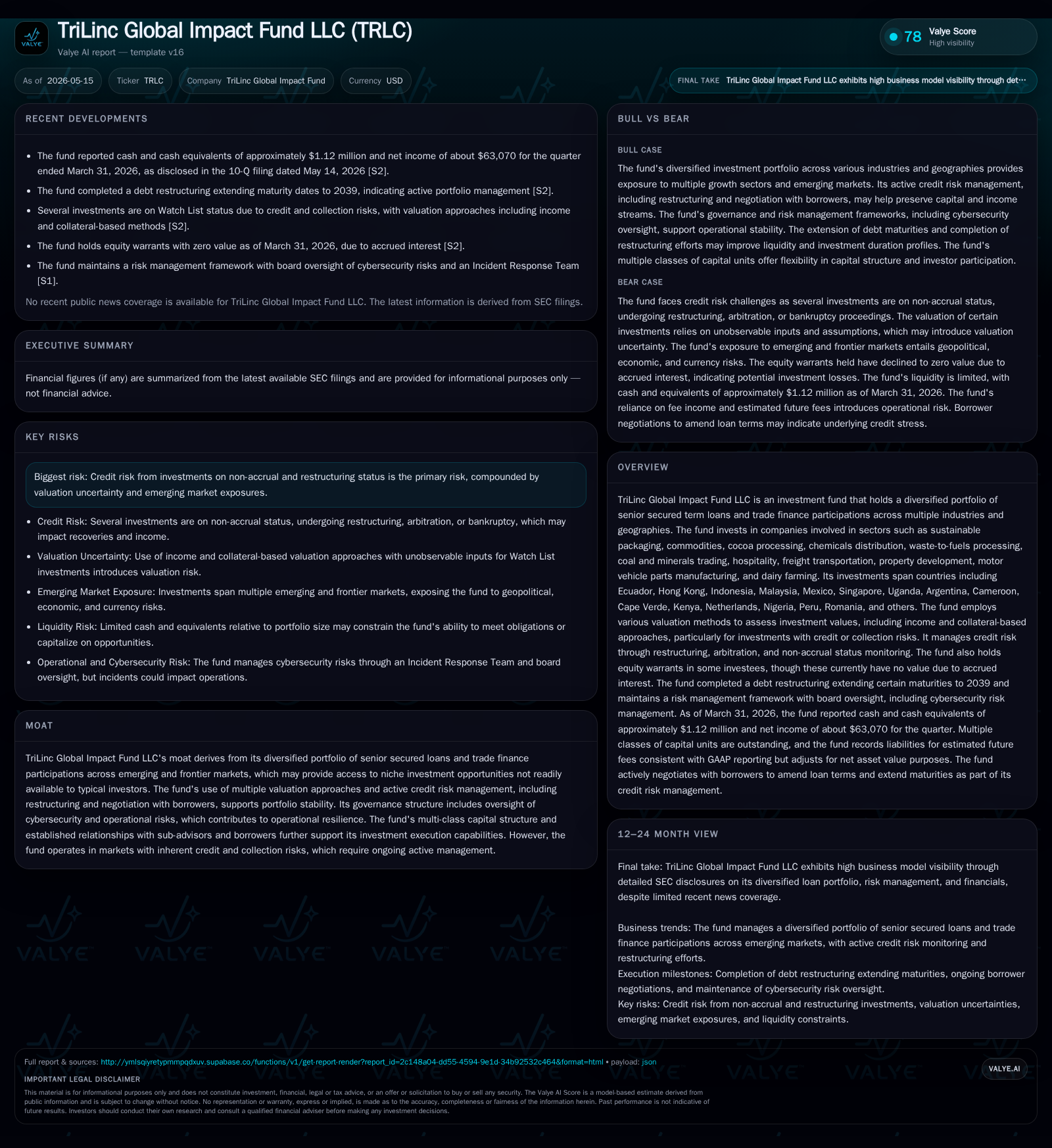
In the first quarter of 2026, TriLinc Global Impact Fund LLC's portfolio expanded to approximately $331 million in assets, with a weighted average loan size of roughly $10 million. Its diversified investments span sustainable sectors and frontier economies worldwide, balancing yield with senior secured protections. The fund’s rigorous credit risk management and multi-method valuation practices continue to underpin portfolio stability despite operating in inherently credit-challenged emerging markets. Key risks center on watch list investments undergoing restructuring or non-accrual status, necessitating ongoing borrower negotiations and collateral-based remediation.
Latest Quarterly Operating Highlights and Portfolio Updates
TriLinc Global Impact Fund LLC's latest SEC filing dated May 14, 2026 (Form 10-Q) discloses a portfolio valued at approximately $331.16 million as of March 31, 2026 [S2]. This reflects an increase in assets managed relative to prior periods where the portfolio was reported at $283 million as per the April 23, 2026 Form 8-K update [S3]. The weighted average loan size remains steady at about $10 million with a notably short weighted average duration of roughly 0.4 years, indicating a relatively quick turnaround investment profile consistent with trade finance participations [S3].
The portfolio composition spans a wide swath of sectors including sustainable packaging manufacturers like Grupo Surpapel (corrugated boxes), waste-to-fuels processors such as BlueArrow Biojet Holdings LLC, agricultural processors (cocoa and coffee exporters like Producam SA), dairy farming cooperatives such as Sancor Cooperativas Unidas Ltda., freight transportation entities, motor vehicle parts manufacturers, property developers, and chemical distributors across numerous emerging economies including Ecuador, Indonesia, Cameroon, Nigeria, Argentina, Peru, Malaysia, Kenya among others [S1,S3]. This sectoral breadth supports diversified socioeconomic impact while mitigating concentration risk.
Credit quality oversight remains core with several watch list investments under active monitoring or restructuring. For example, Courtyard Farms Limited and Alfa Systems defaulted on scheduled repayments leading TriLinc to enter settlement agreements where inventory serves as collateral being liquidated via local agents; conversion into Class A and B convertible notes occurred during restructurings finalized in August 2023 [S1,S2]. Similarly, other impaired investments are valued using hybrid models blending income approach where cash flows are reliable and collateral-based approaches when asset liquidation is primary recovery path [S4]. Borrower flexibility in repayment terms is granted in some trade finance deals to align with contract-specific business cycles negotiated jointly between TriLinc’s sub-advisors and borrowers [S4].
Business Model: Investment Approach and Product Quality
TriLinc operates as an impact-focused investment fund offering exposure primarily through senior secured term loans and trade finance participations—financial instruments positioned at the top of the capital stack ensuring priority claims on assets and cash flows. The fund attracts investors seeking both financial returns aligned with progressive socio-environmental goals by supporting companies fostering economic development in underserved regions.
The investment selection process targets companies contributing positively across themes such as sustainability (e.g., sustainable packaging), energy transition (waste-to-fuels), agricultural value chains (cocoa processing), industrial services (freight transport), and consumer staples (dairy farming). TriLinc’s global footprint includes emerging and frontier markets often overlooked by traditional financiers due to informational asymmetries or operational complexity.
Valuation discipline involves multifaceted methodologies: the income approach considers discounted future cash flows based on borrower financials while the collateral approach derives estimated realizable values directly from pledged assets—critical for positions carrying elevated credit or collection risk. This dual framework augments transparency while accommodating idiosyncratic borrower circumstances [S2,S4].
A multi-class capital structure creates tiered investment options allowing differentiated risk-return profiles tailored to institutional or high-net-worth investors’ preferences. Additionally, long-term partnerships with sub-advisors supply deal flow expertise localized within key jurisdictions ensuring ongoing asset vigilance.
Competitive Positioning Within Impact Finance and Emerging Markets
Within the niche of impact investing focused on senior secured lending in difficult-to-access emerging markets, TriLinc holds a competitive moat anchored on its cultivated proprietary relationships both upstream with sub-advisors embedded locally and downstream with borrowers lacking established access to mainstream capital. This decentralized yet coordinated model mitigates informational barriers pervasive in frontier regions.
Risk management is centralized through an Investment Review Team (IRT) which actively engages on workout strategies including restructurings, settlements, or collateral liquidations when borrowers falter. Such proactive intervention enhances recoveries compared to passive credit exposures common among peer funds.
Information technology governance also strengthens resilience; the firm's Co-Chief Information Security Officers have decades-long cybersecurity leadership credentials overseeing threat mitigation policies discussed annually with the board of managers. This focus attenuates operational risks that could disrupt reporting accuracy or investor communications amidst complex global operations [S1].
The fund’s broad industry reach — from commodities trading firms in Hong Kong to dairy cooperatives in Argentina — combined with depth in structuring senior secured loans sets it apart from funds limited to equity stakes or unsecured lending within similar regions.
Growth Drivers: Geographic Expansion and Sector Penetration
Growth prospects stem from selective geographic expansion targeting countries where financial services penetration remains modest but economic fundamentals support micro to mid-sized enterprise growth. Expanding participation in sectors benefiting from global sustainability trends — such as refining waste-to-fuels technologies or scaling circular economy initiatives through sustainable packaging — further drives demand for impact-aligned capital.
Loan maturities clustered around near terms provide a pipeline for redeployment into new credits or augmenting existing positions at improved spreads. This dynamic capital recycling facilitates flexible portfolio rebalancing responsive to shifting country- or sector-level opportunities reported each quarter.
Moreover, evolving borrower relations enable structured flexibility around payment schedules aligned with seasonality or business cycles—critical for trade finance participations heavily linked to commodity export/import flows—helping sustain portfolio health without strict default triggers that might unfairly penalize counterparties during temporary downturns [S4].
Risk Factors: Credit Exposure, Valuation Complexity, and Regulatory Challenges
The principal challenge remains credit risk posed by borrowings under non-accrual status or those subject to ongoing restructuring negotiations—as exemplified by Courtyard Farms Limited whose settlement depends on inventory liquidation executions through local agents arranged by TriLinc’s advisors [S1,S2]. Investments associated with court-supervised bankruptcy proceedings add layers of uncertainty about timing and ultimate recovery value.
Valuations involving collateral-based methods introduce subjectivity given fluctuating asset prices influenced by local market liquidity constraints. Double-checking assumptions against periodic income approach valuations moderates over-reliance on one methodology but does not eliminate estimation volatility especially amid geopolitical instability affecting some jurisdictions.
Trade finance activities also face evolving regulatory landscapes potentially impacting compliance costs or permissible transaction structures unique to each country—requiring continuous adaptation from compliance teams partnered with legal advisors fluent in multi-jurisdictional frameworks.
Macro factors typical of emerging markets—including foreign exchange volatility or political upheaval—compound sovereign risk exposure albeit somewhat insulated via secured lending instruments adopting conservative underwriting parameters.
Upcoming Catalysts and Monitoring Points
Key near-term milestones involve monitoring loan maturity schedules clustered through calendar year quarters where timely refinancing or repayment affects liquidity deployment capacity [S2,S3]. Resolution outcomes for major watch list cases such as detailed negotiations around restructuring agreements or settlements will materially influence net asset value trajectories.
Performance metrics from sub-advisors providing granular intelligence on borrower recovery prospects plus any shifts in sovereign credit ratings across countries invested remain critical demand signals. Additionally, evolving regulations governing cross-border trade finance could alter deal origination cadence requiring proactive strategic shifts.
Capital units outstanding span multiple classes designed for varied investor needs but distribute risks through layered claim priorities consistent with senior secured loan characteristics.[S2]
This liquidity status coupled with disciplined capital structure supports investment flexibility absent refinancing pressure—a critical advantage given the challenging credit environments prevalent in many underlying markets served.
This analysis focuses solely on publicly disclosed operating data through SEC filings without providing investment advice or recommendations.
Disclaimer: This is research-only, informational analysis and not investment advice. It may include AI-generated interpretation and general industry context. Always verify important details using primary sources.

Comments