
SPRUCE POWER Holding Corp Advances Residential Solar with Strategic Portfolio Expansion
Latest quarterly filings reveal Spruce Power's significant portfolio growth and operational focus amid liquidity and leadership stabilization.
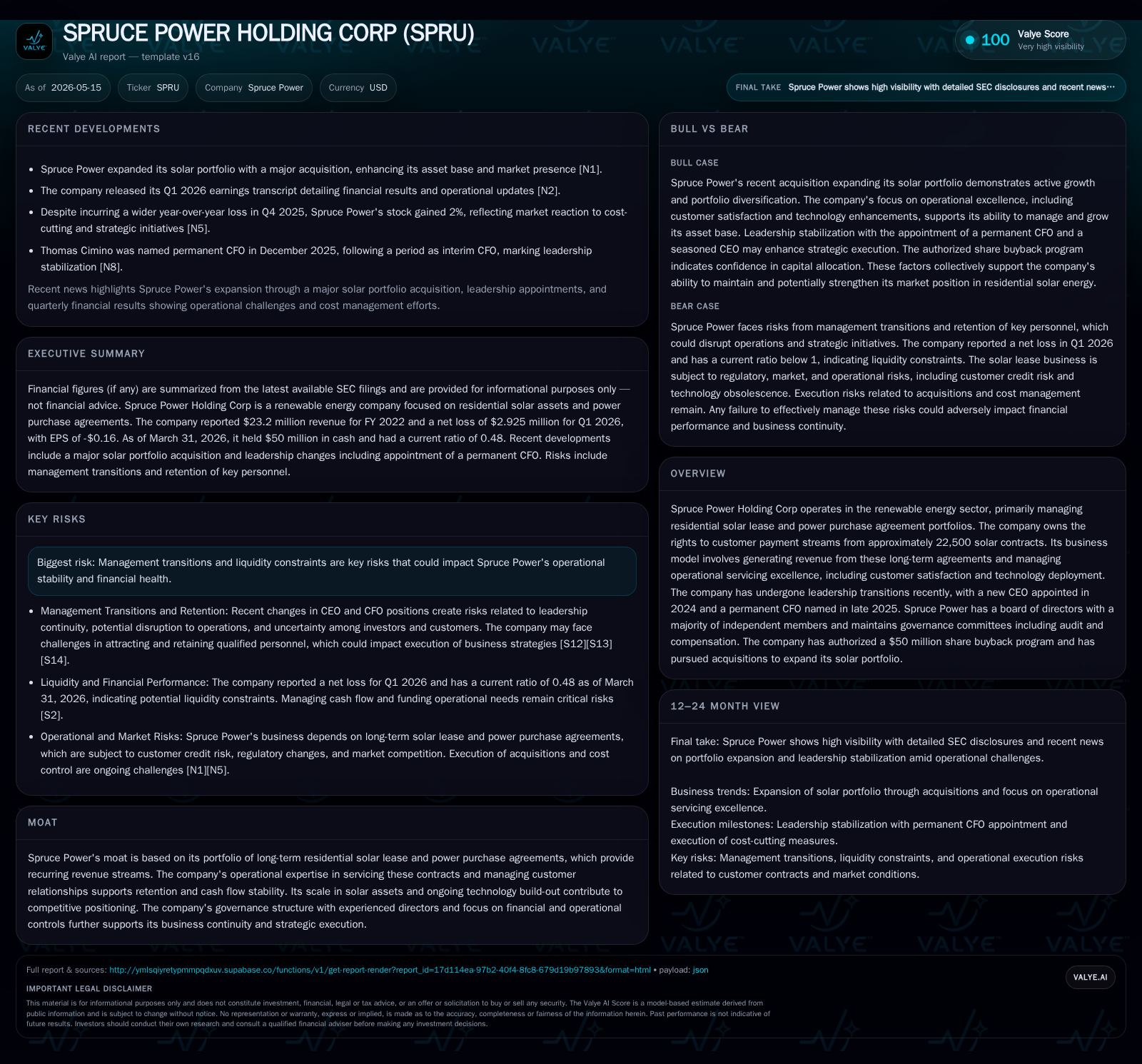
Spruce Power Holding Corp reported its first quarter 2026 operational update highlighting a major expansion of its residential solar contract portfolio. The company owns rights to approximately 22,500 solar lease and power purchase agreements, generating recurring revenues from these long-term customer contracts. Recent strategic acquisitions have grown the portfolio scale, complementing ongoing efforts in technology deployment and customer service excellence. While management transitions have stabilized, balance sheet metrics indicate a high leverage and tight liquidity profile, warranting close monitoring as Spruce scales.
Recent Quarterly Operating Update
Spruce Power Holding Corp’s latest 10-Q filing dated May 14, 2026 [S2] marks a pivotal update driven primarily by a major portfolio acquisition that expands its footprint in the residential solar market. This transaction adds substantial contracted solar assets under management, increasing the total number of residential solar leases and power purchase agreements (PPAs) to roughly 22,500, a figure consistent with the company’s disclosure in its April 2026 annual amendment [S1]. This scale-up directly enhances the company's long-term recurring revenue stream anchored in customer payment rights.
Operationally, the company has stabilized leadership following CEO transition in 2024 and appointment of Thomas J. Cimino as permanent CFO in late 2025 [S25], which has reduced some prior execution uncertainty. The quarterly disclosures signal no material changes to risk factors from the prior annual report [S15], but underscore ongoing demand on cash flows driven by servicing this expanded portfolio.
Notably, the recent event filing [S3] confirms that while there are no new major shifts in regulatory environment or immediate operational risks disclosed, integrating new assets places near-term demands on customer servicing teams and technology systems. Thus the focus remains on operational execution coupled with strategic asset growth aiming to enhance free cash flow margins.
Business Model and Portfolio Quality
Spruce Power generates revenue exclusively through ownership of residential solar lease and PPA contracts. These contracts grant rights to receive customer payments over a multi-year term—typically spanning upwards of two decades—effectively creating a portfolio of predictable cash flow streams. The approximately 22,500 contracts represent use rights wherein customers either lease solar equipment or buy power produced under long-term PPAs.
Revenue scales with growth in systems/contracts owned; pricing mechanisms embed fixed or escalating customer payments structured to deliver stable income less servicing expenses. Operational quality hinges on maintaining low churn via excellent customer care support and technological enhancements allowing real-time system monitoring and efficient administrative servicing.
Scale confers competitive advantages on Spruce Power by enabling optimized cost structures for maintenance, billing, and collections while investing in automated portfolio management platforms. Such technology integration mitigates attrition risks and improves gross collections — key metrics aligned with executive compensation goals for adjusted gross collections and customer satisfaction set forth in the latest annual disclosures [S1].
Industry Competitive Landscape
Within the residential solar sector, players like Spruce Power operate at an intersection between renewable energy asset owners and customer service operators managing leased PV systems through highly standardized or bespoke contracts. This niche requires substantial upfront capital to acquire or develop installed systems followed by years of servicing commitments.
Spruce’s moat is built on its amassed contract portfolio size and operating expertise managing these subscriptions economically amidst a complex regulatory landscape incentivizing solar adoption. Unlike vertically integrated installers who rely heavily on new installations for growth, Spruce focuses on maximizing yield from existing asset bases acquired either organically or through acquisitions [N2].
Yet this market segments under pressure from fluctuating photovoltaic equipment costs affecting entry barriers for new assets alongside evolving state-level regulatory frameworks influencing PPAs’ economics. Competitors include utilities launching green tariff offerings as well as private solar leasing firms competing both by price and technological service quality.
Thus proprietary scale combined with enhanced technology underpins pricing power resilience but also obliges ongoing investment to maintain operational efficiency amid growing competitive intensity.
Growth Drivers: Portfolio Expansion and Technology Deployment
Spruce Power’s primary growth vector lies in expanding its contract base—whether through organic new system additions or accretive acquisitions demonstrated by the recent major portfolio purchase disclosed post-quarter [N2]. Executive pay design disclosed in the April annual filing ties incentives explicitly to “New Business Net Revenue” goals illustrating strategic emphasis on increasing systems/contracts owned [S1].
Technology deployment within asset servicing can drive margin expansion by lowering per-contract overheads through automation of metering data collection, predictive maintenance using AI analytics, and digital customer engagement platforms enhancing retention rates.
Geographically diversified growth opportunities exist where regulatory incentives for residential solar are accelerating installation rates but remain less saturated than core markets such as California or Texas. Expanding into these emerging markets supported by acquisitions enables scaling without proportionally increasing fixed costs.
Overall incremental growth will be measured via contract additions (backlog/bookings), adjusted collections performance metrics per portfolio segment, reductions in churn rates, and improvement in operating EBITDA less project finance service obligations [S1].
Key Risks and Operational Watchpoints
Despite strategic progress, Spruce Power’s leverage profile presents pronounced financial risk: as of March 31, 2026 total debt approximates $687 million against cash reserves near $50 million yielding net debt around $637 million—a high absolute obligation relative to liquidity visible through a sub-0.5 current ratio of 0.48 ([F1]). This constrains flexibility especially if operating cash flow generation fluctuates due to seasonality or unexpected contract prepayments reducing recurring income.
Management turnover experienced recently—with key CFO transition only finalized late last year—injects execution risk though current leadership seems more stable. Retaining talent capable of optimizing portfolio servicing efficiency remains critical.
Contractual churn or increased prepayment rates could impair revenue predictability since each contract represents a finite horizon of payments; moreover technological disruptions creating more cost-effective alternatives may pressure retention indirectly.
Finally regulatory changes impacting net metering policies or PPA legal frameworks could alter underlying economics requiring agility in structuring future agreements or reassessing asset valuations.
Near-Term Milestones and What to Watch Next
The market will track upcoming quarterly releases including Q2 2026 SEC filings expected later this year where management may provide updates regarding integration progress from its recent acquisition [N2], potential refinance strategies addressing leveraged capital structure pressures hinted at historically but not yet materialized publicly.
Key operating KPIs such as new contract volumes booked each quarter, adjusted gross collection improvements reported against PPA portfolios, average customer satisfaction ratings disclosed during earnings calls [N1], and attrition statistics should signal trajectory toward financial stabilization.
Also important will be any announcements related to capital raising efforts or amendments to credit agreements addressing near-term covenant requirements given tight liquidity headroom outlined in Q1 results ([F1], S2).
Finally governance updates especially linked to board independence or any shifts in executive compensation plans tied to newly emerging business priorities could indicate evolving strategic priorities.[S28]
Latest Financial Snapshot
Latest financial snapshot
| Metric | Value | Period |
|---|---|---|
| Cash & equivalents | $50mm | |
| 2026-03-31 | ||
| Total debt | $687mm | |
| 2026-03-31 | ||
| Net debt | $637mm | |
| 2026-03-31 | ||
| Current assets | $111mm | |
| 2026-03-31 | ||
| Current liabilities | $231mm | |
| 2026-03-31 | ||
| Current ratio | 0.48x | |
| 2026-03-31 |
Source: SEC companyfacts cache [F1].
| Metric | Value (USD millions) |
|---|---|
| Cash & Equivalents | 50.0 |
| Total Debt | 687.3 |
| Net Debt | 637.3 |
| Current Assets | 111.3 |
| Current Liabilities | 231.0 |
| Current Ratio | 0.48 |
At quarter-end March 31, 2026, Spruce Power presents a constrained liquidity picture with $50 million in cash against over $230 million of current liabilities resulting in a current ratio under 0.5 — highlighting working capital tightness despite ongoing operational cash generation efforts ([F1], [S2]). Total debt nearing $687 million implies substantial leverage given operating income last reported at $17.9 million for FY2025 ([F1]). These figures emphasize the need for effective balance sheet management amidst scaling challenges due to recent portfolio additions.
Disclaimer: This analysis is based solely on publicly available filings with the U.S. Securities and Exchange Commission as cited along with reputable news sources referenced herein. It does not constitute investment advice or a recommendation.
Disclaimer: This is research-only, informational analysis and not investment advice. It may include AI-generated interpretation and general industry context. Always verify important details using primary sources.

Comments