
Bolt Biotherapeutics Advances Boltbody Platform Amid Clinical and Financial Challenges
Recent protocol adjustments and workforce reductions highlight Bolt’s effort to optimize clinical development and extend its financial runway.
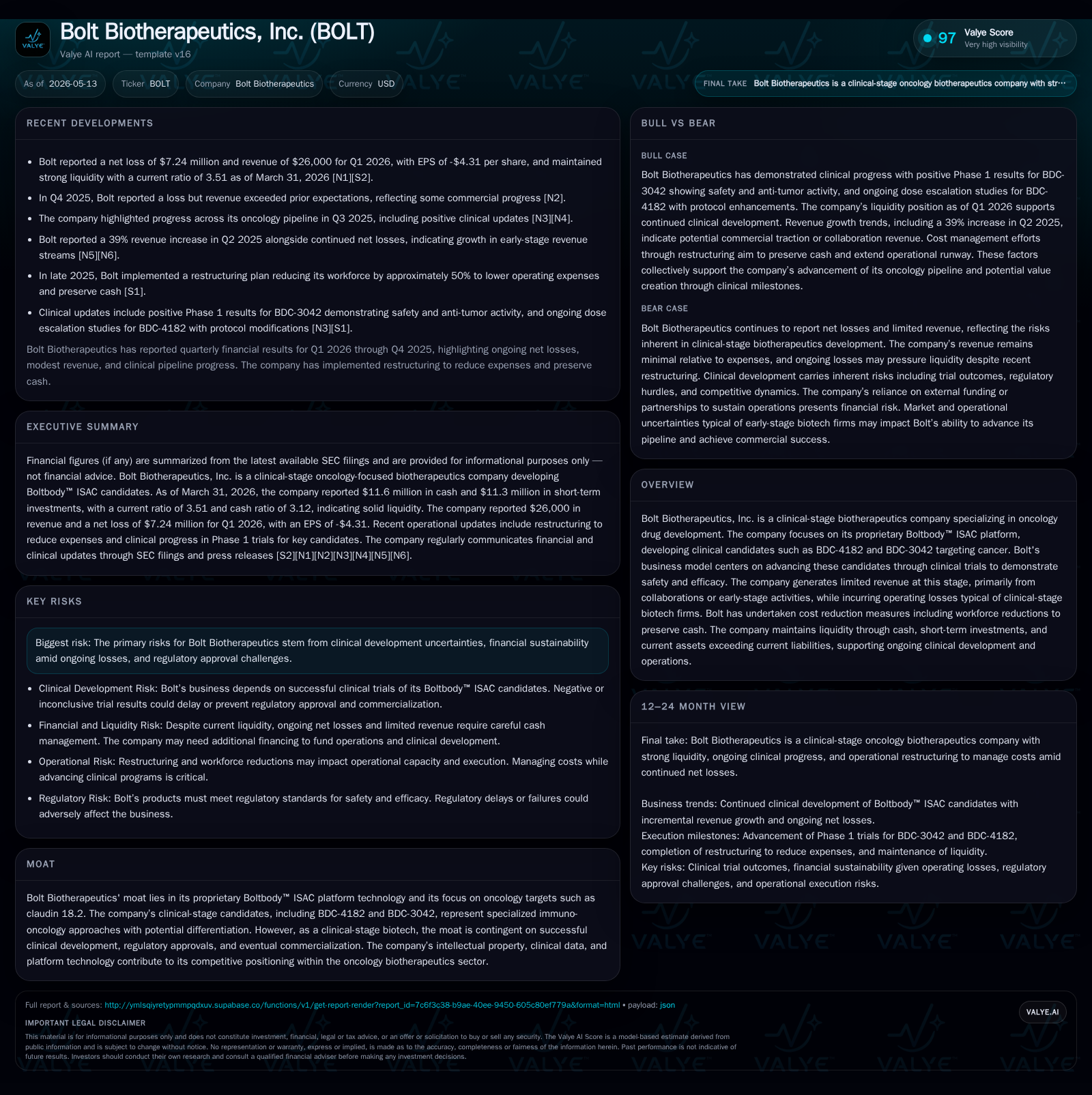
Bolt Biotherapeutics reported first-quarter 2026 results marked by ongoing clinical trial refinements for lead candidate BDC-4182, including introducing a step-up dosing regimen that delays initial data readouts to Q3 2026. The company continues to manage its cash burn by implementing a significant workforce reduction completed by the end of 2025, aiming to preserve capital into 2027. While Bolt’s proprietary Boltbody™ ISAC platform distinguishes its immuno-oncology pipeline, operational progress and liquidity remain tightly linked to clinical milestones and prudent cost control.
First-Quarter Operating Highlights and Clinical Progress Update
Bolt Biotherapeutics’ latest quarterly filing (10-Q dated May 12, 2026) reveals critical developments shaping its near-term trajectory. The company updated its Phase 1 dose escalation study for BDC-4182, a lead clinical candidate derived from its proprietary Boltbody™ ISAC platform targeting claudin 18.2 — a clinically validated protein expressed in various cancers. The trial now incorporates a step-up dosing protocol, a strategy adapted from commercially successful T-cell engagers to potentially enhance safety and tolerability. This modification delays the expected timeline for initial clinical data release from earlier projections into the third quarter of 2026 [S2][S3][S4].
Concurrently, Bolt finalized a substantial workforce reduction in late 2025, cutting approximately half of its staff (around 20 employees) to preserve capital during extended development timelines and typical clinical-stage biotech operating losses [S4]. This restructuring aims to lower expenses systematically and support the company’s cash runway extending into calendar year 2027. These measures frame Bolt’s operational reality: advancing complex immuno-oncology trials under strict resource discipline.
Market reaction has acknowledged these updates as indicative of prudent management adapting to evolving clinical insights and financing constraints while maintaining commitment to advancing BDC-4182’s development program [N1].
The Boltbody™ ISAC Platform: Innovation Drivers in Immuno-Oncology
At the core of Bolt Biotherapeutics’ value proposition is its Boltbody™ Immuno-Stimulatory Antibody Conjugate (ISAC) platform technology. This proprietary approach combines targeted antibody specificity with immune-stimulatory payloads designed to activate innate immunity within the immunosuppressive tumor microenvironment. Its leading candidates—BDC-4182 and BDC-3042—focus on claudin 18.2, an antigen overexpressed in multiple gastrointestinal malignancies.
The platform enables selective immune activation preferentially at tumor sites rather than systemically, potentially mitigating off-target toxicities that limit other immunotherapies. IP protections around Boltbody™ cover both conjugation chemistry and biological targets, forming a moat that depends largely on eventual successful clinical validation and scale-up for commercialization [S1].
This positioning places Bolt in alignment with industry trends emphasizing precision immunotherapies leveraging novel mechanisms beyond checkpoint inhibition or conventional T-cell engagement.
Competitive Environment and Industry Positioning in Oncology Biotech
Bolt operates within an intensely competitive landscape of emerging biopharmaceutical companies focused on next-generation immuno-oncology agents. Key competitors include firms developing T-cell engagers, immune-stimulatory antibody conjugates (ISACs), bispecific antibodies, and cellular therapies targeting similar oncology indications.
While the innovation-rich segment offers significant therapeutic upside potential, it also entails high technical complexity in biologics manufacturing capacity and regulatory scrutiny given safety profiles unique to immune modulation agents. These factors contribute to elevated development risk.
Bolt’s smaller scale confers nimbleness for rapid R&D pivoting but constrains pricing power or negotiation leverage relative to larger established biotech or pharma entities that dominate late-stage assets or commercial channels. Thus, Bolt’s competitive standing depends heavily on demonstrating clinical proof-of-concept promptly with BDC-4182 while managing operating cost efficiency [S1].
Growth Catalysts: Advancing Clinical Programs and Pipeline Expansion
Primary growth drivers for Bolt center on progression through key clinical milestones with its Boltbody™ pipeline. The modified Phase 1 trial design for BDC-4182 with step-up dosing may produce favorable safety signals enabling dose escalation conducive to efficacy evaluations—the initial data slated for Q3 2026 are pivotal inflection points for validation prospects.
Beyond this frontrunner asset, potential exists for expanding the therapeutic scope of the Boltbody™ ISAC platform into additional oncology targets or combinations; however, such endeavors remain contingent on resource availability.
Recent filings underscore Bolt’s acknowledgment of these vulnerabilities alongside explicit operational steps—such as workforce cutbacks—to mitigate cash burn [S21][S2][S1].
Milestones on the Horizon: Trial Data Releases and Operational Efficiency
Investors should monitor several near-term milestones:
- Q3/Q4 2026 Initial Data Readout: Safety/tolerability results from modified BDC-4182 dose-escalation study will serve as critical signals determining further development pace.
- Ongoing Cost Management Metrics: Evidence of sustained expense control post-restructuring that extends cash runway without compromising trial integrity.
- Potential Corporate Updates: Any announcements surrounding new collaborations or pipeline candidate initiations could broaden growth vectors.
Yet the modest cash balance combined with no reported revenue beyond exploratory collaborations accentuates Bolt's dependency on capital market access or partnerships for longer-term sustainability [F1][S2].
Disclaimer: This analysis is based solely on publicly available SEC filings and news reports as referenced; it does not constitute investment advice or recommendations. Investors should conduct their own due diligence considering comprehensive sources before making decisions.
Disclaimer: This is research-only, informational analysis and not investment advice. It may include AI-generated interpretation and general industry context. Always verify important details using primary sources.

Comments