
Prestige Consumer Healthcare Battles Supply Constraints While Pursuing Strategic Acquisitions
Persistent third-party manufacturing shortages challenge Prestige’s sales momentum despite brand strength and acquisition-driven growth.
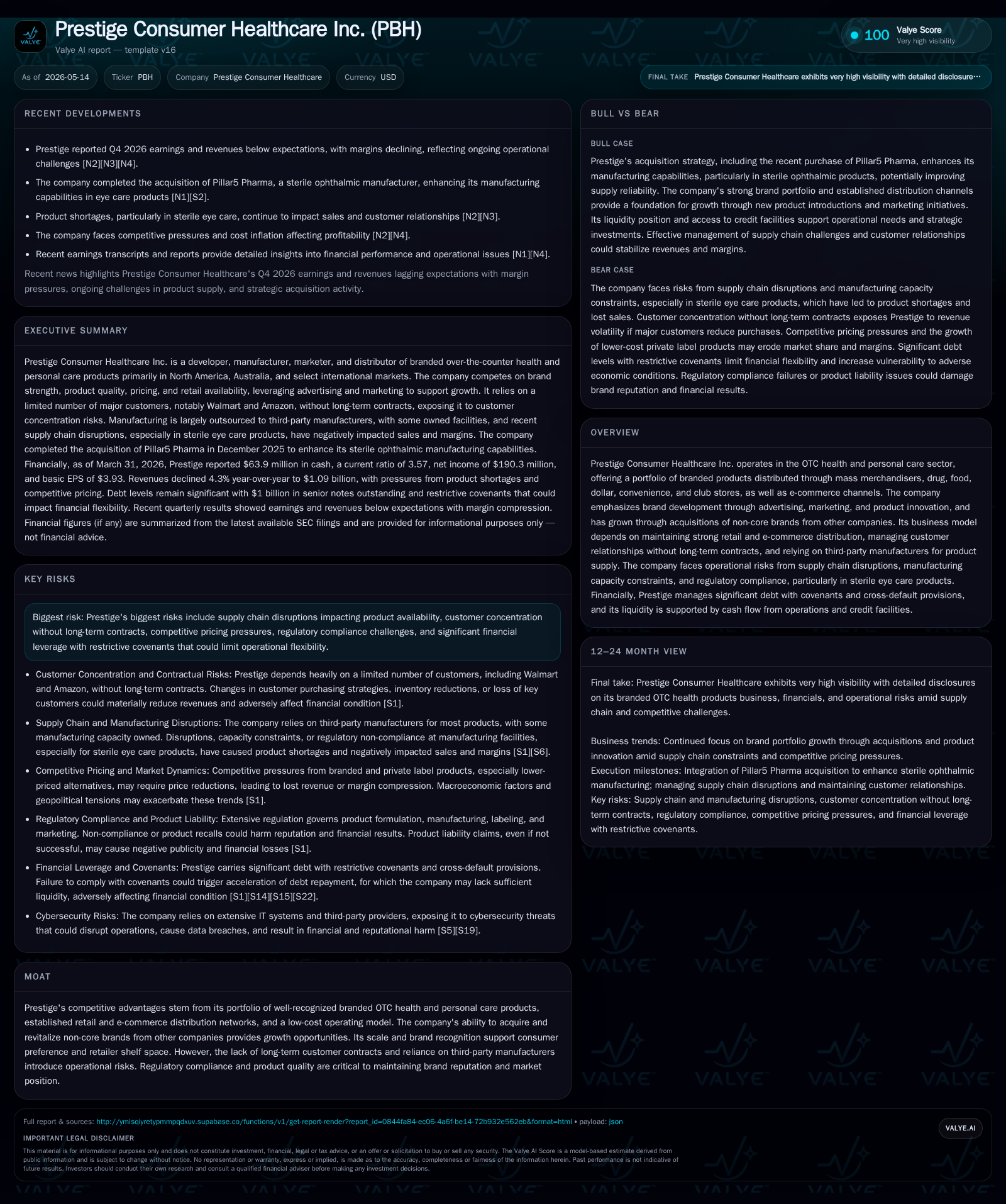
Prestige Consumer Healthcare's latest quarterly results reveal ongoing supply chain disruptions, especially in eye care products, impinging on sales and operational performance. The company pursues growth through acquisitions, including a recent deal for a sterile ophthalmic manufacturer and a pending transaction to acquire notable OTC brands like Breathe Right. Its business model leverages branded OTC health products distributed across diverse retail channels without long-term contracts, relying heavily on third-party manufacturers. Operational risks from supply constraints, customer concentration, and financial leverage pose watchpoints as Prestige navigates volatile economic conditions.
Recent Operating Update
Prestige Consumer Healthcare reported in its latest quarterly filing dated February 5, 2026 ([S2]) ongoing operational challenges stemming from difficulty experienced by third-party manufacturers to meet demand. These supply constraints have led to persistent product shortages notably in eye care categories—a critical segment for Prestige—and continue to weigh on sales performance. The company signaled expectations that these shortages will likely persist near-term.
General and administrative expenses rose modestly by $5 million for the nine months ended December 31, 2025 vs prior year primarily driven by increased allowance for doubtful accounts related to one customer and higher compensation plus acquisition-related costs. Depreciation & amortization were consistent year-over-year.
Further developments disclosed on May 13, 2026 ([S3]) included execution of a definitive agreement for the acquisition of assets primarily related to the Foundation Consumer Brands’ OTC portfolio encompassing well-known names such as Breathe Right®. This deal is expected to close in the first half of fiscal 2027 ([S1], [S12]). The acquisition represents strategic expansion through adding complementary consumer health brands.
Business Model
Prestige’s core business involves developing, marketing, selling, and distributing branded over-the-counter (OTC) health and personal care products predominantly within North America and Australia. Its offerings span multiple categories including eye care (Clear Eyes), cold remedies (e.g., Chloraseptic), feminine products (Summer's Eve), hydration products (Hydralyte), wound care (Compound W), among others ([S1]).
Revenue is generated by selling finished goods primarily through mass merchandisers, drug stores, dollar chains, food outlets, convenience stores, club stores, and increasingly e-commerce platforms—reflecting shifting consumer purchase behaviors ([S1], [S2]). The company invests significantly in advertising support and product innovation aimed at driving consumer preference and shelf visibility.
Notably Prestige does not operate under long-term contractual agreements with its retail customers; instead it relies on maintaining solid relationships via distribution availability and robust marketing. This distribution breadth combined with well-recognized brands constitutes a central competitive advantage ([S1], [S2]).
Manufacturing is outsourced mostly to third-party partners; Prestige has taken steps towards vertically integrating some production capabilities as shown by its December 2025 acquisition of Pillar5 Pharma—a sterile ophthalmic manufacturer supplying Clear Eyes products—thereby aiming to mitigate supply risks tied to key inputs ([S2], [S12]).
Industry Structure & Competitive Position
The OTC health sector is highly fragmented with competitors ranging from large CPG/pharma conglomerates to niche players. Retail shelf space is fiercely contested with private-label generics presenting increasing pricing pressure. Consumer sensitivity towards price coupled with inflationary macro forces influences purchasing behavior toward lower-cost alternatives at times ([S15]).
Prestige’s portfolio benefits from strong brand equity accumulated over years alongside established retail networks allowing it relatively secure access across diverse channels. Its low-cost operating model helps sustain margins despite competitive dynamics.
However operational dependence on a limited number of critical suppliers creates vulnerability—as evidenced by recent manufacturing capacity problems impacting sales and potentially threatening shelf presence should stock-outs persist ([S15], [S16], [S18]). Regulatory scrutiny also demands continuous compliance efforts especially given pharmaceutical-like controls applicable in sterile product lines.
Growth Drivers
Acquisition-Led Expansion:
Prestige actively pursues accretive acquisitions targeting established but non-core brands neglected by previous owners. This build strategy supplements organic growth through broadened brand portfolios enabling cross-promotion opportunities. Recent acquisition of Pillar5 Pharma enhances control over critical eye care product quality and supply chain resilience ([S1], [S2], [S12]). Pending acquisition of Foundation Consumer Brands’ portfolio slated for FY27 could provide further scale and diversification.
Brand Revitalization & Innovation:
Post-acquisition initiatives focus on reinvigorating acquired brands via increased advertising spend appropriately targeted marketing campaigns, new product line introductions/extensions, packaging redesigns, formulation improvements, all intended to capture incremental market share within existing channels while exploring new distribution avenues including e-commerce ([S1],[S2]).
Channel Diversification & E-commerce Penetration:
Shifts in consumer buying toward online channels present both opportunity and risk; Prestige’s adaptation to omni-channel distribution models aims to exploit growth as digital penetration grows while sustaining traditional retail shelf presence through sales force effectiveness ([N1],[N4],[N7]).
Risks / Watchpoints / Growth Constraints
Supply Chain Disruptions:
Continuing inability of third-party manufacturers to fulfill demand—especially seen in eye care category—poses most immediate operational threat affecting revenue continuity and retailer confidence. Efforts to onboard additional suppliers or bring more manufacturing in-house face timing lags and regulatory hurdles ([S15],[S18],[N2]).
Customer & Supplier Concentration:
A few customers represent significant sales volumes without binding long-term contracts increasing exposure if purchasing policies shift or if alternative private label offers erode shelf space. Similarly concentration among top-tier suppliers accounting for ~60% gross sales heightens operational vulnerability ([S15],[S22]).
Financial Leverage & Covenant Restrictions:
With net debt approaching $936 million against cash reserves of ~$64 million as of March 31, 2026 ([F1]), Prestige carries considerable financial leverage constrained by restrictive covenants binding capital actions such as dividend payments or additional debt issuance. Failure to comply with fixed charge ratios or cross-default provisions could trigger acceleration of repayment obligations an existential risk ([S4],[S10],[S11],[S20],[F1]).
Regulatory & Litigation Exposure:
Product liability risks including recalls or allegations may harm reputation while regulatory enforcement on product claims intensifies under FTC/FDA scrutiny potentially impacting marketing freedom or leading to expense increases ([S15],[S16],[S19],[N3]).
Macroeconomic Uncertainty:
Global inflationary pressures together with geopolitical conflicts disrupt raw material availability/shipping costs challenging margin stability. Consumer shifts toward cheaper alternatives can depress pricing power undermining financial returns ([N10],[N12],[N3],[N7]).
What To Watch Next
- Completion of the Foundation Consumer Brands acquisition expected within first half FY27 will be pivotal in expanding Prestige’s footprint into nasal strips (Breathe Right) category enhancing adjacency coverage.
- Progress resolving third-party manufacturing bottlenecks especially for eye care lines will influence near-term sales recovery dynamics; supplier diversification or internal capacity expansions could signal operational strengthening.
- Retailer shelf space retention metrics alongside online ranking trends provide early indicators of brand competitiveness against private labels.
- Quarterly general & administrative expense trends reflecting integration costs or doubtful accounts provisions offer visibility into credit risk management.
- Covenant compliance monitoring amid debt reduction efforts imperative given cross-default risks; any signs of breach would be materially consequential.
- Evolving macro conditions impacting consumer discretionary spending patterns could affect volume/mix going forward.
Financial Profile Summary
Latest financial snapshot
| Metric | Value | Period |
|---|---|---|
| Cash & equivalents | $64mm | |
| 2026-03-31 | ||
| Total debt | $1000mm | |
| 2026-03-31 | ||
| Net debt | $936mm | |
| 2026-03-31 | ||
| Current assets | $431mm | |
| 2026-03-31 | ||
| Current liabilities | $121mm | |
| 2026-03-31 | ||
| Current ratio | 3.57x | |
| 2026-03-31 |
Source: SEC companyfacts cache [F1].
As of fiscal quarter ended March 31, 2026 ([F1]), Prestige reported cash & equivalents of approximately $64 million against total debt of about $1 billion, resulting in net debt near $936 million.
Acquisitions propelled investing cash outflows which surged by over $119 million year-on-year representing strategic deployment for growth including Pillar5 purchase. Financing activities consumed less cash compared to previous periods largely due to reduced net debt repayments offset partially by share buybacks.
This analysis synthesizes recent SEC disclosures up through May 14, 2026 together with secondary public reporting references that highlight prestige’s operational challenges amidst strategic initiatives to bolster its market position through acquisitions and brand management. Supply chain resilience remains the most pressing short-term constraint whereas longer-term outcomes pivot critically on integration success, category extension efficacy and regulatory compliance vigilance.
Disclaimer: This report is prepared solely for informational purposes without any investment advice or recommendations. It reflects publicly filed information as sourced but does not endorse any security or issuer discussed.
Disclaimer: This is research-only, informational analysis and not investment advice. It may include AI-generated interpretation and general industry context. Always verify important details using primary sources.

Comments