
AnaptysBio Focuses on Royalty Streams Post Spin-Off with High Dependence on GSK’s Jemperli
Following its April 2026 spin-off, AnaptysBio concentrates on managing royalty revenues from licensed products, primarily GSK’s Jemperli, while navigating collaboration risks and patent challenges.
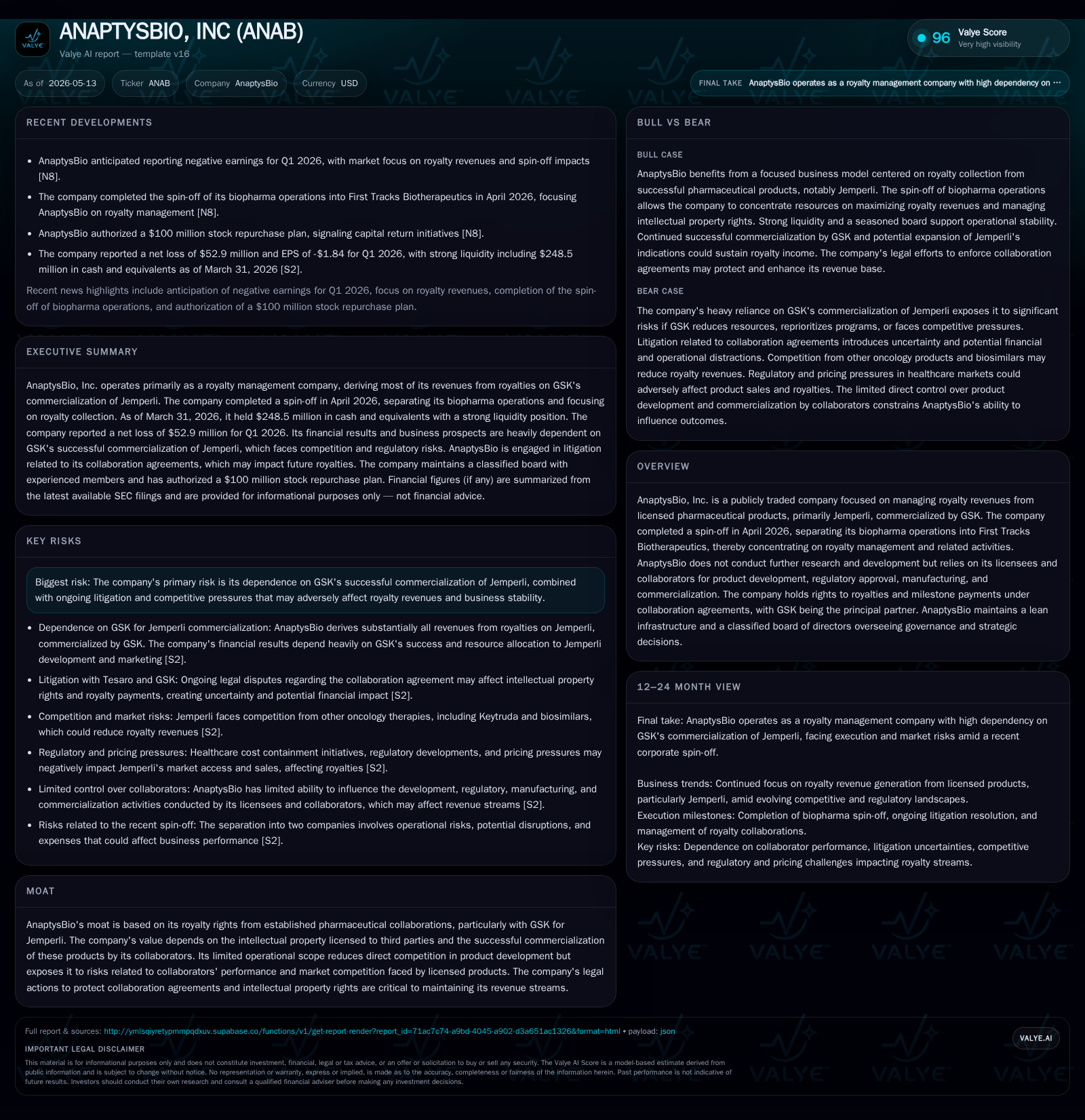
AnaptysBio recently completed a strategic spin-off that separated its biopharma development operations into First Tracks Biotherapeutics, leaving AnaptysBio as a lean royalty management entity. Its primary revenue source stems from royalties tied to GSK’s commercialization of Jemperli, making the company highly dependent on GSK’s execution and market performance. The business model pivots away from R&D towards intellectual property licensing and royalty collection. Key risks include reliance on collaborator success, ongoing litigation, and the inherent uncertainties in patent protection and enforcement. Near-term growth drivers hinge largely on sustained sales momentum of Jemperli and potential milestone payments. The company maintains strong liquidity with no reported debt, positioning it to manage operational expenses and strategic initiatives with a streamlined cost base.
Recent Operating Update
AnaptysBio's most recent quarterly filing dated May 12, 2026 [S2], alongside a contemporaneous event report [S3], reveals the company's transition to a royalty-focused entity following its April 2026 spin-off. This structural change separated AnaptysBio’s research-intensive biopharmaceutical operations into a new independent public company named First Tracks Biotherapeutics. Consequently, AnaptysBio refocused strategically onto managing royalty payments derived principally from licensed pharmaceutical products — specifically Jemperli, commercialized by GSK.
This spin-off marks a critical shift: AnaptysBio no longer actively engages in drug research, development, or commercialization but rather oversees existing licensing agreements and collects corresponding revenue streams. The May quarterly filing highlights that the company's financial results are now chiefly influenced by the performance of GSK’s marketed assets under license agreements [S2].
Business Model
AnaptysBio functions as a royalty management company infused with the intellectual property rights it previously developed. Its revenue stems exclusively from contractual royalties and milestone payments agreed upon with licensees like GSK. These payments are contingent upon successful market commercialization of licensed products.
The core asset is the royalty-bearing license for Jemperli — an oncology immunotherapy drug approved in multiple territories for cancer treatment indications. AnaptysBio licenses out patent portfolios related to Jemperli to GSK, who assumes responsibility for development costs, regulatory processes, production logistics, marketing efforts, and sales operations.
Because AnaptysBio has divested internal R&D resources post-spin-off [S1], its cost structure is significantly leaner; operating expenses largely relate to administration, legal proceedings concerning intellectual property rights protection, and monitoring collaborator agreements.
Revenue mechanics depend on:
- Royalties paid as a percentage of net product sales by licensees,
- Milestone payments triggered by regulatory progress or sales volume achievements,
- Potential sublicensing arrangements handled by collaborators.
Margins are expected to be high due to minimal direct operational costs; however, cash conversion depends heavily on timely payments from partners.
Industry Structure and Competitive Position
Within the broader biopharma licensing ecosystem, AnaptysBio occupies a specialized niche focused exclusively on IP monetization rather than drug creation or marketing. This post-spin-off form situates it among pure-play royalty companies that leverage their patent estates through partnership-driven models.
Its dominant collaboration with GSK positions it squarely inside large pharmaceutical dynamics where partner investment priorities shape revenue outlooks. However, this reliance creates concentration risk — if GSK deprioritizes Jemperli or encounters setbacks in commercialization or regulatory domains, AnaptysBio's revenues could be directly impacted [S2].
Jemperli competes within oncology immunotherapy markets against both established drugs (including other checkpoint inhibitors) and emerging treatments developed by competitors or even GSK itself [S2]. This competitive pressure influences royalty income prospects.
Patent strength offers partial moat protection but requires continuous legal vigilance. Since AnaptysBio does not control patent prosecution directly — these activities reside with licensees/collaborators — its ability to influence intellectual property strategy is limited [S10],[S23]. Litigation risks exist due to possible validity challenges or infringement disputes common in pharma IP landscapes.
Growth Drivers
AnaptysBio's growth fundamentally ties back to:
- GSK's commercial success with Jemperli: The size and growth of royalty revenues hinge on product sales volume expansion across approved geographies.
- Regulatory milestones: Attaining new approvals or label expansions can unlock substantial milestone payments.
- Additional licensing agreements: Potential future partnerships could add diversified royalty streams.
- Patent portfolio maintenance: Effective protection prolongs exclusivity periods essential for sustained royalties.
Given that the company's own product pipeline resides fully within First Tracks Biotherapeutics post spin-off [S1],[N12], all future upside depends materially on collaborator execution efficiency and market uptake.
Risks / Watchpoints / Growth Constraints
The following risks merit close attention:
- Highly concentrated revenue source: Overwhelming dependency on GSK for royalties creates vulnerability if commercial outcomes falter [S2].
- Collaborator reprioritization: Should GSK shift focus away from Jemperli or reallocate budgets internally, AnaptysBio faces material earnings pressure [S25].
- Competitive intensity: Rival therapies may erode market share or induce pricing pressures harming sales volumes [S2].
- Intellectual property challenges: Patent validity disputes or adverse litigation outcomes could diminish royalty entitlements [S10],[S23].
- Limited operational control: Lack of direct influence over clinical development or commercialization may delay response times to market changes.
- Spin-off execution residuals: Post-separation complexities around governance and transition services may impose incremental costs or operational hurdles currently underway [S1],[S26].
- Stock price volatility: Given dependence on single-product royalties amid biotech sector fluctuations, equity remains susceptible to wide price swings [S2].
What To Watch Next
Investors should monitor:
- Quarterly updates from both AnaptysBio and GSK regarding Jemperli sales volumes and geographical expansion.
- Regulatory announcements tied to additional label indications or market approvals potentially triggering milestone revenues.
- Intellectual property developments including lawsuits or patent oppositions affecting licensed assets.
- Any new partnership deals or changes in existing collaboration terms that might diversify or reduce concentration risk.
- Financial disclosures for signs of cash flow stability alongside operating expense trends reflecting lean infrastructure maintenance.
Financial Profile (Latest Quarter Snapshot)
Latest financial snapshot
| Metric | Value | Period |
|---|---|---|
| Cash & equivalents | $248mm | |
| 2026-03-31 | ||
| Current assets | $316mm | |
| 2026-03-31 | ||
| Current liabilities | $42mm | |
| 2026-03-31 | ||
| Current ratio | 7.58x | |
| 2026-03-31 |
Source: SEC companyfacts cache [F1].
As of March 31, 2026 ([F1]), AnaptysBio reported strong liquidity:
| Metric | Value (USD) | Period End |
|---|---|---|
| Cash & Equivalents | 248,469,000 | |
| 2026-03-31 | ||
| Current Assets | 316,109,000 | |
| 2026-03-31 | ||
| Current Liabilities | 41,702,000 | |
| 2026-03-31 | ||
| Current Ratio | 7.58 | |
| 2026-03-31 |
In conclusion, AnaptysBio in mid-2026 stands as a focused royalty firm reliant chiefly upon GSK's stewardship of Jemperli commercialization. Its streamlined business model benefits from reduced cost base but faces inherent risks stemming from collaborator dependency and pharma IP complexity. Sustained licensee performance and regulatory progress will define its growth trajectory while vigilant governance over patents remains essential to protecting value streams moving forward.
This analysis is based solely on publicly available filings dated through May 13, 2026. It does not constitute investment advice or an offer to buy/sell securities.
Disclaimer: This is research-only, informational analysis and not investment advice. It may include AI-generated interpretation and general industry context. Always verify important details using primary sources.

Comments