
Lixte Biotechnology Advances LB-100 Trials and Restructures Executive Incentives Amid Clinical Milestones
Recent quarterly updates reveal clinical trial progress on LB-100 and executive compensation adjustments shaping Lixte's development outlook.
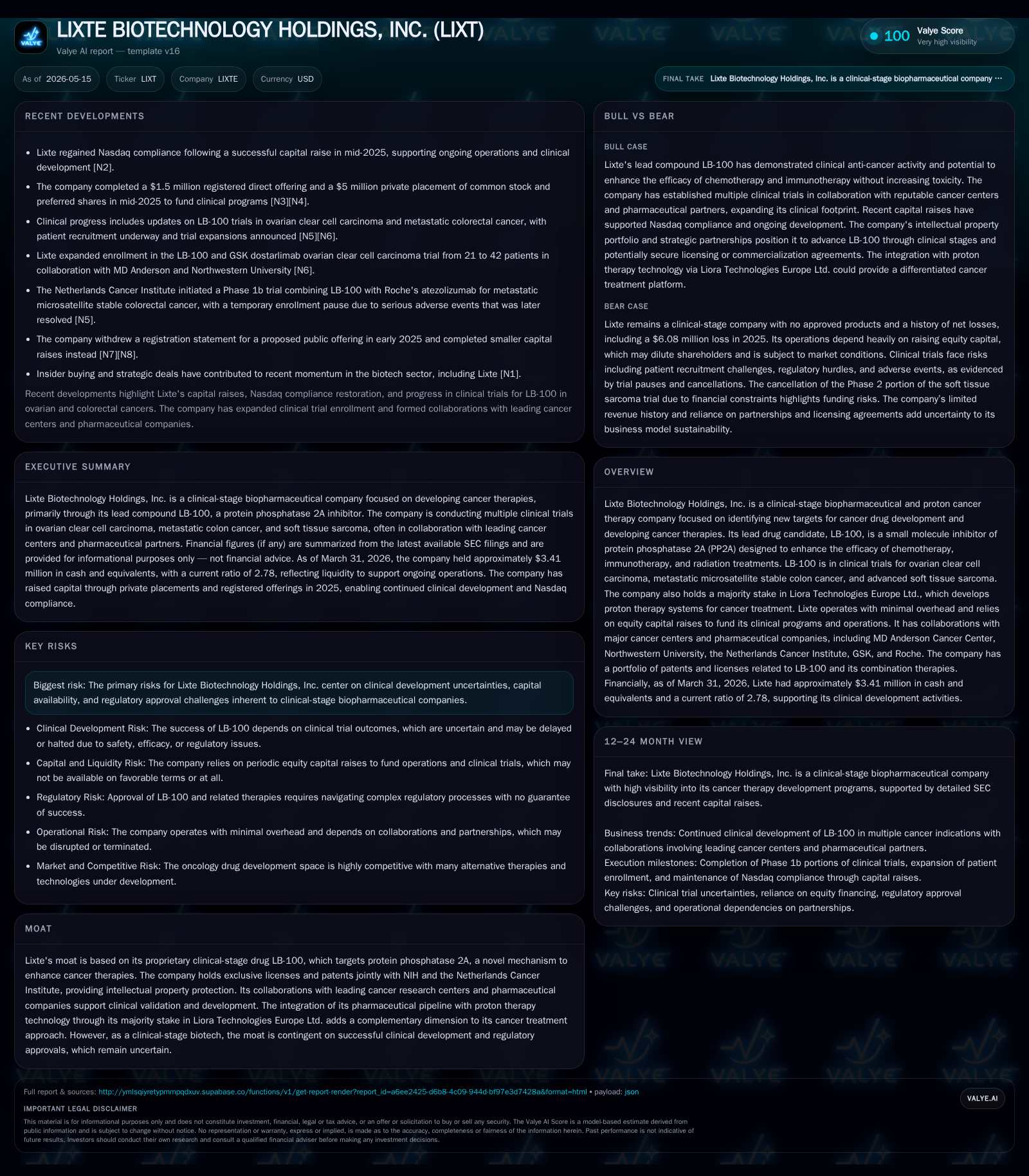
Lixte Biotechnology Holdings, Inc. reported continued clinical advancement of its lead candidate LB-100 across multiple cancer indications in its May 2026 quarterly filing, highlighting enrollment progress in key trials at MD Anderson and the Netherlands Cancer Institute. The company has refined its executive compensation by replacing stock options with vested restricted share units to enhance retention. Lixte's core business model revolves around the clinical development of PP2A inhibitor LB-100 and its strategic stake in proton therapy technology through Liora Technologies Europe. Growth hinges on progressing LB-100’s clinical trials towards regulatory milestones while managing capital needs inherent to clinical-stage biotech firms.
Recent Operating Update
Lixte Biotechnology Holdings’ latest quarterly filing dated May 14, 2026 [S2] reinforced the company’s forward momentum in its clinical programs centered on LB-100, a small molecule protein phosphatase 2A (PP2A) inhibitor. The company disclosed active patient recruitment and dosing across multiple Phase 1b trials targeting ovarian clear cell carcinoma (MD Anderson), metastatic microsatellite stable (MSS) colon cancer (Netherlands Cancer Institute), and advanced soft tissue sarcoma (GEIS Group). Notably, the trial with the Netherlands Cancer Institute commenced patient enrolment in August 2024, with ongoing efforts to determine the recommended Phase 2 dose in combination with Roche’s atezolizumab immunotherapy [S1].
Alongside these studies, Lixte announced via the April 17, 2026 8-K [S3] a significant shift in executive compensation structure: cancellation of previously granted stock options for key officers and directors was replaced with fully vested restricted share units (RSUs). This move aims to strengthen retention incentives aligned with shareholder interests without relying on longer-term option vesting schedules.
There were no recent changes in the risk profile since the March 31, 2026 annual report [S1], maintaining existing concerns related to regulatory approval uncertainty, funding requirements for ongoing trials, and general operational risks intrinsic to clinical-stage biotechnology.
Business Model
Lixte operates primarily as a clinical-stage biopharmaceutical enterprise focused on developing LB-100—a novel PP2A inhibitor designed to sensitize tumors to chemotherapy, immunotherapy agents like immune checkpoint inhibitors, and radiation treatment modalities. The approach targets a relatively underexplored cancer biology mechanism known as activation lethality, which paradoxically overdrives oncogenic signaling pathways rendering tumors more vulnerable to treatment.
The company generates value by advancing LB-100 through phased clinical trials via collaborations with premier oncology institutions such as MD Anderson Cancer Center and Netherlands Cancer Institute. These partnerships not only facilitate trial execution but also reinforce IP protection regimes supported by licenses co-held with NIH and the Netherlands Cancer Institute [S1].
Besides its drug development focus, Lixte holds a controlling interest in Liora Technologies Europe Ltd., a developer of the LiGHT System—an image-guided linac technology for precision proton therapy. The synergy between pharmaceutical innovation and sophisticated radiation technology positions Lixte uniquely within cancer treatment modalities.
Fundamentally, revenue generation is currently non-existent; all operations are funded through equity capital raises timed alongside attainment of key program milestones reflecting increasing compound value as it progresses towards regulatory approval stages.
Industry Structure and Competitive Position
Within the oncology therapeutic landscape, Lixte occupies a niche focusing on PP2A inhibition as an adjunct to existing cytotoxic and immune therapies. This distinct mechanism differentiates it from companies pursuing more common kinase inhibitors or direct cytotoxic agents.
The biopharmaceutical sector for oncology drugs is intensely competitive with numerous players advancing immune checkpoint inhibitors or targeted therapies; however, few have exploited activation lethality as a strategic therapeutic approach. Securing IP exclusivity through patents jointly managed with established research entities provides moderate moat protection contingent on favorable clinical outcomes.
Ownership of proton therapy technology via Liora Technologies adds vertical diversification uncommon among small specialty biotech firms. Given proton therapy’s high capital intensity and technological complexity, Lixte’s involvement through this majority stake grants access to emerging image-guided hadron therapy markets potentially complementary to its pharmaceutical pipeline.
Growth Drivers
Clinical Trial Progression
Clinical success trajectory for LB-100 across ovarian clear cell carcinoma, metastatic MSS colon cancer, and soft tissue sarcoma will critically define future growth. Preliminary efficacy signals expected by late-stage Phases can unlock licensing partnerships or strategic alliances that bring in non-dilutive funding and expertise.
Collaborations With Leading Oncology Centers
Partnerships with MD Anderson and Netherlands Cancer Institute enable efficient trial enrollment, access to specialized patient populations, shared data insights, and leverage regulatory credibility — supporting accelerated clinical development timelines.
Intellectual Property Expansion
Ongoing patent portfolio expansion around LB-100 enhances valuation potential by extending exclusivity periods covering molecule use combinational settings.
Integration With Proton Therapy Platform
Development progress at Liora Technologies Europe could open cross-selling opportunities for combined modality protocols leveraging both pharmacologic sensitization and precise proton delivery against cancers.
Risks / Watchpoints / Growth Constraints
The most material uncertainties revolve around:
- Clinical Trial Outcomes: Failure or delays in demonstrating safety/efficacy markers could stall or terminate development efforts given no alternative revenue streams exist.
- Capital Requirements: As an overhead-minimized clinical-stage entity relying on equity financings tied to milestones [S1], potential market volatility or investor appetite shifts could constrain runway.
- Regulatory Approval Hurdles: FDA clearance demands rigorous evidence gathering; any setbacks impact timelines significantly.
- Competition: Other biotechs or pharma companies pursuing similar combination therapies or alternative mechanisms may saturate trial recruitment pools or capture licensing interest first.
- Operational Complexity: Balancing drug development alongside proton therapy tech investments requires adept management oversight amid limited resources.
- Legal Contingencies: Past settlements ($100k expense recognized per FY25) illustrate potential unforeseen liabilities impacting finances marginally but underscore governance vigilance [S1].
What to Watch Next
Key near-to-mid term indicators include:
- Interim Phase 1b data releases from LB-100 combination trials (MSS colorectal at NKI; ovarian clear cell at MD Anderson).
- Initiation plans for Phase 2 randomized trials assessing expanded efficacy metrics particularly progression-free survival endpoints.
- Updates from Liora Technologies on engineering milestones or regulatory submissions related to LiGHT System commercial readiness.
- Further adjustments to executive compensation plans evidencing governance adaptations optimizing talent retention.
- Capital markets activity reflective of funding sufficiency necessary for sustained trial progression.
Financial Profile Contextualization
Latest financial snapshot
| Metric | Value | Period |
|---|---|---|
| Current assets | $3mm | |
| 2026-03-31 | ||
| Current liabilities | $1224934 | |
| 2026-03-31 | ||
| Current ratio | 2.78x | |
| 2026-03-31 |
Source: SEC companyfacts cache [F1].
As of March 31, 2026 [F1], Lixte held current assets totaling approximately $3.4 million against current liabilities near $1.2 million—a conservative balance sheet yielding a robust current ratio of about 2.78 indicative of reasonable short-term liquidity coverage amidst operating burn typical for clinical-stage biotech.[F1]
Operating losses remain significant given ongoing R&D expenses without corresponding top-line revenues—the last recorded revenue point stems from preclinical service income dating back over a decade ago [F1]. The company’s financial strategy hinges on milestone-driven equity issuances sustaining pipeline advancement rather than internal cash flow generation.
This financial posture aligns with sector norms where biotech entities experience long development cycles prior to product commercialization phases or partnership monetization events.
This report is provided for informational purposes only based on publicly available filings and does not constitute investment advice.
Disclaimer: This is research-only, informational analysis and not investment advice. It may include AI-generated interpretation and general industry context. Always verify important details using primary sources.

Comments