
Mobile Infrastructure Faces Revenue Headwinds and Debt Pressures in Latest Quarter
Q1 2026 results underscore challenging parking demand and heavy leverage pressures for Mobile Infrastructure Corp.
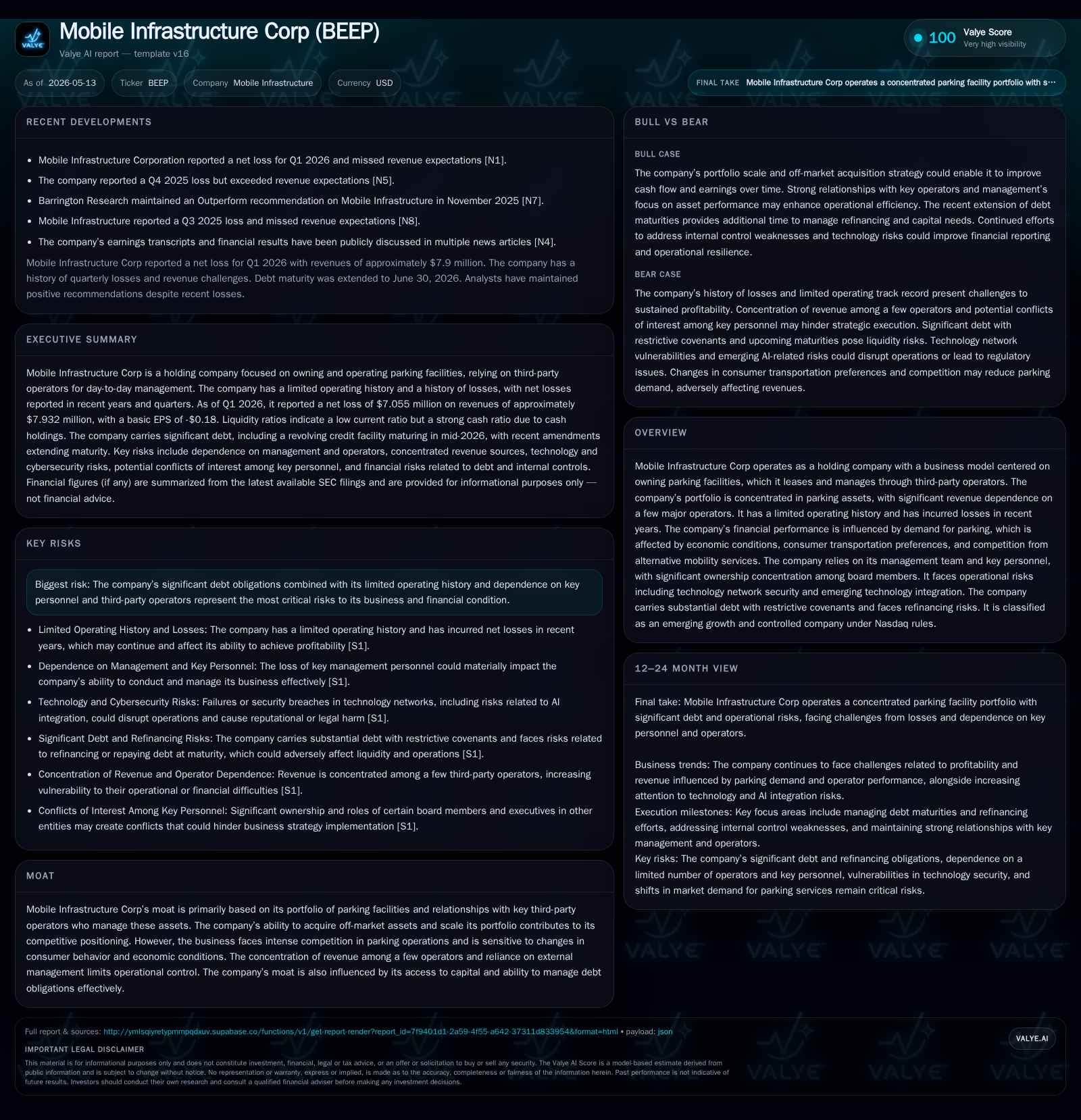
Mobile Infrastructure Corp reported a first quarter marked by missed revenue estimates and continuing net losses, highlighting ongoing operational challenges amid shifting parking demand dynamics. The company's business model relies heavily on third-party operators managing a concentrated portfolio of parking facilities, which limits direct control and exposes it to operator performance risks. Additionally, Mobile Infrastructure faces significant financial constraints from a substantial debt load and an imminent credit facility maturity, raising refinancing uncertainties. Near-term growth hinges on effective asset management, potential portfolio expansion, and navigating financial pressures while adapting to evolving mobility trends.
Q1 2026 Operating Update: Missed Targets and Persistent Losses
Mobile Infrastructure Corp’s first quarter ended March 31, 2026, revealed that the company continues to face pronounced revenue challenges and persistent net losses. According to the filings dated May 12, 2026 ([S2], [S3]), the company failed to meet revenue estimates amid weaker-than-expected parking demand. The available press releases highlight that this softness reflects both macroeconomic factors affecting consumer transportation choices and localized competitive pressures.
Despite ongoing efforts to optimize operations through collaborations with third-party operators, Mobile Infrastructure reported no improvement toward profitability in the latest quarter, reinforcing the fragility rooted in its current business setup. This operating update is particularly telling because it comes after a full year ending December 2025 where the company posted $35.1 million in revenue but suffered a daunting $21.4 million net loss ([F1]). The quarterly results compounded concerns about the company's ability to stabilize cash flows or expand margins given these continuing headwinds.
Business Model Overview: Concentrated Portfolio and Third-Party Leasing Dynamics
Mobile Infrastructure functions primarily as a holding company that owns parking facilities but does not directly operate them. Instead, it leases these assets to third-party operators who handle day-to-day management ([S1]). This structure inherently restricts Mobile Infrastructure's operational control over price setting, customer experience, and utilization optimization.
The portfolio’s revenue stream is heavily concentrated among two major operators—Metropolis and LAZ—which comprised approximately 63.1% and 16.8% of parking revenue respectively for fiscal year 2025 ([S26]). Such concentration sharpens risks tied to operator performance variability including efficiency, financial stability, and contract renewal terms.
Furthermore, most of the company’s assets (28 of 36 properties) are under management contracts rather than long-term leases, increasing exposure to fluctuations in operating agreements' terms or sudden operator withdrawal ([S26], [S18]). This dependency makes Mobile Infrastructure vulnerable not only to direct economic shifts in parking demand but also operational risks stemming from external managers’ capabilities.
Competitive Landscape: Parking Asset Management Amid Emerging Mobility Trends
The parking asset management sector is grappling with structural change as urban transportation evolves rapidly. Traditional parking demand is under pressure from increasing adoption of ride-sharing services, micromobility options (e.g., e-bikes and scooters), public transit improvements, and electric vehicle infrastructure expansion. These trends collectively dilute utilization rates for fixed parking infrastructure like that owned by Mobile Infrastructure ([S1] analysis).
Pricing power is constrained because competitors—including municipal garages and private operators—often compete heavily on price or convenience enhancements supported by digital platforms, making operator execution critical for maintaining occupancy levels. The firm’s lack of direct operational involvement reduces its agility compared to vertically integrated competitors or those adopting technology-centric management approaches.
Growth Drivers and Strategic Opportunities
Mobile Infrastructure’s growth path is primarily tied to expanding its portfolio through off-market acquisitions at favorable valuations—an area where management aims to leverage relationships for proprietary deal flow ([S1]). Additionally, improving collaboration with existing operator partners to enhance business plans for each facility could modestly boost cash flow and incremental revenue.
Potential exists around integrating emerging technologies within properties (e.g., automated payment systems, AI-driven space allocation) but specifics remain unelaborated at this stage. Given the company’s limited operating history with active facility management, technology adaptation may be slow or reliant on third parties.
Key performance indicators such as lease renewal rates with dominant tenants Metropolis and LAZ, occupancy/utilization statistics at core sites, and backlog/order pipeline for acquisitions will be crucial metrics signaling any inflection.
Risks and Constraints: Debt Burden, Concentration, and Market Demand Uncertainties
A defining risk factor is Mobile Infrastructure’s high leverage level: total debt stood near $189 million at quarter-end March 31, 2026 versus only around $8.5 million cash on hand ([F1]). The resultant net debt position (~$180.9 million) underscores significant refinancing risk given the imminent maturity of a $25.9 million revolving credit facility scheduled for March 31, 2026 ([S4], [S5], [S12]).
Failure to refinance or extend this facility on acceptable terms could trigger defaults under restrictive covenants embedded within various loan agreements ([S4], [S5]).
Other operational constraints include operator concentration risk alongside governance challenges arising from a shareholder with over 50% voting power controlling board decisions ([S1]). Conflicts related to executive leadership’s interests also compound strategic execution uncertainties. Lastly, weak liquidity ratios (approximate current ratio at 0.04 based on mid-2023 metrics) further reflect constrained working capital flexibility ([F1]).
Upcoming Catalysts and Monitoring Points
Investor focus should concentrate on several near-term markers:
- Progress in refinancing or extending the March 2026 credit line maturity through potential asset sales or alternative debt issuance,
- Updates on leasing agreements or renewals with principal operators Metropolis and LAZ,
- Second quarter operational results which may provide clearer signal on parking demand stabilization or deterioration,
- Any announcements regarding portfolio acquisitions or disposals that demonstrate strategic decisiveness,
- Management commentary on integrating new technology solutions or diversifying asset usage linked to mobility evolution trends. These actionable milestones will help delineate if Mobile Infrastructure can mitigate near-term pressures without compromising long-term viability.
Latest Financial Snapshot
Latest financial snapshot
| Metric | Value | Period |
|---|---|---|
| Cash & equivalents | $8.5mm | |
| 2026-03-31 | ||
| Total debt | $189.4mm | |
| 2026-03-31 | ||
| Net debt | $180.9mm | |
| 2026-03-31 | ||
| Current ratio | 0.04x | |
| 2023-06-30 |
Source: SEC companyfacts cache [F1].
| Metric | Value | Period End |
|---|---|---|
| Cash & Equivalents | $8.5 million | |
| 2026-03-31 | ||
| Total Debt | $189.4 million | |
| 2026-03-31 | ||
| Net Debt | ~$180.9 million | |
| 2026-03-31 | ||
| Revenue | $35.1 million* | |
| 2025-12-31 | ||
| Net Income | -$21.4 million* | |
| 2025-12-31 |
*Note: Year-end figures preceding quarter due to data availability.
The snapshot puts into perspective the company’s stretched capital structure juxtaposed against modest annual top-line scale amid persistent net losses.
This analysis relies comprehensively on SEC filings including the latest quarterly report dated May 12, 2026 ([S2], [S3]), supported by annual disclosures ([S1]) and validated company facts ([F1]). It abstains from conjecture beyond documented evidence and industry norms relevant to parking real estate investment structures.
Disclaimer: This report is intended purely for informational purposes as internal industry research; it does not constitute investment advice or recommendations.
Disclaimer: This is research-only, informational analysis and not investment advice. It may include AI-generated interpretation and general industry context. Always verify important details using primary sources.

Comments