
Avidity Biosciences Advances RNA Therapeutics Pipeline amid Pending Novartis Merger and Spin-Off
Avidity pursues breakthrough muscular dystrophy treatments while navigating a transformative merger and corporate reorganization.
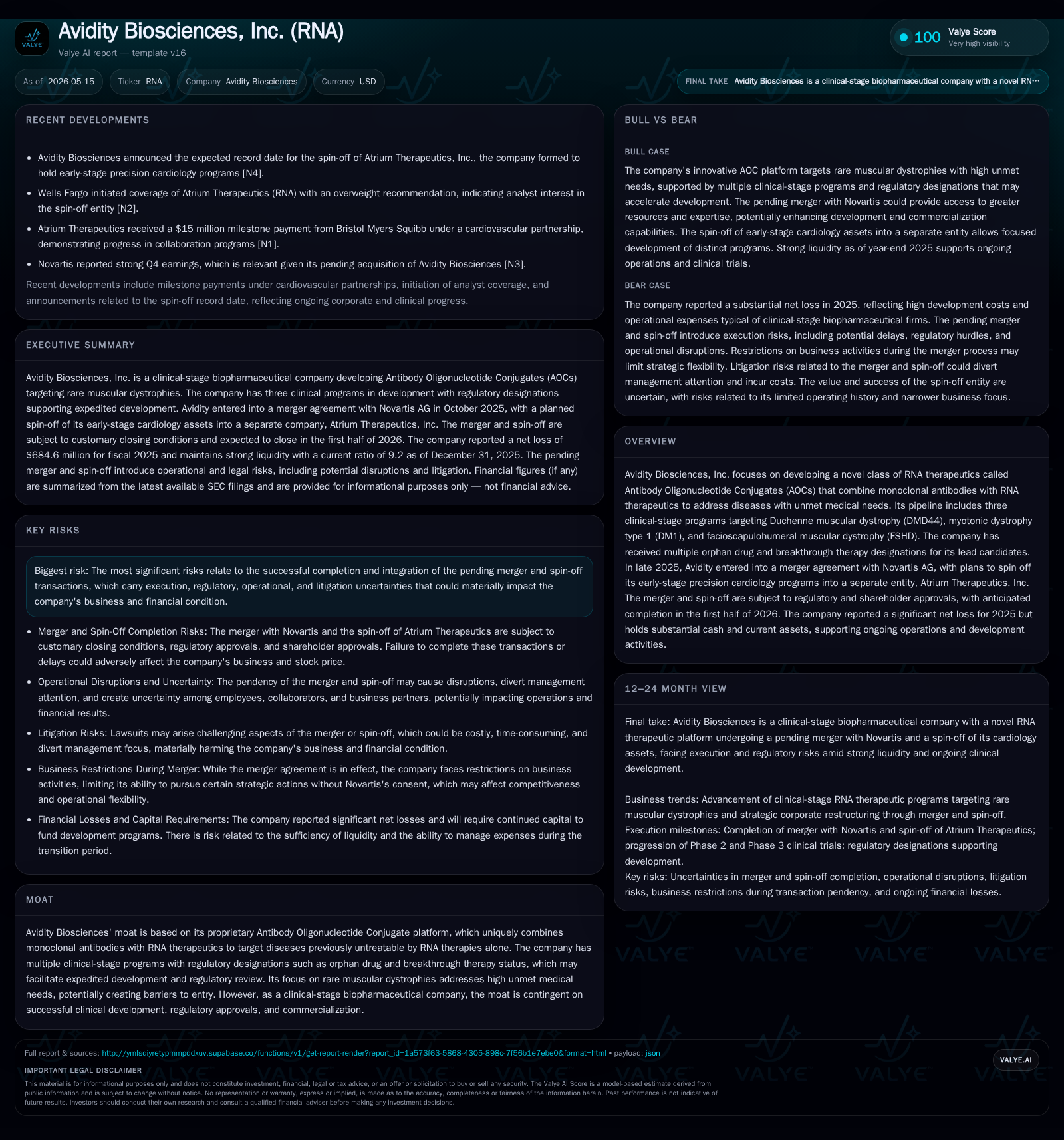
Avidity Biosciences specializes in a pioneering RNA therapeutic platform called Antibody Oligonucleotide Conjugates (AOCs), targeting rare muscular dystrophies with three key clinical-stage programs. Recent progress includes an FDA-authorized Managed Access Program for its lead Duchenne muscular dystrophy candidate and a pending merger with Novartis, alongside a planned spin-off of early-stage cardiovascular assets into Atrium Therapeutics. The success of these strategic moves, combined with clinical progress, underpins the company’s growth potential but also introduces execution and regulatory risks. Avidity maintains a robust cash position with no debt, while operating losses have increased significantly as it advances its pipeline.
Recent Operating Update
Avidity Biosciences’ latest quarterly filing as of November 10, 2025 [S2] reflects continued advancement across its three clinical-stage programs targeting neuromuscular diseases. Notably, the company launched an FDA-authorized Managed Access Program (MAP) in late 2025 for delpacibart zotadirsen (del-zota), designed for Duchenne muscular dystrophy patients amenable to exon 44 skipping (DMD44). This MAP provides early access through participating U.S. healthcare providers concurrent with ongoing trials.
Strategically pivotal is Avidity’s October 2025 announcement of a definitive Merger Agreement with Novartis AG [S1][S6], whereby Avidity will become an indirect wholly owned Novartis subsidiary. This transaction includes a spin-off of early-stage precision cardiology assets into Atrium Therapeutics (formerly Bryce Therapeutics), expected to complete in early 2026 [S13][S16][S26]. The spin-off enables focused development of cardiovascular programs separate from the core neuromuscular pipeline integrating into Novartis’s broader pharma infrastructure.
Business Model
At its core, Avidity operates an innovative biopharmaceutical platform: Antibody Oligonucleotide Conjugates (AOCs). This modality couples monoclonal antibodies’ specificity with RNA-based therapies' precision to deliver oligonucleotides selectively into disease-relevant tissues like muscle cells—an approach distinct from standalone RNA therapeutics that often suffer delivery limitations. By leveraging mAbs to direct therapeutic oligonucleotides intracellularly, AOCs aim to silence or modulate mutant genes that cause debilitating muscular diseases.
Revenue generation remains nascent as all assets are investigational. The business model anticipates value creation from clinical progression towards potential regulatory approvals and subsequent commercialization of lead AOC therapies primarily targeting rare genetic decoders—namely Duchenne muscular dystrophy (exon-specific del-zota), myotonic dystrophy type 1 (del-desiran), and facioscapulohumeral muscular dystrophy (del-brax). Revenue will ultimately depend on successfully navigating regulatory pathways supported by orphan drug status and expedited review designations.
Margins are currently negative due to heavy R&D spending required for clinical development, manufacturing scale-up of conjugated biomolecules, and compliance activities. However, the novel platform’s inherent differentiation offers potential for premium pricing and durable market capture if efficacy and safety endpoints are met.
Industry Structure and Competitive Position
The rare neuromuscular disorder market is characterized by significant unmet needs owing to historically limited treatment options. Existing competitors largely rely on small molecules or antisense oligonucleotide therapies without targeted delivery mechanisms akin to AOCs. This positions Avidity as a first-mover in antibody-conjugated RNA therapeutics within its targeted indications.
Regulatory incentives such as orphan drug status confer advantages including market exclusivity periods post-approval in major jurisdictions. Fast Track and Breakthrough Therapy designations held by several candidates further enhance the potential for accelerated development timelines relative to traditional biotech entrants.
Nevertheless, the biotech industry features high entry barriers regarding proprietary technology platforms and specialized manufacturing knowledge. Yet competition is dynamic with multiple RNA therapeutic companies pursuing delivery innovations—highlighting the importance of sustained pipeline advancement and intellectual property protection.
Growth Drivers
Pipeline Clinical Progress: Three active programs—del-zota for DMD44 is in Phase 2/registrational open-label extension; del-desiran for DM1 is undergoing global Phase 3 trials including HARBOR-OLE; del-brax for FSHD is progressing through Phase 1/2 FORTITUDE cohorts along with Phase 3 FORTITUDE-3 enrollment [S1]. Advancing these trials towards completion is critical.
Regulatory Designations: Multiple orphan drug and fast track awards plus FDA Breakthrough Therapy status for del-desiran and del-zota facilitate potentially faster reviews and real-world access pathways.
Managed Access Rollout: MAP deployment broadens patient reach pre-approval enhancing familiarity among clinicians and payors.
Strategic Collaboration & Corporate Restructuring: Merger with Novartis provides expanded resources, commercial infrastructure, and global reach; spin-off allows focused capital allocation to early precision cardiology discoveries at Atrium Therapeutics [N1].
Platform Expansion Potential: The modular nature of the AOC platform could support future indications beyond current pipeline if initial successes validate mechanism.
Risks / Watchpoints / Growth Constraints
Key risks pivot around:
Merger & Spin-Off Execution: Delays or failure in consummating transactions could disrupt operational continuity and investor confidence [S2][S17][S22]. Regulatory approvals required across jurisdictions introduce timing uncertainties.
Clinical Development Uncertainty: As an inherently high-risk sector, clinical outcomes may not meet safety or efficacy thresholds necessary for approval.
Litigation Exposure: Potential lawsuits challenging transaction terms or intellectual property disputes could divert management effort and generate significant costs [S17].
Market Competition & Pricing: Emerging RNA therapeutic modalities by established pharma or biotech could erode competitive advantages.
Regulatory Environment: Unexpected changes in drug approval policies or reimbursement practices may constrain market entry or commercial returns.
What to Watch Next
Investors should monitor:
Completion status of the Novartis merger alongside approval/finalization of the SpinCo distribution slated for February 2026 [S12][S26][S28]. These corporate milestones affect future organizational structure and capital allocation.
Readouts from pivotal trials such as ongoing EXPLORE44-OLE extension data release schedules impacting del-zota positioning.
Uptake metrics from the Managed Access Program signaling clinician acceptance prior to potential full regulatory approval.
Regulatory filings efficacy including new drug applications submissions or breakthrough therapy updates influencing pathway acceleration.
Partnership developments related to collaborations like those with Bristol Myers Squibb underpinning non-core asset monetization strategy executed through Atrium Therapeutics [N1].
Financial Profile Summary
Historical performance (annual)
Capital returns and efficiency (annual)
Avidity’s financials as reported in its FY2025 annual report filed February 23, 2026 [F1] reveal:
The substantial net loss reflects intensive investment in R&D related to advancing clinical-stage asset candidates through expensive trial phases. Operating cash flow is negative at approximately $650 million yearly indicating ongoing capital consumption without commercial revenues yet realized. Importantly, the company holds no formal debt obligations contributing to strong liquidity headroom bolstered by $383 million cash balances enabling near-term operational sustenance.
Equity has nearly tripled since FY2023 due largely to financing rounds supporting cash needs plus accumulated comprehensive losses reducing retained earnings but offset somewhat by capital inflows related to stock issuance activities surrounding merger planning phases.
Disclaimer
This analysis is intended solely for informational purposes reflecting publicly available data as of mid-2026. It does not constitute investment advice or recommendations. Readers should consider additional sources before making any decisions regarding securities mentioned herein.
Disclaimer: This is research-only, informational analysis and not investment advice. It may include AI-generated interpretation and general industry context. Always verify important details using primary sources.

Comments