
Tenax Prioritizes Oral Levosimendan as Phase 3 Trials Progress and Capital Strengthens
Tenax Therapeutics updates on Phase 3 oral levosimendan trials in PH-HFpEF with robust liquidity underpinning development.
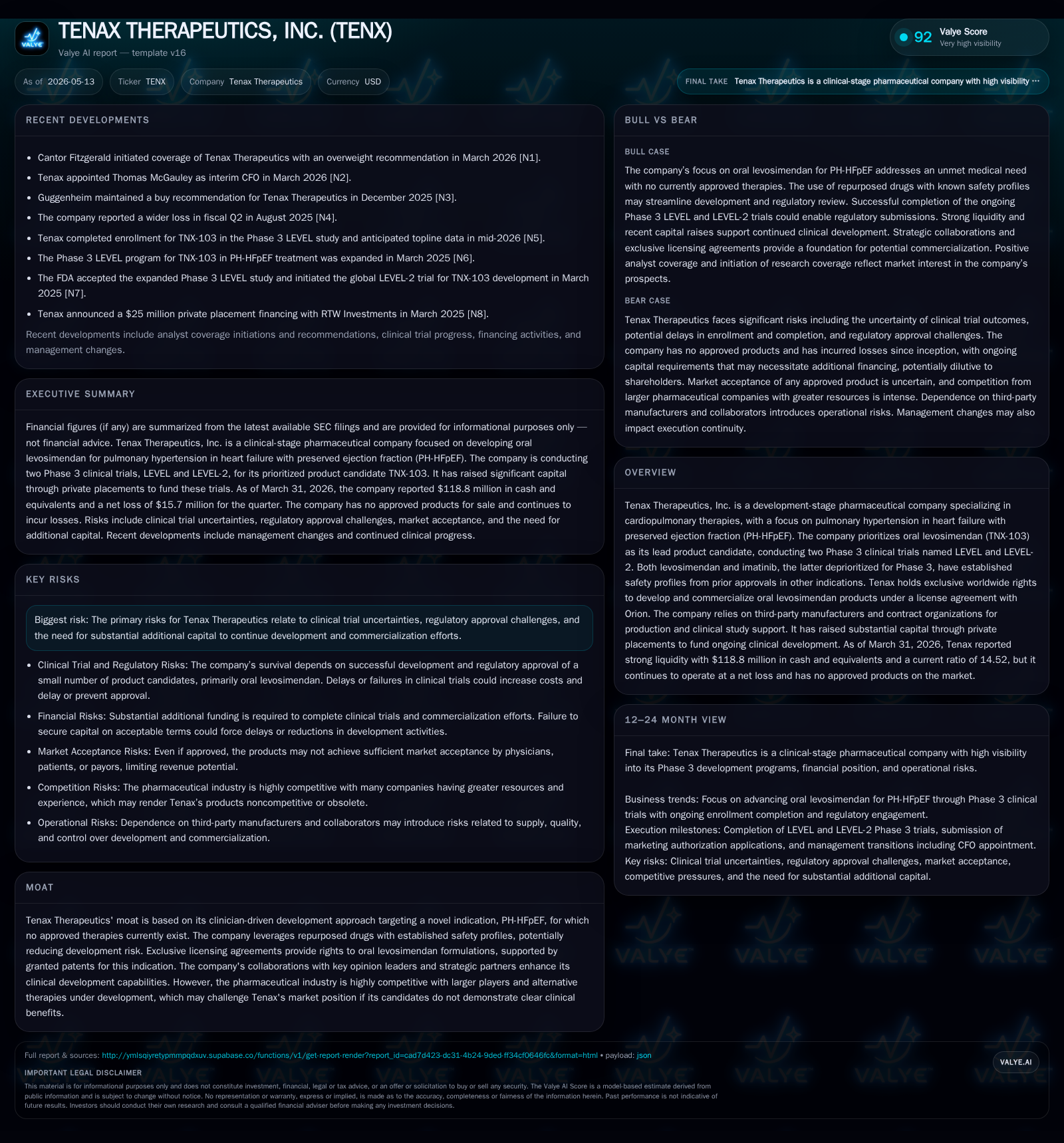
Tenax Therapeutics, focusing on oral levosimendan for pulmonary hypertension in heart failure with preserved ejection fraction (PH-HFpEF), reported steady progress in its ongoing Phase 3 LEVEL and LEVEL-2 trials as of Q1 2026. The company has deferred advancement of imatinib and strengthened its capital base through recent financing rounds, ensuring adequate runway for clinical milestones. Leveraging repurposed drugs with established safety profiles and exclusive licensing rights, Tenax targets a large unmet need in a novel indication with no approved therapies. Key risks include clinical and regulatory uncertainties alongside the necessity for future capital raises.
Latest Operating Update: Phase 3 Programs and Capital Status
In its latest quarterly filing dated May 12, 2026 [S2], Tenax Therapeutics reinforced its primary focus on advancing oral levosimendan (TNX-103) through two ongoing Phase 3 clinical studies: LEVEL and LEVEL-2. Patient enrollment continues actively, underpinning progress toward trial completion. Concurrently, Tenax has formally deprioritized further Phase 3 development of imatinib for pulmonary arterial hypertension to marshal resources effectively behind levosimendan’s advancement [S1].
The company’s recent event filing on the same date confirmed these operational priorities while incorporating details of recent capital raises [S3]. Notably, substantial gross proceeds were secured from private placements in late 2024 and early 2025 totaling upwards of $125 million combined [S1]. These funds have bolstered operational liquidity amid rising costs typical of late-stage clinical programs focused on novel cardiopulmonary indications.
The unencumbered cash position stands at $118.8 million as of March 31, 2026 [F1], providing a solid financial foundation to support anticipated clinical milestones without immediate refinancing concerns. This financial cushion affords the company flexibility to sustain extended enrollment durations or respond to regulatory requests without jeopardizing trial continuity.
Business Model: Oral Levosimendan in a Unique Pulmonary Hypertension Niche
Tenax’s business strategy hinges on the repurposing of oral levosimendan (TNX-103), targeting pulmonary hypertension complicating heart failure with preserved ejection fraction (PH-HFpEF) – an orphan cardiopulmonary condition lacking any approved pharmacological therapies, [S1]. The drug leverages a long-standing safety profile derived from over two decades of use in other indications globally.
Under an exclusive worldwide license agreement with Orion Corporation [S16], Tenax controls rights to develop, manufacture, and commercialize oral formulations of levosimendan. The company does not maintain internal manufacturing but relies extensively on third-party contract manufacturers adhering to current Good Manufacturing Practices to supply clinical trial material and planned commercial supply [S26]. This asset-light model allows focused deployment of capital towards formulation optimization, clinical development, patent protection, and commercialization infrastructure without heavy fixed manufacturing overhead.
Royalty payments structured under the Orion license introduce profitability considerations post-commercialization; tiered royalties payable on net sales could cumulatively reach substantial amounts contingent upon reaching regulatory approvals and commercial sales tiers [S1], [S16].
By centering on a de-risked compound with known pharmacodynamics but novel application, Tenax aims to accelerate time-to-market relative to traditional novel entity pathways while positioning itself strategically in a large underserved patient population estimated at over 1.5 million in the U.S. alone [S25].
Industry Dynamics: Competitive Positioning within PH-HFpEF Therapeutics
The therapeutic market for PH-HFpEF is currently void of approved treatment options – creating both opportunity and inherent risk for Tenax, [S26]. Competitors within broader pulmonary hypertension segments such as PAH have multiple agents available; however, these do not adequately address the physiology or patient profile in PH-HFpEF.
Tenax’s approach benefits from an intellectually protected licensed compound with granted patents extending into late 2039 and beyond [S15]. Its clinician-led drug development strategy deepens credibility among pulmonary hypertension specialists who are notoriously cautious given high barriers for new therapeutics adoption driven by safety concerns in delicate cardiopulmonary populations.
Nonetheless, the industry is intensely competitive with both well-capitalized pharma players and academic research groups pursuing small molecules, biologics, or device strategies aiming at related pathologies. Market entry success will depend heavily on demonstrating clear clinical benefit versus placebo or standard care specifically within this patient subset. Pricing pressures stemming from reimbursement constraints also impose challenges given cost-sensitive hospital formulary dynamics linked to cardiovascular therapeutics.
Drivers of Growth: Clinical Trial Milestones and Regulatory Pathway
Crucial near-term growth catalysts for Tenax center around delivering statistically significant results from its pivotal Phase 3 LEVEL and LEVEL-2 trials evaluating oral levosimendan efficacy and safety endpoints in PH-HFpEF patients [S2], [S1]. Completion of patient enrollment followed by data readouts will be defining inflection points validating the product candidate's therapeutic value proposition.
Subsequent filing of marketing authorization applications with regulators such as the FDA will initiate formal review cycles that could enable first-in-class approval status if criteria are met. Leveraging prior approvals of levosimendan analogues globally aids regulatory confidence but does not obviate thorough evidence requirements tied to this new indication.
Successful navigation through open-label extension studies coupled with positive physician advocacy arising from clinician collaborators further strengthen market entry prospects. Sustained capital allocation efficiency will be necessary to ensure these milestones are met without undue delays that could inflate costs or erode investor confidence.
Risks and Challenges: Clinical, Regulatory, and Funding Constraints
Clinical uncertainties loom large given inherent difficulties treating PH-HFpEF due to comorbidities and heterogeneous patient phenotypes [S4],. Any negative or inconclusive Phase 3 result risks derailing approval efforts entirely. Regulatory agencies may request additional studies increasing timelines or require label limitations affecting commercial uptake.
Intellectual property is largely secured via licensed patents; however, dependence on external patent holders exposes Tenax to litigation or licensing renegotiation risks which could elevate costs or constrain commercialization freedom [S4]. Further dilution risk emerges if additional capital raises become necessary – a plausible scenario given prolonged development timelines typical for cardiopulmonary conditions with complex clinical endpoints [S9], [S12].
Competition from other pipeline candidates by larger firms possessing more comprehensive sales infrastructures could challenge physician prescribing behavior post-launch especially if alternative therapies show superior efficacy or safety profiles.
Key Developments to Monitor: Trial Readouts, Capital Raises, and Partnership Moves
Investors should track upcoming SEC filings detailing interim enrolment status updates or top-line trial data releases from the LEVEL programs scheduled throughout late 2026 into early 2027 [S2], [S3]. Press releases or conference presentations relating preliminary findings will provide directional insights influencing valuation narratives.
Any announcements regarding collaborations—particularly commercialization partnerships leveraging external distribution networks—or additional financing transactions will be critical markers signaling management's execution capability against strategic plans [S6].
Management commentary trends during quarterly earnings calls about regulatory interactions or shifts in R&D prioritization may also offer clues into operational momentum or emerging headwinds.
Financial Snapshot: Cash Reserves and Balance Sheet Strength
Latest financial snapshot
| Metric | Value | Period |
|---|---|---|
| Cash & equivalents | $119mm | |
| 2026-03-31 | ||
| Current assets | $123mm | |
| 2026-03-31 | ||
| Current liabilities | $8mm | |
| 2026-03-31 | ||
| Current ratio | 14.52x | |
| 2026-03-31 |
Source: SEC companyfacts cache [F1].
As per the latest financial data reported at quarter end March 31, 2026 [F1], Tenax Therapeutics commands a strong liquidity position anchored by nearly $119 million in cash reserves complemented by modest short-term liabilities totaling approximately $8.5 million.
No significant debt obligations burden the balance sheet per available disclosures [F1], mitigating refinancing risk amid broader biotech sector volatility. The company’s financial posture thus supports sustained investment into its prioritized oral levosimendan program through critical upcoming R&D phases before potential revenue generation begins.
This analysis is based strictly on publicly disclosed SEC filings as of May 12–13, 2026 ([S1]-[S29], [F1]) without forward-looking speculation beyond stated corporate strategy or risk factors. All financial figures are taken from the latest official sources referenced herein without extrapolation or forecast projections.
Disclaimer: This is research-only, informational analysis and not investment advice. It may include AI-generated interpretation and general industry context. Always verify important details using primary sources.

Comments