
AECOM Strengthens Backlog and Navigates Competitive Infrastructure Consulting Landscape
Q2 fiscal 2026 results show backlog growth supporting AECOM’s leading infrastructure services amid cyclical and competitive pressures.
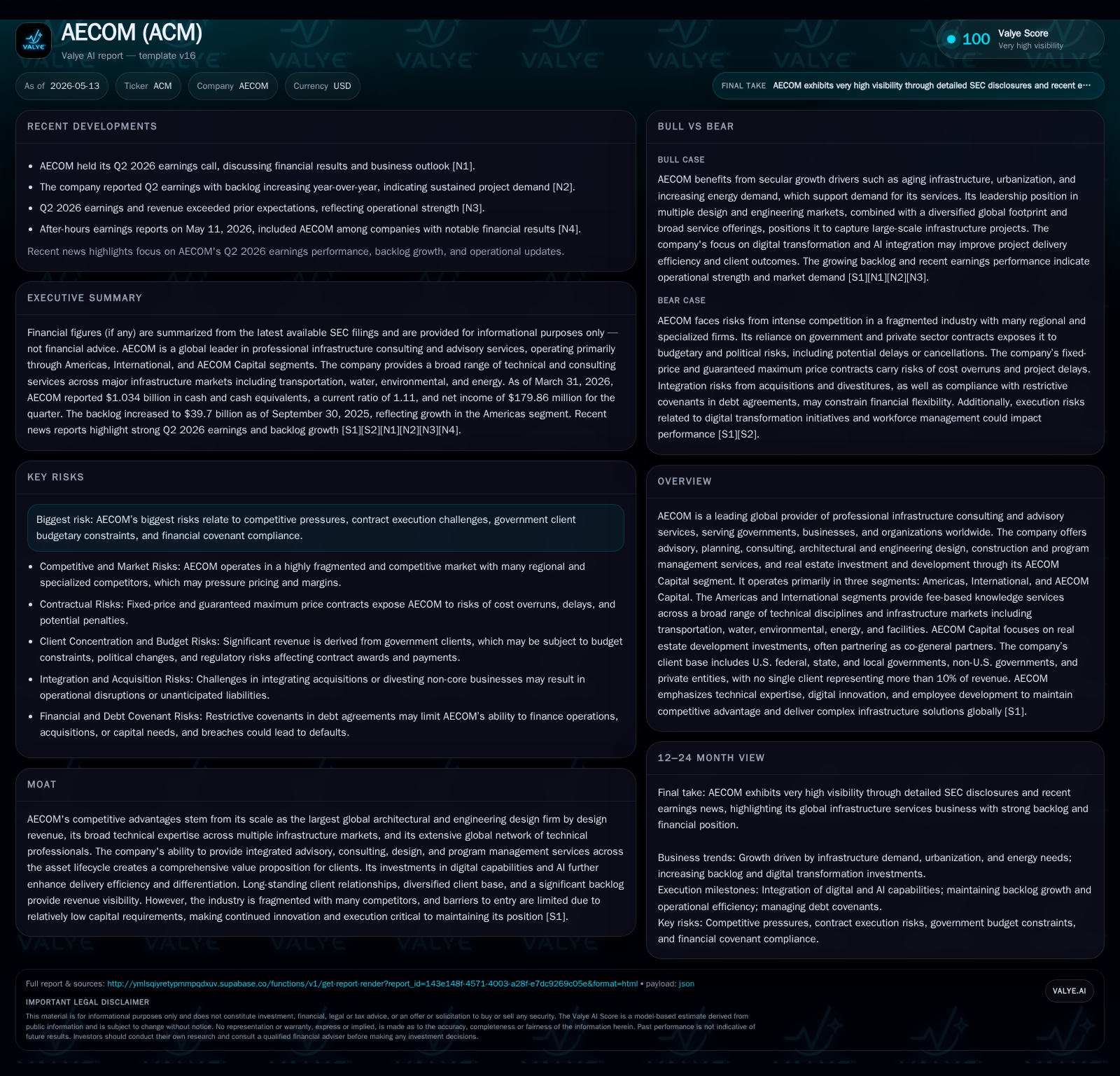
In its latest quarter ending March 31, 2026, AECOM reported an increase in backlog and sustained operational performance that reinforces its position as the world’s largest architectural and engineering design firm by revenue. The company continues to leverage its scale, diverse service offerings, and global footprint across Americas, International, and real estate investment segments. Key growth drivers include secular infrastructure demands driven by aging assets, urbanization, and energy transition needs. However, AECOM faces risks from competitive intensity, client budget constraints especially in government sectors, and project execution challenges. The company's capital structure remains stable with manageable leverage and sufficient liquidity to support ongoing operations.
Recent Operating Update
AECOM reported its second quarter fiscal 2026 results for the period ending March 31, 2026, emphasizing both top-line momentum and backlog growth that signal ongoing client demand across its global infrastructure consulting business [S2], [S3], [N2]. The company highlighted an increased backlog compared to previous periods—a key indicator given the fee-based nature of its service segments providing revenue visibility against project awards expected over multiple years. This improvement in backlog is particularly important as it suggests resilience despite cyclical market factors such as government budget cycles and private sector investment volatility.
Alongside backlog figures, AECOM’s Q2 results showcased operational progress within its Americas and International segments that deliver architectural/engineering design, advisory consulting, and program management services. These segments remain foundational sources of revenue predominantly from governments at multiple levels plus private enterprises facing increasing infrastructure modernization demands.
On the financing side, AECOM closed recent refinancing amendments extending debt maturity to March 2031 on revolving credit facilities and term loans. Interest margins are variable but benefit from incentives tied to sustainability measures such as CO2 emissions thresholds — reflecting emerging trends where ESG-linked loan terms increasingly influence corporate credit profiles [S4], [S10].
Business Model Overview
AECOM generates income primarily through fee-based professional services related to infrastructure lifecycle management encompassing advisory, planning, consulting, design (architectural and engineering), construction program management, and real estate development via its AECOM Capital segment. Clients pay typically based on time spent by technical personnel or under fixed-price contract frameworks on a project basis.
The company’s revenue mechanics revolve around employees’ utilization rates billed to clients with service offerings spanning transportation systems, water infrastructure including treatment and distribution systems, environmental consulting addressing regulatory compliance challenges, facilities design for public and private sectors, plus energy infrastructure projects including grid modernization.
AECOM Capital diversifies income sources by acting as a co-general partner in real estate ventures across major U.S. markets targeting stabilized (“build-to-core”) assets alongside development opportunities. This segment provides investment returns through sales proceeds and management fees linked to operational oversight of real estate portfolios.
Strategically, AECOM leverages its unparalleled scale—ranked globally as the largest by design revenue—and multi-disciplinary technical workforce residing across seven geographic regions encompassing Americas and international zones combined with a strong foothold in digital platforms enhancing project delivery efficiency. This integrated service mix allows clients either broad lifecycle solutions or specialized expert engagements on complex projects.
Industry Structure and Competitive Position
The global professional infrastructure consulting industry is characterized by a fragmented vendor landscape consisting of regional specialists alongside large multinational firms like AECOM competing for sizeable public/private contracts. Barriers to entry are modest since initial capital intensity is relatively low compared to other industries; however, the value accrues through reputation for quality execution, client relationships cultivating repeat business pipelines, technical expertise breadth/depth, geographic reach, and digital innovation capabilities.
AECOM’s moat rests on four pillars:
- Market-leading scale enables resource pooling for large multi-disciplinary megaprojects difficult for smaller firms.
- Breadth of technical disciplines covering civil/structural/environmental/mechanical/electrical engineering plus architectural design.
- Extensive global footprint facilitating local knowledge deployment while accessing international best practices.
- Investments in AI-driven digital tools that optimize project planning/costing/timelines creating efficiency gains beyond peers.
Nevertheless, competition remains intense with regional providers specializing deeply in niche verticals or geographies sometimes winning bids on price or particular expertise. Government clients exert pricing pressure especially when budgets tighten during economic slowdowns requiring careful margin management by consultancies.
Growth Drivers
Several structural trends underpin expected demand growth for AECOM's businesses:
- Aging Infrastructure Replacement: Government-funded initiatives globally prioritize renewal of critical transport networks (roads/rail), water treatment plants, wastewater systems amidst deteriorating civil assets.
- Urbanization Pressures: Expanding metropolitan populations stimulate demand for smart city designs including sustainable facility planning integrating energy-efficient systems.
- Energy Transition: Decarbonization policies drive investment in grid upgrades incorporating renewable resources necessitating advisory/design expertise.
- Environmental Compliance & Remediation: Increasing regulatory stringency compels municipalities/industries toward pollution control solutions entailing environmental consulting services.
- Digital Adoption: Clients seek consultants who provide technology-enabled integration accelerating construction timelines reducing cost overruns — positioning digitally advanced firms favorably.
Backlog trends validated these drivers with reported increases primarily from transportation-focused construction management assignments within Americas coupled with steady International growth. Additionally, growing interest from private sector real estate investors enhances ACAP’s co-investment portfolio opportunities supporting recurring management fees along with capital gains potential in selective developments.
Risks and Watchpoints
Despite significant opportunities enabling secular growth paths, AECOM confronts several risks:
- Contract Execution Complexity: Large-scale infrastructure projects inherently involve technical challenges risking cost overruns or delays negatively impacting profit margins.
- Competitive Pricing Pressure: Fragmented market conditions induce bidding wars potentially compressing fees especially among more commoditized service offerings.
- Client Budget Volatility: Approximately half of revenues derive from government contracts subject to annual appropriation uncertainty creating timing risk for awards/payment delays [S1].
- Workforce Retention: Talent attraction/retention is vital as key personnel possess unique qualifications often mandated by clients; turnover disrupts continuity potentially hampering client trust.
- Macro-Economic Sensitivities: Broader economic downturns could curtail infrastructure spending patterns reducing new contract flows temporarily.
Monitoring evolving backlog composition nuances post-award remains critical since signed contracts may be adjusted or canceled affecting near-term revenue recognition projections and profitability forecasting accuracy. In addition, unforeseen regulatory investigations or litigation linked to government contracting standards pose intermittent legal exposure threats common in this sector [S29].
What to Watch Next
Key indicators signaling AECOM’s trajectory should focus on:
- Quarterly backlog updates measuring contract awards relative to cancellations or extensions provide forward revenue visibility insights.
- Margins on recently awarded contracts may reveal pricing dynamics under current market conditions.
- Execution progress on major projects including any disclosed scope changes informing cost control effectiveness.
- Updates around digital platform rollouts or AI tool adoption impacting operational efficiency benchmarks.
- Real estate segment transaction activities indicating capital deployment success or repositioning strategies under ACAP advisory agreements.
The company’s recent refinancing extending maturities reduces near-term refinancing risk while variable rate loan structures expose interest expense sensitivity though partially mitigated by ESG-linked margin adjustments rewarding carbon emission reductions [F1], [S4], [S10].
DISCLAIMER: This analysis is for informational purposes only based on public filings and does not constitute investment advice or recommendations. Readers are encouraged to perform their independent due diligence regarding any investment decisions involving AECOM or its industry sector.
Disclaimer: This is research-only, informational analysis and not investment advice. It may include AI-generated interpretation and general industry context. Always verify important details using primary sources.

Comments