
Wheels Up Advances Fleet Modernization and Seeks $100M Unsecured Term Loan to Support Growth
The company accelerates its transition to a premium jet fleet while pursuing cost efficiencies and financial resilience in Q1 2026.
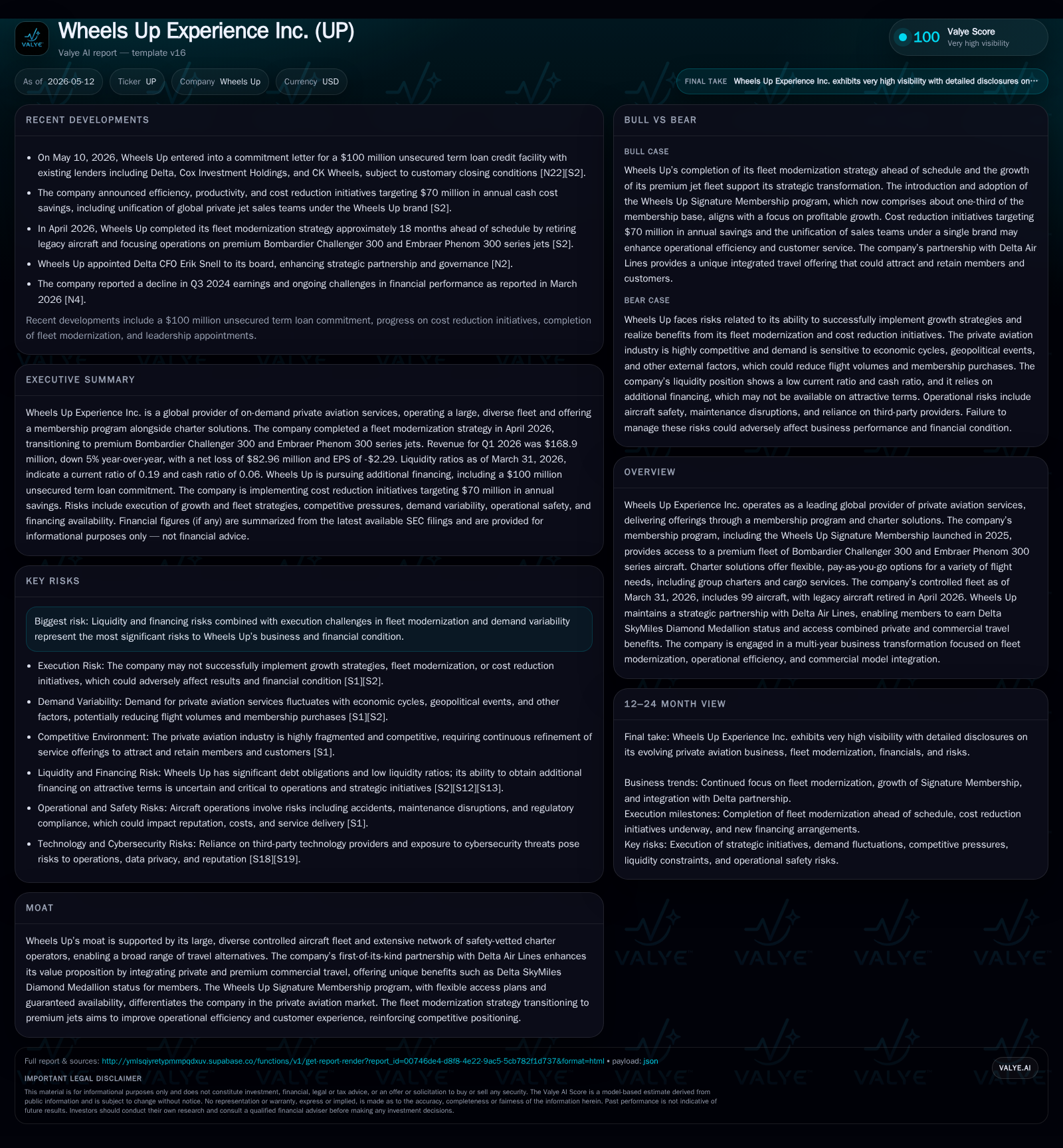
In the first quarter of 2026, Wheels Up Experience Inc. made significant strides in completing its fleet modernization strategy ahead of schedule by retiring legacy aircraft and focusing on its core Bombardier Challenger 300 and Embraer Phenom 300 jets. Despite a slight revenue decline of 5% year-over-year, operational efficiencies and cost reduction initiatives have contributed to narrowing losses. In May 2026, the company secured a commitment for a $100 million unsecured term loan from existing lenders including Delta Air Lines and private investment firms, aiming to bolster liquidity for ongoing transformation and working capital needs. Wheels Up continues to leverage its innovative membership program, integrated with Delta's loyalty platform, positioning itself as a differentiator in private aviation; however, refinancing risks and execution challenges in fleet transition remain key watchpoints.
Recent Operating Update
Wheels Up Experience Inc.’s latest quarterly filing (Form 10-Q dated May 11, 2026) reveals pivotal developments that sharpen the near-term operating picture. The company announced completion of its fleet modernization strategy nearly 18 months ahead of initial guidance by retiring all remaining legacy aircraft, notably the Cessna Citation jets, during April 2026 [S2]. This strategic pivot secures a more uniform premium fleet comprising primarily Bombardier Challenger 300 series and Embraer Phenom 300 series aircraft, explicitly aligning product offerings under the Wheels Up Signature Membership program.
Financially, wheels Up reported $168.9 million in revenue for Q1 ended March 31, 2026—a reduction of approximately 5% compared to the prior year quarter [S2][S13]. Despite this headwind, total costs declined by about $32 million (12%), driven largely by lower general & administrative expenses (-53%) and depreciation & amortization (-42%) reflecting early retirements of older assets [S18]. The Adjusted Contribution Margin compressed from 12.6% to an estimated 8.7%, influenced by integration costs tied to the business transformation as well as expenses related to legacy fleet retirements embedded in cost of revenues [S13].
On the liquidity front, Wheels Up secured a new financing commitment via an unsecured term loan credit facility of $100 million from lead lenders including Delta Air Lines, Cox Investment Holdings LLC, and CK Wheels LLC—expected to close within Q2 2026 [S2][S9]. This capital infusion aims to provide working capital flexibility alongside funding for ongoing strategic initiatives such as fleet growth scaling and operational enhancements.
Business Model
Wheels Up operates primarily through two revenue-generating streams: its membership program—dominated by the Signature Membership—and charter solutions. Members pay a monthly fee plus purchase "Membership Funds," which are prepaid amounts applied against future flight services including aircraft usage, catering, ground transport, etc. Members can select between two payment access models: Dynamic Access Plan offering discounted hourly rates with flexible pricing or Fixed Access Plan providing price predictability through locked-in hourly rates [S1][S2].
Charter solutions complement memberships by allowing non-committed customers or members opting for occasional use without upfront capital to book flights on-demand. This side includes large group charters serving sports teams or corporate events plus cargo services operated via partnerships such as Air Partner Cargo [S1][S2].
A notable strategic asset is the partnership with Delta Air Lines which integrates Wheels Up’s private aviation network with Delta's commercial platforms—members accrue Delta SkyMiles Diamond Medallion status based on qualifying spend and can redeem membership funds for discounted flights on Delta’s network [S1][S2]. This synergy boosts brand appeal within premium travelers who prize seamless private-to-commercial travel.
Industry Structure and Competitive Position
The private aviation sector has been showing signs of maturation towards premium-focused offers emphasizing quality-of-service, safety record adherence, operational reliability, and flexible usage plans. Wheels Up distinguishes itself through its sizable controlled fleet (~99 aircraft as of March-end), diverse safety-vetted global charter operator network, and innovative product bundling—particularly the signature membership tier built around standardized premium jets rather than a fragmented aircraft mix [N1][S1].
Fleet homogenization around Bombardier Challenger and Embraer Phenom aircraft not only simplifies operations but also enhances customer experience due to fleet commonality influencing comfort levels and service consistency. Combined with unique benefits derived from the affiliation with Delta Air Lines—a first-of-its-kind partnership—the company leverages an ecosystem effect difficult for smaller competitors to replicate [S1][N1]. Nevertheless, competition remains fierce from established fractional ownership providers and other private jet membership companies that often have deeper pockets or broader geographic reach.
Growth Drivers
Wheels Up’s growth is primed on expanding its Signature Membership base as legacy membership options were discontinued by March-end 2026 to focus sales resources exclusively on this profitable segment [S17]. The scalable nature of the Signature Membership allows members predictable costs coupled with guaranteed availability—a crucial factor in customer retention given growing expectations around service reliability in high-net-worth individual markets.
Operational efficiencies unlocked through centralized sales integration under one brand combined with technological improvements should elevate acquisition effectiveness while reducing overheads [S16]. Moreover, leveraging Delta's expansive network enables cross-selling opportunities both ways—private flyer data informs commercial passenger targeting while commercial passengers may convert to private flyers over time.
Fleet modernization enables reduced maintenance costs over time relative to legacy fleets burdened with higher upkeep expenses while simultaneously improving asset utilization rates [S16]. Cost reduction programs target $70 million annually in cash savings reflecting streamlining of sales & marketing functions, back-office consolidation without impairing experience quality [S16].
Global expansion potential via international charter offerings including group charters for business events or sports teams provide incremental volume upside beyond traditional single charter trips [S1][S2]. Additionally, cargo services enhance revenue diversity particularly in times when passenger volumes may fluctuate.
Risks / Watchpoints / Growth Constraints
Liquidity risk remains pronounced despite recent lending commitments due to substantial outstanding debt ($749 million total debt) against cash reserves near $54 million at quarter-end March 31, yielding a constrained current ratio of approximately 0.19 [F1][S2]. The ability to close committed financings on favorable terms is critical given ongoing capital intensity tied to modernizing fleet assets.
Execution risk shadows any large multi-year transformation involving aircraft acquisitions/leases terminated legacy fleets exit coupled with operational restructuring efforts such as sales team unification and cost reduction drives; failure or delay could adversely impact customer satisfaction or increase operating losses [S1][S16]. Demand variability inherent in private aviation linked strongly to macroeconomic cycles presents cyclicality risk—downturns could stifle flight volume growth or cause shifts from membership prepayments towards shorter-term charters lowering upfront cash flow visibility [S1].
Regulatory factors encompassing aviation safety compliance remain ever-present though Wheels Up’s rigorous supplier vetting provides some mitigation [S1]. Legal exposure exists surrounding prior contractual disputes like the flyExclusive litigation but do not appear materially threatening currently [S1]. Lastly, competitive pressures could erode pricing power if incumbents respond aggressively or new entrants innovate faster.
What To Watch Next
Key milestones include finalizing the Proposed 2026 Term Loan financing closing expected imminently Q2 calendar year; investors will watch closely any changes in liquidity position following consummation along with updates regarding amendments to existing credit agreements that enable such financing activities [S2][S9].
Membership fund purchase trends especially within Signature Membership enrollment rates will signal adoption dynamics post-transition away from legacy products; accelerating growth therein supports scalable revenue streams underpinned by contracted prepayments [S17].
Cost savings realization observed via quarterly expense trends starting third quarter onward—as the majority of planned $70 million annualized run-rate savings should begin reflecting sequential improvements in profitability metrics [S16].
Operational KPIs like flight completion rates, on-time performance within threshold windows (A-30 arrivals / D-60 departures), delay incidence rates above three hours will illuminate execution quality influencing customer experience retention risks [S18].
Lastly, external factors such as economic conditions affecting discretionary spending where premium travel is sensitive could quickly manifest impacts on flight booking volumes across business segments.
Financial Profile (Latest Snapshot)
Latest financial snapshot
| Metric | Value | Period |
|---|---|---|
| Cash & equivalents | $54mm | |
| 2026-03-31 | ||
| Total debt | $749mm | |
| 2026-03-31 | ||
| Net debt | $695mm | |
| 2026-03-31 | ||
| Current assets | $165mm | |
| 2026-03-31 | ||
| Current liabilities | $854mm | |
| 2026-03-31 | ||
| Current ratio | 0.19x | |
| 2026-03-31 |
Source: SEC companyfacts cache [F1].
The balance sheet evidences significant leverage relative to liquidity resources necessitating further financing actions reflected in recent term loan commitments designed as stopgaps ensuring operational continuity during transformation phases [F1][S2][S9]. Losses narrowed year-over-year owing mainly to disciplined expense management (-12% total costs) although gross margins remain negative at roughly -1.2% underscoring continued heavy investment required before profitable scale is realized fully [S13][S18].
This analysis synthesizes publicly filed information as anchored by Wheels Up’s most recent quarterly disclosures without offering investment advice or price forecasts. All financial data presented is sourced exclusively from SEC filings or explicitly stated company releases through May 11th, 2026.
Disclaimer: This is research-only, informational analysis and not investment advice. It may include AI-generated interpretation and general industry context. Always verify important details using primary sources.

Comments