
DocGo Accelerates Mobile Healthcare Delivery Amid Labor Cost Pressures and Regulatory Complexity
Q1 2026 results highlight growth in patient interactions but rising labor costs and regulatory risks challenge profitability and liquidity.
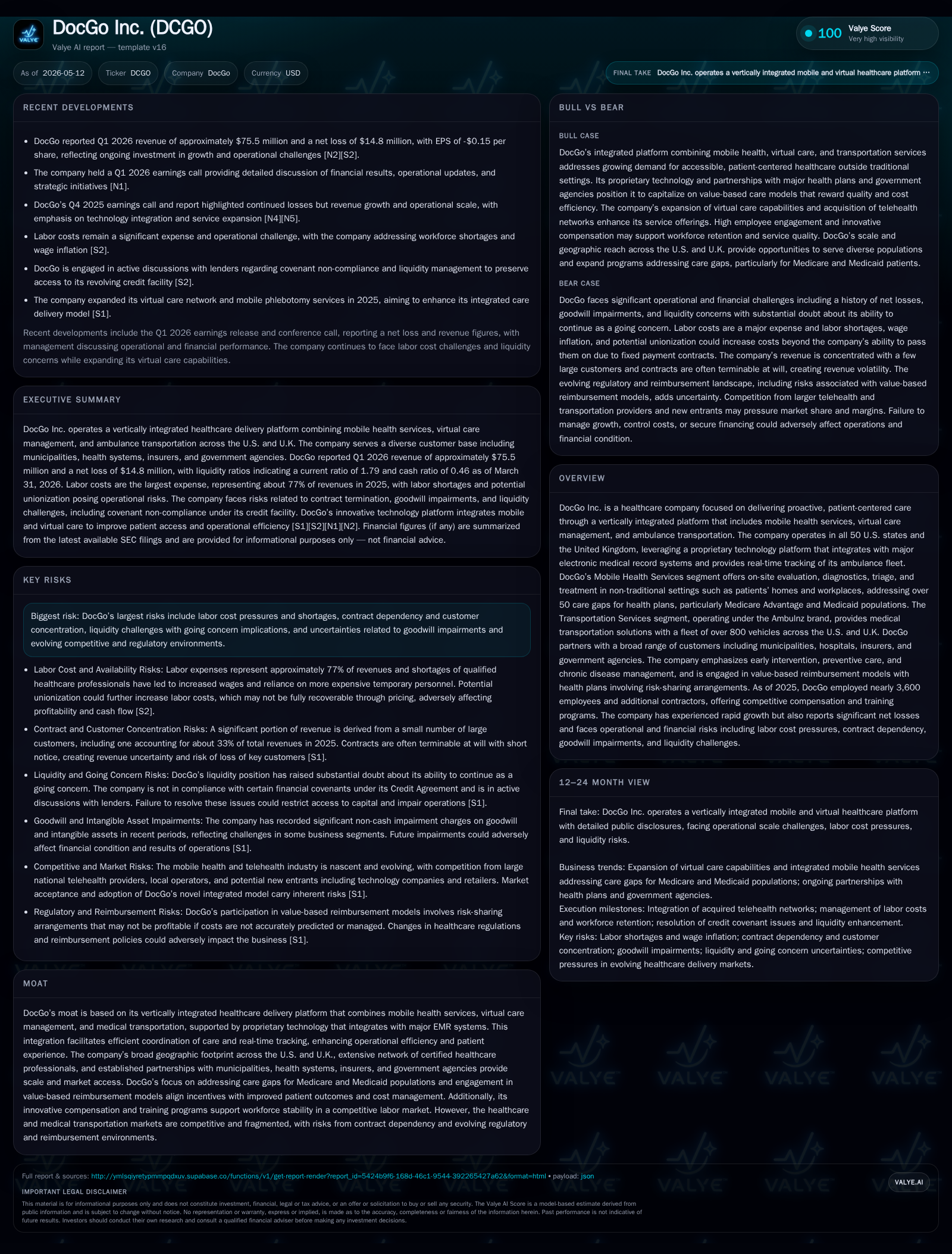
DocGo Inc. demonstrated continuing expansion of its vertically integrated mobile healthcare and ambulance services in Q1 2026 with over 1.3 million patient interactions recorded across its service model, including virtual care and onsite mobile health. However, substantial labor cost pressures—comprising roughly 70% of revenue—and limited pricing flexibility under fixed reimbursement contracts are constraining margins. The company’s broad U.S. and U.K. footprint and proprietary technology platform underpin competitive advantages, yet evolving regulations, contract concentrations, and liquidity covenant breaches emphasize operational risks. DocGo’s pathway to growth hinges on deepening insurer partnerships, expanding virtual care offerings, and cost management, while navigating workforce shortages and potential covenant renegotiations.
Recent Operating Update
DocGo Inc. reported its first quarter results for the period ended March 31, 2026 [S2][S3], reaffirming its leadership in delivering patient-centered mobile healthcare services. The company detailed no material changes in risk factors since its annual disclosure in March but highlighted increasing labor cost pressures as a critical challenge moving forward. DocGo remains active in its discussions with lenders regarding financial covenants related to liquidity underscoring ongoing constraints despite a cash position around $35.7 million as of March [F1].
Total revenues for the trailing full year ended December 31, 2025 stood at approximately $322 million; however, the company continued to operate at a net loss exceeding $182 million reflective of scale investments and operational headwinds [F1]. Management emphasized their adjusted gross margin metric during the recent earnings call as a measure to track operational improvements excluding non-cash allocations [N1][N2][S15].
Business Model
DocGo generates revenue primarily through long-term contracts with insurance companies (notably Medicare Advantage and Medicaid managed plans), municipalities, healthcare systems, and other payors who utilize its vertically integrated platform encompassing Mobile Health Services and Transportation Services.
- Mobile Health Services: This segment delivers diagnostic evaluations, triage services, treatments outside traditional clinical settings—including homes and workplaces—addressing over fifty documented 'care gaps' identified by payer organizations to improve patient outcomes and reduce downstream costs [S1]. Their model couples advanced practice providers (APPs) like nurse practitioners with licensed clinicians onsite (RNs/LPNs) supported by telehealth technology.
- Transportation Services: Operating under the Ambulnz brand with an extensive fleet exceeding 800 vehicles across the U.S. and U.K., this unit provides both emergency and non-emergency medical transportation solutions integrating seamlessly with their health delivery platform.
Revenue mechanics involve prospective payment arrangements often fixed or partially fixed by contracts covering volume-driven deliverables such as patient visits or transport trips. Revenue sustainability depends on contract renewals and expansions driven by demonstrable clinical effectiveness through closing care gaps.
Margins are pressured heavily by labor costs—inclusive of wages for EMTs/paramedics/nurses—the largest expense category representing nearly three-quarters of revenue [S2]. DocGo’s ability to increase pricing is constrained by fixed-rate government reimbursements or bundled payment models prevalent in value-based agreements.
Industry Structure & Competitive Position
DocGo operates within a fragmented healthcare delivery landscape transitioning towards decentralized care models emphasizing accessibility outside traditional brick-and-mortar facilities. Its competitive moat derives from:
- Vertical Integration: Combining mobile healthcare delivery with transportation services enables end-to-end patient engagement reducing fragmentation.
- Technology Integration: Real-time ambulance fleet tracking integrated with major EMR systems differentiates operational coordination capabilities.
- Geographic Reach & Scale: Nationwide presence in all U.S. states plus operations in the U.K. provide wide market access uncommon among peers.
- Network Credentials: Over 900 certified clinicians enable scalable deployment.
- Strategic Partnerships: Long-term contracts with insurers and municipalities act as barriers to entry.
Competitors may include localized ambulance providers, telehealth operators without mobility components, or traditional home health agencies; however, few combine these elements at scale supported by proprietary technology.
Growth Drivers
Growth prospects hinge on several fronts:
- Expanding Care Gap Closure Programs: Increasing adoption by health plans leveraging DocGo’s platform to improve quality scores incentivizes partnership growth.
- Virtual Care Network Expansion: Acquisitions enhancing telehealth services extend addressable markets into chronic disease management and wellness programs.
- Market Penetration & Geographic Expansion: Strengthening presence in underpenetrated states; potential international growth beyond the U.K.
- Operational Efficiencies: Technology-enabled scheduling optimization reduces unit costs enabling better margin profiles if labor cost inflation can be managed.
- Regulatory Tailwinds Favoring Home-Based Care: Policy shifts encouraging value-based care models boost demand for decentralized providers that address social determinants impacting Medicare/Medicaid populations.
KPIs like clinician utilization rates, patient encounter volumes (reported over 1.3 million interactions), adjusted gross margins, contract renewals/bookings will signal momentum.
Risks & Watchpoints
Key risks include:
- Labor Market Constraints: Acute shortages of clinical staff force wage inflation above reimbursement growth; unionization adds complexity [S2]. If unmitigated, this compresses operating margins severely.
- Customer Concentration & Contract Dependency: Reliance on key insurance carriers or municipal contracts exposes revenue to renewal uncertainties or pricing renegotiations.
- Regulatory Compliance & Legal Challenges: Navigating complex healthcare fraud statutes (False Claims Act), compliance with HIPAA privacy rules, state-level corporate practice of medicine restrictions pose persistent legal exposure [S10][S12][S25].
- Liquidity & Financial Covenants: Breach of credit agreement covenants could restrict capital availability; ongoing lender negotiations create execution risk [S4][S5].
- Integration Risks: Pace of virtual network acquisitions requires smooth assimilation to avoid dilutive effects or distraction from core operations.
What to Watch Next
Investors should monitor:
- Quarterly updates on adjusted gross margin trends reflecting cost control efficacy amid labor inflation;
- Progress on new contract wins or extensions with insurers targeting Medicare/Medicaid segments;
- Updates on union negotiations or broader labor relations impacting workforce stability;
- Regulatory developments affecting reimbursement methodologies or licensing requirements;
- Liquidity status updates regarding revolving credit facility availability post covenant discussions;
- Execution milestones from expanded virtual care platforms including patient engagement metrics;
- Any disclosures regarding legal proceedings or audits impacting financial outlook.
Financial Snapshot (as of Q1 2026 end)
Latest financial snapshot
| Metric | Value | Period |
|---|---|---|
| Cash & equivalents | $36mm | |
| 2026-03-31 | ||
| Total debt | $220,992 | |
| 2026-03-31 | ||
| Net debt | $-35mm | |
| 2026-03-31 | ||
| Current assets | $138mm | |
| 2026-03-31 | ||
| Current liabilities | $77mm | |
| 2026-03-31 | ||
| Current ratio | 1.79x | |
| 2026-03-31 |
Source: SEC companyfacts cache [F1].
DocGo demonstrates ample liquidity relative to short-term obligations despite operating losses due largely to investment in growth initiatives [F1].
Disclaimer
This report is a factual business analysis based exclusively on publicly filed SEC documents, news reports, and available financial data as of May 2026. It does not constitute investment advice or recommendations regarding the purchase or sale of securities related to DocGo Inc.
Disclaimer: This is research-only, informational analysis and not investment advice. It may include AI-generated interpretation and general industry context. Always verify important details using primary sources.

Comments