
VS Trust Updates Offer Clarity on SVIX’s Latest Position Limits and Market Impact
SVIX’s May 2026 quarter filing reveals key trading constraints arising from exchange-imposed futures position limits, shaping operational flexibility and risk management.
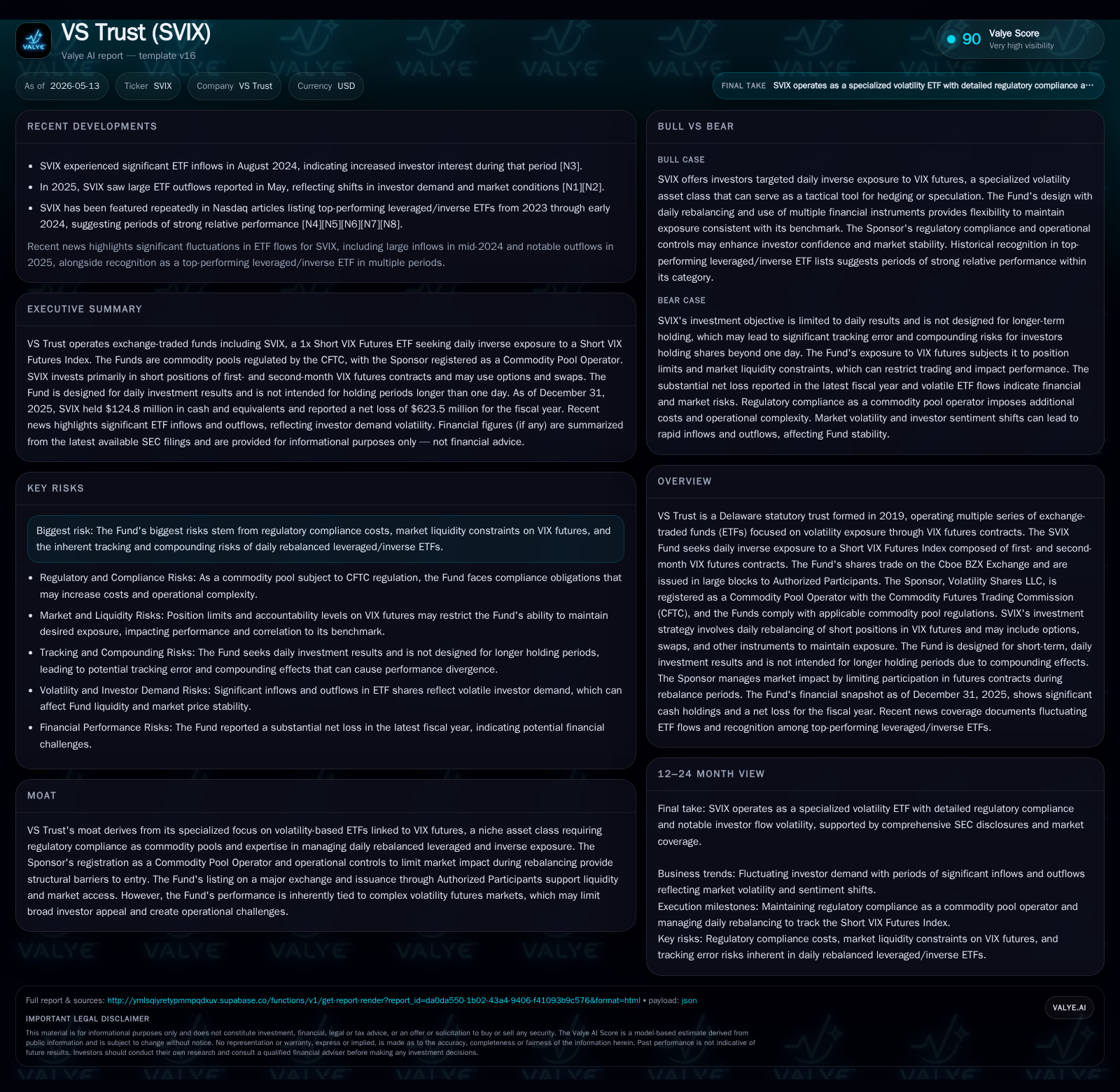
VS Trust’s SVIX ETF confronts tightening trading position limits on VIX futures contracts that could materially restrict Fund operations, including portfolio sizing and daily rebalancing. As a daily inverse volatility exposure vehicle, SVIX’s business model hinges on navigating these constraints alongside regulatory compliance as a commodity pool operator. The niche volatility ETF industry faces structural barriers from market liquidity, compounded tracking risk, and compliance overheads, while demand remains linked to short-term tactical investor appetite for volatility hedges. Monitoring SVIX’s adaptations to exchange limits and operational milestones will be critical in assessing ongoing viability within a complex derivatives-driven environment.
Latest Quarterly Developments: Position Limits and Operational Implications
The May 2026 10-Q filing surfaced critical operational developments for SVIX centered on the impact of exchange-imposed position limits on VIX futures contracts [S2][S3]. These regulatory caps restrict the maximum number of futures contracts the Fund can hold or transact, directly influencing its ability to scale positions or execute creation/redemption processes efficiently. The Sponsor flagged that such constraints might necessitate reducing existing open positions or prevent entering new ones that otherwise align with the Fund’s investment mandate.
This development adds a tangible layer of complexity on top of SVIX's daily rebalancing obligation, which targets inverse exposure to a Short VIX Futures Index comprising front two-month VIX futures. Limited position sizes may lead to difficulties matching benchmark performance precisely, thus degrading correlation quality and potentially reducing investor confidence. Furthermore, constrained trading could impede the Fund's responsiveness in volatile markets where swift rebalancing is essential.
Operationally, this situation demands enhanced coordination between the Sponsor and Authorized Participants responsible for liquidity provisioning through large-block share issuances known as Creation Units. With smaller allowable contract volumes, the ETF's market-making ecosystem faces amplified pressures to maintain orderly flows and manage NAV tracking effectively.
SVIX’s Business Model: Leveraged Volatility Exposure via VIX Futures
SVIX is a specialized series within VS Trust structured as an exchange-traded fund aimed at providing daily inverse exposure to short-term volatility through VIX futures instruments [S1]. Its core strategy involves maintaining short positions predominantly in first- and second-month VIX futures contracts—futures based on the CBOE Volatility Index (VIX). This approach allows investors access to dynamic volatility hedging or speculative positioning without direct futures account management.
The Fund targets single-day returns inverse to those of a Short VIX Futures Index, demanding daily portfolio rebalancing that compounds returns uniquely over time. This continual resetting feature differentiates SVIX from traditional ETFs by causing path-dependent performance outcomes that diverge over longer holding periods.
Volatility Shares LLC acts as the Sponsor and Commodity Pool Operator (CPO) registered with the Commodity Futures Trading Commission (CFTC), ensuring adherence to comprehensive commodity pool regulations [S1]. This designation enhances credibility but also introduces rigorous compliance costs related to transparency, reporting, margining, and risk controls.
An integral part of SVIX’s revenue mechanics lies in fees charged on assets under management paid by investors acquiring fund shares listed and traded on the Cboe BZX Exchange. Authorized Participants play a pivotal role by transacting Creation Units — large baskets of shares issued or redeemed in exchange for baskets of securities or cash—enabling liquidity provisioning vital for intraday price alignment with NAV.
In addition to futures contracts, strategies may employ options and swaps selectively to finely tune exposure or manage risk arising from price movements or liquidity constraints in underlying futures markets.
Industry Context: Volatility ETFs and Regulatory Complexities
The segment encompassing volatility-based ETFs like SVIX is markedly distinct within asset management due to its reliance on derivative instruments subject to multifaceted regulation [S1]. Such Funds classify as commodity pools under the Commodity Exchange Act (CEA), placing them squarely under CFTC oversight with mandatory registration for Sponsors as Commodity Pool Operators. This regulatory framework imposes ongoing obligations including operational audits, segregation of assets, enhanced disclosure standards, and strict margin management practices.
Position limits set forth by futures exchanges add another systemic layer impacting these products. These caps restrict aggregate contract holdings either per entity or product series to mitigate excessive market influence by individual traders. For SVIX, which inherently maintains concentrated short positions in high-volatility instruments, these limits pose scalability ceiling risks restricting growth or tactical adjustments during episodic spikes in volatility.
Competition within this space includes other volatility ETFs pursuing long or leveraged objectives often sharing similar structural challenges but differentiated by index construction approaches or leverage multiples. The complexity of managing daily reset leveraged/inverse exposure combined with commodity pool duties raises both entry barriers and operational risk profiles uncommon among equity-focused ETFs.
Market liquidity conditions in VIX futures — often thinner during calm periods — further complicate execution efficiency affecting bid-ask spreads and variation margin demands necessary for maintaining funded positions. These factors collectively create an ecosystem where institutional expertise in derivatives governance confers competitive advantage but narrows broad retail adoption potential.
Growth Drivers: Demand Catalysts in Short-Duration Volatility Products
Investor interest driving SVIX growth primarily emanates from tactical demand for short-duration hedging products capable of profiting or mitigating risk during heightened volatility regimes [S1]. Such demand spikes occur episodically during macroeconomic shocks, geopolitical events, or systemic sell-offs when traditional asset correlations break down.
Short-duration inverse volatility ETFs serve sophisticated investors—hedge funds employing volatility arbitrage strategies or active institutional managers seeking portfolio insurance—with precisely these use cases. Expanding distribution through authorized brokerage channels enhancing ease-of-access could incrementally expand adoption among retail segments increasingly seeking alternative betas beyond vanilla equities or bonds.
Innovation enhancing product features such as complementary use of swaps or options may provide finer granularity in managing intraday exposures improving risk-return profiles relative to pure futures-only strategies. Lastly, sustained episodes of market turbulence rekindle sharp increases in trading volumes consistent with inflows into volatility-linked instruments bolstering AUM expansion prospects.
Key Risks: Exchange Limits, Compounding Effects, and Market Liquidity
The May 2026 filings explicitly underline several salient risks affecting SVIX’s investment outcomes [S2][S3]. Chief among these are:
- Position Limits: The imposition of hard caps on allowable open positions constrains trading activity critical for maintaining target exposures and portfolio rebalances. Non-compliance risks forced deleveraging or inability to enter new positions detrimental to tracking fidelity.
- Compounding Risk: Daily resetting mechanisms cause exposures over periods beyond one day to be path-dependent; this introduces tracking error relative to benchmark indices especially if held long term contrary to product design intentions.
- Liquidity Constraints: Thin markets for VIX futures during off-peak volatility phases can inflate transaction costs impacting NAV accuracy while increasing margin calls raising funding risks.
- Regulatory Burdens: The commodity pool operator status entails elevated compliance costs involving reporting rigor plus potential legal/regulatory scrutiny impinging operating flexibility or profitability margins.
Collectively these structural vulnerabilities require vigilant operational discipline from SVIX management teams alongside transparent communication with shareholders regarding appropriate product suitability emphasizing short-term usage horizons.
Execution Outlook: Upcoming Milestones and Potential Demand Signals
Looking forward, critical indicators shaping SVIX’s trajectory will include adjustments made by VS Trust management regarding position sizing approaches amidst evolving exchange limit regimes [S2]. Any announced changes around EFCRP utilization—a mechanism allowing exchange-for-physical replacement trades with Authorized Participants—could ameliorate some position limit impacts by enabling off-exchange transfers reducing market footprint.
Further scrutiny will center on changes proposed for underlying index methodology construction possibly reflecting newer liquidity realities or adapting weighting schemes enhancing investability under imposed constraints. Monitoring creations/redemptions flow metrics on Cboe BZX will offer real-time signals about investor appetite shifts influenced by prevailing macro-volatility conditions.
Margin requirement updates from exchanges impacting funding costs represent another variable directly affecting operational economics potentially reflected through variation margin call fluctuations reported periodically. Sustained fund inflows backed by expanding active user base would underscore successful navigation through these challenges while reversals might suggest mounting headwinds necessitating strategic recalibration.
Financial Briefing: Current Profitability and Liquidity Snapshot
SVIX’s financial profile as conveyed in year-end metrics [F1] exhibits operating income subdued at approximately -$54,634 with net income reflecting substantial loss (-$623 million) primarily attributable to investment valuation swings inherent in the volatility strategy rather than core operating deficits. Cash & equivalents near $125 million provide a solid liquidity base sufficient for meeting required variation margin calls ensuring uninterrupted portfolio operations despite episodic market stress.[F1]
These figures typify capital-intensive trading entities operating under heavy regulatory regimes typical for commodity pools relying extensively on derivatives rather than traditional fee-based asset gathering. The Sponsor’s focus remains balancing cost efficiency while maintaining stringent compliance posture essential for continued listing privileges and investor trust.
This analysis synthesizes publicly available SEC filings up to May 2026 alongside sector insights relevant specifically to VS Trust’s SVIX Fund without offering investment advice.
Disclaimer: This is research-only, informational analysis and not investment advice. It may include AI-generated interpretation and general industry context. Always verify important details using primary sources.

Comments