
Kopin Corp Advances Integrated Microdisplay Solutions with AI-Enabled NeuralDisplay Innovation
Latest quarterly disclosures highlight Kopin’s progress on proprietary AI-enabled microdisplay technologies and expanding defense-related contracts.
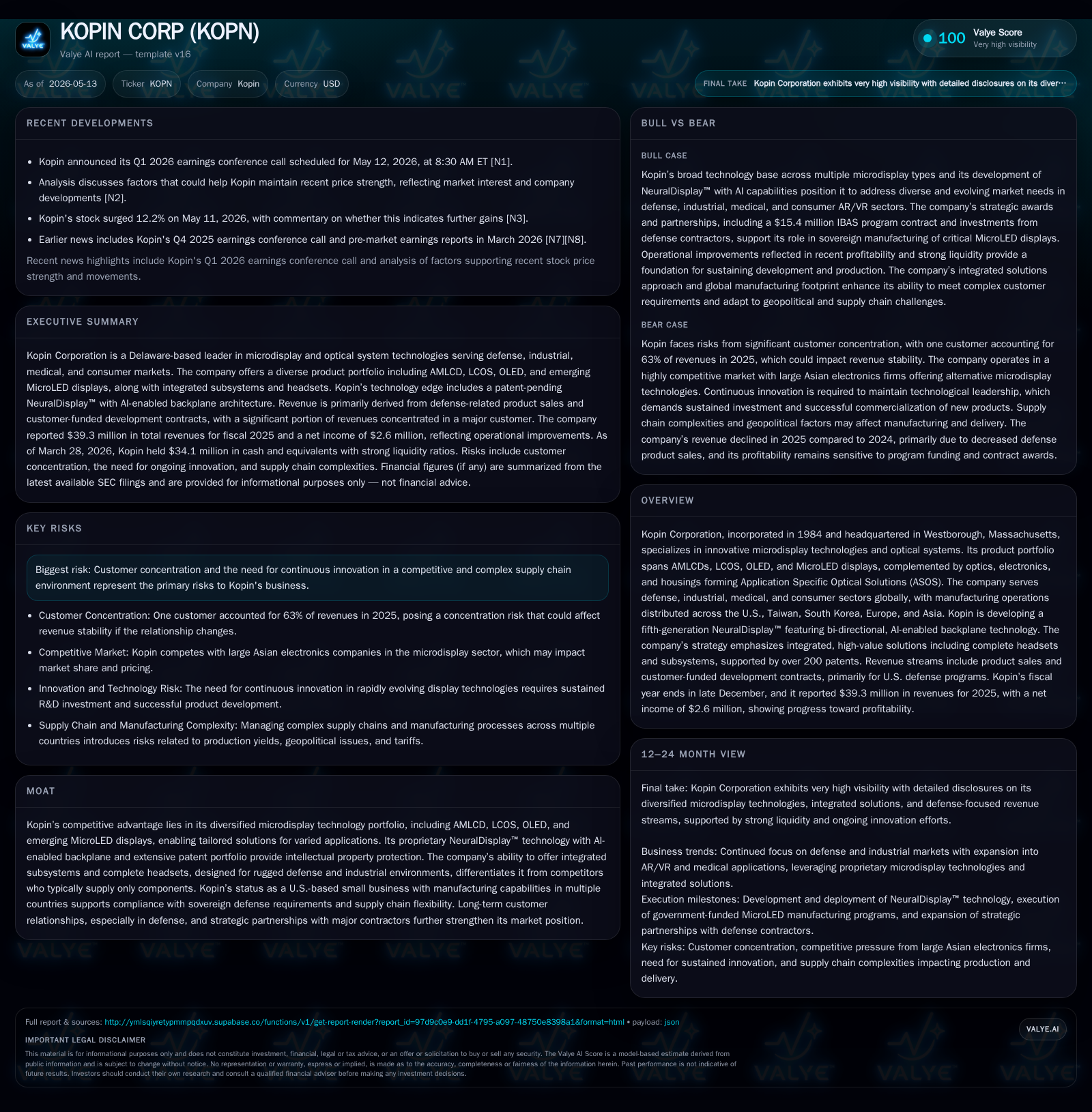
Kopin Corporation’s May 2026 quarterly filing reveals ongoing execution on advanced microdisplay innovations, particularly the fifth-generation NeuralDisplay™ with bi-directional AI-enabled backplane technology. The company’s strategic shift toward integrated Application Specific Optical Solutions (ASOS) and complete headsets supports deeper defense and industrial market penetration. Robust government-funded development contracts underpin revenue growth potential, though customer concentration and supply chain risks persist. Kopin’s global manufacturing footprint and extensive patent portfolio reinforce its competitive moat in a complex, capital-intensive industry.
Recent Quarterly Highlights: Operational Progress and Strategic Wins
Kopin Corporation’s latest Form 10-Q filing dated May 12, 2026, alongside an accompanying 8-K press release posting Q1 financial results for the period ended March 28, 2026 [S2][S3], signals ongoing advancement in several strategic initiatives. Most notably, the company is furthering development of its patented fifth-generation NeuralDisplay™, a microdisplay featuring a bi-directional human-in-the-loop and AI-enabled backplane deployable via OLED or MicroLED technology. This innovation garners backing from the U.S. Department of War’s Industrial Base Analysis and Sustainment Act (IBAS) program.
The company continues to secure development contracts primarily from U.S. Government agencies or prime contractors serving defense applications—these are priced under Federal Acquisition Regulations (FAR) guidelines [S1]. Contracts related to sovereign manufacturing capability for color MicroLED displays demonstrate Kopin’s entrenchment in soldier borne systems as well as heads-up displays for aircraft. Production qualification for initial MicroLED display orders deployed on combat jet platforms was also highlighted during the quarter [S1].
Management reported stable operations with incremental revenue contributions from recurring thermal weapon sight modules, pilot helmet HUD displays, and training simulation modules—further evidence of more mature programs converting into production-level sales [S3]. Alongside strategic capital investments including a $15 million partnership injection from Theon International PLC—expanding military-grade MicroLED display development—Kopin is bolstering its position in US sovereignty-compliant manufacturing capacity both domestically and in Europe [S1][S14][S15].
Core Business Model and Product Portfolio Overview
Kopin’s revenues derive mainly from selling microdisplay components—namely AMLCDs, LCOS displays, OLEDs, and emergent MicroLEDs—as either standalone units or integrated into higher-level subsystem solutions termed Application Specific Optical Solutions (ASOS) [S1]. These ASOS incorporate optics, electronics, housings designed for rugged environments to meet size-weight-power-cost constraints typical of defense applications such as thermal weapon sights or aircraft helmets.
Revenue streams combine product sales alongside customer-funded research and development contracts characterized by lengthy transition cycles from R&D to low-rate initial production (LRIP) phases [S1]. For U.S. government contracts governed by FAR pricing mechanisms, billings typically align with recognized costs plus allowable margins; non-government customer pricing is negotiated separately [S1]. This cost-plus structure combined with milestone payments offers some predictability but also leads to complexities in revenue recognition.
Further sharpening their competitive edge is Kopin’s proprietary NeuralDisplay™, which integrates AI-software defined backplanes enabling bi-directional pixel sensing—a capability not broadly available among peers [S1]. The neural architecture holds promise for enhanced interactive augmented reality (AR) or virtual reality (VR) headsets poised for defense and consumer adoption. Licensing legacy headset technologies has also provided royalty income streams allowing the reallocation of resources toward these new innovations [S1].
Competitive Positioning Within the Microdisplay Industry
Kopin occupies a distinctive niche within the highly specialized microdisplay sector due to its broad technology portfolio spanning four distinct microdisplay types complemented by integrated optics/electronics subsystems [S1]. This diversification enables tailored solutions that few competitors can match who usually focus exclusively on single-component supply.
The company’s U.S.-based manufacturing footprint combined with facilities in Taiwan, South Korea, Europe (Kopin Europe Ltd.), and Asia preserves flexible sovereignty-compliant supply chains crucial for defense customers wary of foreign dependency [S1][S14]. This geographic breadth also insulates against disruption risks inherent in low-volume bespoke defense production runs that cannot easily scale component sourcing.
Extensive intellectual property protection bolsters Kopin’s position: over 200 granted patents or applications cover core technologies around microdisplays and optical systems [S1]. While this patent moat provides leverage versus competitors attempting to replicate designs or infringe functionalities, ongoing litigation remnants—specifically BlueRadios trade secret dispute resulting in significant accrued damages—pose legal risk although management maintains active mitigation through appeals [S10][S20][S21].
The company faces constraints tied to its niche supplier base providing specialized chips or raw materials required for microdisplays assembly; these vendors tend to be small with limited alternatives available [S4]. Thus supply chain reliability remains a key operational watchpoint.
Growth Catalysts Shaping Demand and Market Penetration
Multiple structural growth drivers underpin Kopin's forward trajectory including sustained increases in U.S. military modernization budgets that finance soldier-worn systems integration featuring MicroLED displays backed by IBAS funding awards totaling $15+ million [S1][N5][N6]. Expansion into European markets via Kopin Europe Ltd., now deconsolidated but strategically positioned to fulfill EU defense procurement preferences closer to home, further widens addressable opportunities [S14][S15].
The maturation of NeuralDisplay technologies — leveraging AI-enabled backplanes with bidirectional sensing — is projected to unlock diverse end markets extending beyond traditional defense into medical visualization headsets and industrial AR wearables where performance demands mirror those needed for combat environments but require added ergonomic sophistication [S1][N5].
Contractual pipeline visibility coupled with progression of research collaborations highlights a pathway where active customer-funded development phases convert into low-to-mid volume production awards thereby increasing revenue visibility over medium terms [S1][N6]. Licensing income derived from past headset system IP continues as a steady royalty base enabling reinvestment in innovation pipelines.
Risks and Constraints Impacting Future Performance
Two dominant risks warrant attention:
Customer Concentration: The largest client DRS Network & Imaging Systems LLC accounted for approximately 63% of revenues in 2025 [S14], emphasizing dependence on a narrow customer base primarily within U.S. defense sector limits diversification benefits and exposes Kopin to program funding fluctuations or contract losses.
Supplier Dependencies: Complex supply chains are reliant on select specialized semiconductor foundries and material suppliers whose capacity limitations reduce bargaining power; this risk amplifies given typically low unit volumes demanding custom parts that cannot be economically sourced from multiple vendors simultaneously [S4][S14].
Ongoing patent litigation related to BlueRadios adds financial contingencies stemming from accrued judgments totaling nearly $20 million but is currently secured via bonds pending appeal outcomes; reputational impact and diversion of executive focus are non-quantifiable risks here as well [S10][S20]
Additionally, compliance requirements under ITAR export controls environmental regulations governing hazardous substances impose operational diligence obligations that could result in costly fines or production interruptions upon breaches [S22][S25]. The need for continuous innovation imposes substantial R&D spend commitments without guaranteed product commercialization success.
Near-Term Milestones and What Investors Should Monitor
Upcoming catalysts include:
- Progression milestones toward commercial readiness of NeuralDisplay™ backplane-based OLED/MicroLED products particularly leveraging AI capabilities suitable for soldier-augmented vision devices.
- Delivery status updates on IBAS-funded sovereign manufacturing setups aimed at color MicroLED displays reflecting ability to meet volume targets demanded by Defense departments.
- Enhancement announcements tied to new licensing agreements or royalty income related to previously developed headset platforms.
- Additional collaborative ventures and strategic investments beyond the existing Theon International partnership expected to broaden co-development defenserelated product portfolios.
- Quarterly guidance evolution reflecting revenue ramp from conversion of development contracts into production orders; any shift away from major defense client overconcentration would be notable.
- Execution on automation improvements within ASOS manufacturing reducing labor intensity while improving yield rates.
Monitoring regulatory filings for updates on litigation status remains warranted given the materiality of accrued liabilities relating to trade secrets disputes.
Latest Financial Snapshot: Liquidity and Capital Position
Latest financial snapshot
| Metric | Value | Period |
|---|---|---|
| Cash & equivalents | $34mm | |
| 2026-03-28 | ||
| Current assets | $82mm | |
| 2026-03-28 | ||
| Current liabilities | $32mm | |
| 2026-03-28 | ||
| Current ratio | 2.61x | |
| 2026-03-28 |
Source: SEC companyfacts cache [F1].
Kopin reported a cash balance inclusive of cash equivalents standing at $34.1 million as of March 28, 2026, supported by current assets totalizing approximately $82.4 million against current liabilities near $31.5 million; this yields an overall current ratio of about 2.61 indicating strong short-term liquidity able to support ongoing operations [F1][S2][S3]. There is no indication of near-term debt repayment stress or covenant breaches per recent filings.
| Metric | Amount (USD) | Period End |
|---|---|---|
| Cash & Equivalents | $34,100,000 | |
| 2026-03-28 | ||
| Current Assets | $82,422,744 | |
| 2026-03-28 | ||
| Current Liabilities | $31,531,152 | |
| 2026-03-28 | ||
| Current Ratio | 2.61 | |
| 2026-03-28 |
This financial foundation supports continued investment into long-cycle R&D projects while absorbing contingencies related to litigation accruals without immediate liquidity strain.
This analysis synthesizes data exclusively derived from Kopin Corporation's recent SEC filings including their latest quarterly Form 10-Q (dated May 12, 2026), associated Form 8-K releases on Q1 results (May 12, 2026), their most recent annual report Form 10-K (April 13, 2026), as well as contemporary external reports referenced by filing date.[F1] All observations reflect publicly disclosed information without speculative extrapolation beyond documented facts.
Disclaimer: This is research-only, informational analysis and not investment advice. It may include AI-generated interpretation and general industry context. Always verify important details using primary sources.

Comments