
Flywheel Advanced Technology’s Pursuit of a Viable Operating Business Amid Shell Company Status
FWFW remains a shell company navigating acquisition challenges while leveraging its minority-owned robotics distribution subsidiary.
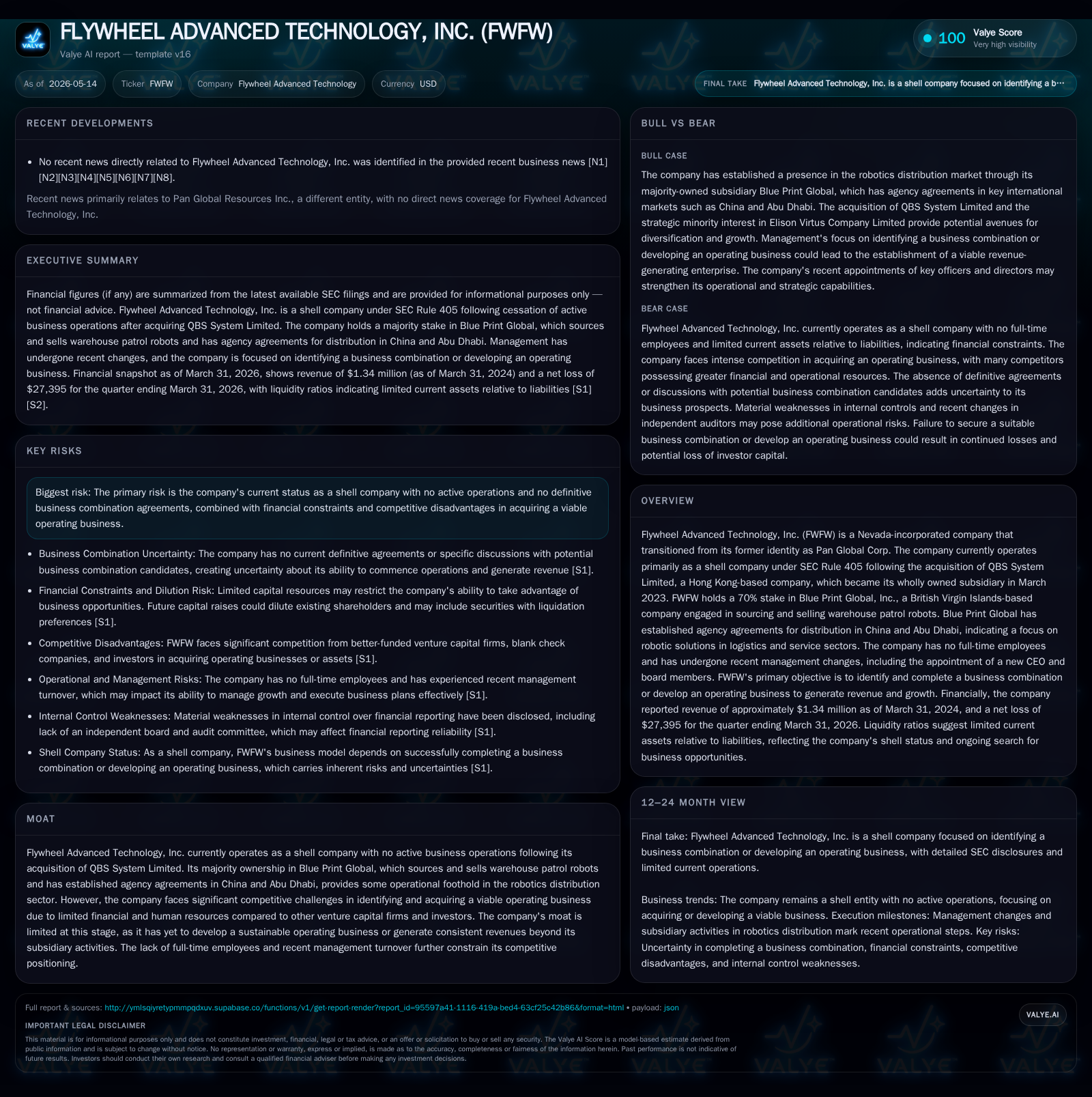
Flywheel Advanced Technology, Inc. filed its latest 10-Q on May 14, 2026, confirming its status as a shell company with no full-time employees but with ongoing strategic initiatives including management changes and operations under its majority-owned agent for warehouse patrol robots. FWFW’s core business model centers on acquiring an operating company or scaling subsidiary activities through Blue Print Global’s distribution agreements in China and Abu Dhabi. Competitive pressures in robotics distribution and limited capital pose material challenges to executing growth plans. Investors should monitor milestones related to business combination announcements and capital raising efforts amid a constrained financial runway.
Latest Quarterly Developments Highlighting Strategic Status
In the most recent 10-Q filing dated May 14, 2026 [S2], Flywheel Advanced Technology, Inc. (FWFW) confirms its continued operation as a shell company under SEC Rule 405. Notably, the company reports zero full-time employees, underscoring its minimal internal operational footprint. During the interim period through March 31, 2026, the company underwent significant management restructuring, including the dismissal of its independent auditor BCRG Group as of April 1, 2026 [S3], and appointment of WSJ And Partners as the new auditor [S8]. The new CEO, Luk Yuen Leung, assumes multiple principal executive roles, consolidating leadership which reflects both organizational streamlining and potential challenges in governance.
This latest quarterly disclosure reiterates that FWFW has no active operations aside from its role as a holding entity for subsidiaries and investment interests. The audit change followed identification of material weaknesses in internal controls related primarily to an absence of an independent board or audit committee and reliance on outsourced financial consultants [S8]. The material weaknesses and lack of strong governance mechanisms can impair investor confidence particularly given the company’s dependence on future acquisition success.
Management also restates that the primary goal remains achieving long-term growth through either a business combination or ramping up subsidiary operations with Blue Print Global Limited (Blue Print) [S2]. However, there are no concrete agreements or letters of intent with acquisition targets currently reported.
Company Business Model and Subsidiary Overview
FWFW operates chiefly as a Nevada-incorporated shell company that acquired Hong Kong-based QBS System Limited in March 2023 [S1]. This transaction effectively resulted in FWFW becoming a shell entity due to cessation of any standalone active operations post-acquisition. In parallel, FWFW holds a controlling 70% stake in Blue Print Global Inc., situated in the British Virgin Islands, which functions to source and sell warehouse patrol robots — an emerging class of autonomous logistics technology intended to automate security and monitoring tasks within warehouses [S1].
Blue Print has entered agency agreements granting distribution rights for these robotic products across China through International Supply Chain Alliance Co., Ltd. (ISCA), as well as in Abu Dhabi via XCoffee Robotics Trading Ltd., evidencing a geographical focus on logistics hubs experiencing rapid automation adoption [S12]. These agency contracts are non-exclusive but span multi-year terms with automatic renewals barring termination notices.
Despite having these subsidiaries with operational activity, FWFW itself does not generate material direct revenues or maintain full-time operational staff. Instead, revenue generation is indirect through equity interests and distribution commissions earned by Blue Print. The lack of direct control over operations coupled with pending business combination ambitions leaves FWFW’s overall business model speculative at this stage [S1].
Competitive Dynamics in Robotics Distribution
Within the warehouse robotics sector served by Blue Print Global, competition arises from numerous well-capitalized players developing integrated robotic solutions encompassing autonomous mobile robots (AMRs), automated guided vehicles (AGVs), and patrol robots embedded with advanced sensors for surveillance tasks. The demand for such warehouse automation is propelled structurally by e-commerce growth, labor shortages in logistics sectors, and cost pressures to improve supply chain efficiency.
However, Blue Print operates primarily on an agency/distribution model rather than vertically integrated manufacturing or proprietary product development [S1]. This constrains margin potential versus original equipment manufacturers (OEMs) who capture higher value add through R&D and product innovation cycles.
Additionally, global supply chain disruptions continue to affect availability of semiconductors and mechanical components critical for robotics production. Pricing pressure exists from industrial automation incumbents offering bundled IoT platforms alongside robotic units. Regulatory compliance and data privacy laws in target regions like China further complicate deployment timelines for surveillance-enabled patrol robots.
Thus, while market demand appears structurally favorable for warehouse patrol robots, Blue Print faces stiff headwinds stemming from limited scale, reliance on third-party suppliers for products, and competitive pressure from more diversified robotics providers.
Growth Outlook and Capital Acquisition Challenges
The path to growth for FWFW hinges on two foundational pillars: successfully completing an acquisition or merger that would transition it out of shell status into an active operating business; or driving significant scale through Blue Print Global's distribution operations. Current disclosures make clear that neither pillar is assured at this juncture.
The company’s pursuit of suitable acquisition targets appears hampered by capital constraints—its balance sheet reveals cash reserves around $439K as of March 31, 2026 [F1], which is minimal relative to expected transaction costs or working capital needs post-acquisition. The large current liabilities totaling just over $1 million dwarf current assets around $4.9K resulting in a severely negative working capital situation measured by an approximate current ratio near zero [F1]. This scenario underscores pressing liquidity issues which further restrict bargaining power in pursuing competitive acquisitions amidst crowded venture capital markets favoring deep-pocketed buyers [S1][S2].
Moreover, any acquisition financing is anticipated to come at the expense of existing shareholders through dilution given FWFW’s history of stock issuances tied to preferred stock conversions and share sales [S13]. A successful raise could also involve debt issuance carrying senior rights over common stockholders.
Growth via subsidiary scaling requires intensive investments including expanding sales channels beyond existing agency partners, augmenting product portfolios with additional robotics solutions, enhancing supply chain reliability amid semiconductor shortages, and addressing regional regulatory complexities. Such investments demand accessible capital which FWFW currently lacks.
Collectively these factors illustrate that while structural drivers exist supporting robotics adoption globally — including labor cost inflation pressures favoring automation — FWFW must overcome severe capital hurdles to translate these into sustainable revenue growth.
Key Risks Inherent in Shell Company Operations
Multiple risk layers compound FWFW's investment profile given its current status:
- Lack of Active Operations: Without an operating business delivering revenue-generating activities internally or through fully controlled subsidiaries, valuation remains speculative purely on acquisition prospects [S1][S28].
- Acquisition Execution Risk: No definitive letters or agreements are in place for business combinations; failure to consummate such deals within reasonable time frames may lead to discontinuation of business plans ultimately harming shareholder value [S1][S28].
- Governance Weaknesses: Material weaknesses highlighted by auditors relate to absence of independent directors/audit committee along with outsourced financial reporting—a feature that can delay regulatory compliance and erode market confidence [S8].
- Competitive Disadvantages: Limited capital restricts access to attractive acquisition opportunities compared to VC-backed competitors with greater financial firepower and deal-making experience [S26].
- Dilution Risk: Future capital raises required for acquisitions or operational scaling will likely dilute existing shareholders’ equity stakes substantially [S18][S19].
- Operational Cash Flow Deficiency: Subsidiaries’ limited scale precludes meaningful cash flow generation; overhead burdens fall disproportionately on parent level assets constrained by liquidity [F1].
- Market Liquidity & Stock Volatility: OTC Basic market listing results in illiquid trading with wide price swings unrelated to fundamentals further complicating investor exit options [S20][S28].
These intertwined risks amplify uncertainty around the ultimate realization of value for shareholders absent near-term successful transactions.
Upcoming Milestones and Monitoring Points
Investors eyeing FWFW should closely watch several concrete developments emanating from public disclosures:
- Business Combination Announcements: Any filing disclosing letters of intent or definitive agreements will significantly reduce uncertainty around operational commencement timelines [S2][S3].
- Capital Raising Activities: Notices concerning equity or debt issuances will elucidate funding runway length as well as dilution magnitude [S2][S3].
- Subsidiary Operational Progress: Updates regarding expansion of agency agreements beyond China and Abu Dhabi or product portfolio enhancement by Blue Print could indicate trajectory toward scalable revenue streams.
- Governance Improvements: Formation of independent board committees or remediation of material weaknesses would signal maturation aiming at better transparency standards crucial for attracting partners/investors.
- Auditor Reports & Filings: Subsequent quarterly filings may provide clarity into financial control improvements under new auditing firm WSJ And Partners established April 2026 [S8].
Given limited liquidity approximated at quarter end March 31 ($439K cash vs $1M+ liabilities) without new financings visible soon, timing around next fundraising events will be pivotal milestones determining operational continuity probabilities [F1][S2].
Current Financial Profile Snapshot
Latest financial snapshot
| Metric | Value | Period |
|---|---|---|
| Current assets | $4900 | |
| 2026-03-31 | ||
| Current liabilities | $1009204 | |
| 2026-03-31 | ||
| Current ratio | 0x | |
| 2026-03-31 |
Source: SEC companyfacts cache [F1].
Below is a compact summary reflecting FWFW’s most recent financial position highlighting critical liquidity constraints:
| Metric | Value (USD) | Period End |
|---|---|---|
| Cash & Equivalents | 439,518 | |
| 2026-03-31 | ||
| Current Assets | 4,900 | |
| 2026-03-31 | ||
| Current Liabilities | 1,009,204 | |
| 2026-03-31 | ||
| Current Ratio (derived) | ~0 | |
| 2026-03-31 |
This snapshot reveals severely negative working capital indicative of an urgent need for asset replenishment either via equity/debt raises or profitable asset acquisitions capable of reversing liquidity drain trends. Historical total debt approximates $193K but is outdated relative to present balances suggesting minimal leverage but substantial short-term obligation pressures remain unfunded internally [F1].
This analysis reflects Flywheel Advanced Technology’s ongoing uncertainty living as a shell entity shadowed by mild operational footholds through minority subsidiaries concentrated on niche robotic distribution markets undergoing transformative demand shifts. The company's strategic path depends critically on successfully securing capital sufficient to consummate acquisitions or materially scale subsidiary ventures before running out of operational runway capacity.
Disclaimer: This analysis is provided solely for informational purposes without any investment recommendation or advice. It is based strictly on publicly available filings and data sourced up to May 14, 2026.
Disclaimer: This is research-only, informational analysis and not investment advice. It may include AI-generated interpretation and general industry context. Always verify important details using primary sources.

Comments