
NETSOL Technologies Signals Platform Growth and Partnership Leverage in Q3 2026
Q3 2026 results highlight revenue growth driven by platform expansion and bolstered UK bank partnerships amid profit margin pressures.
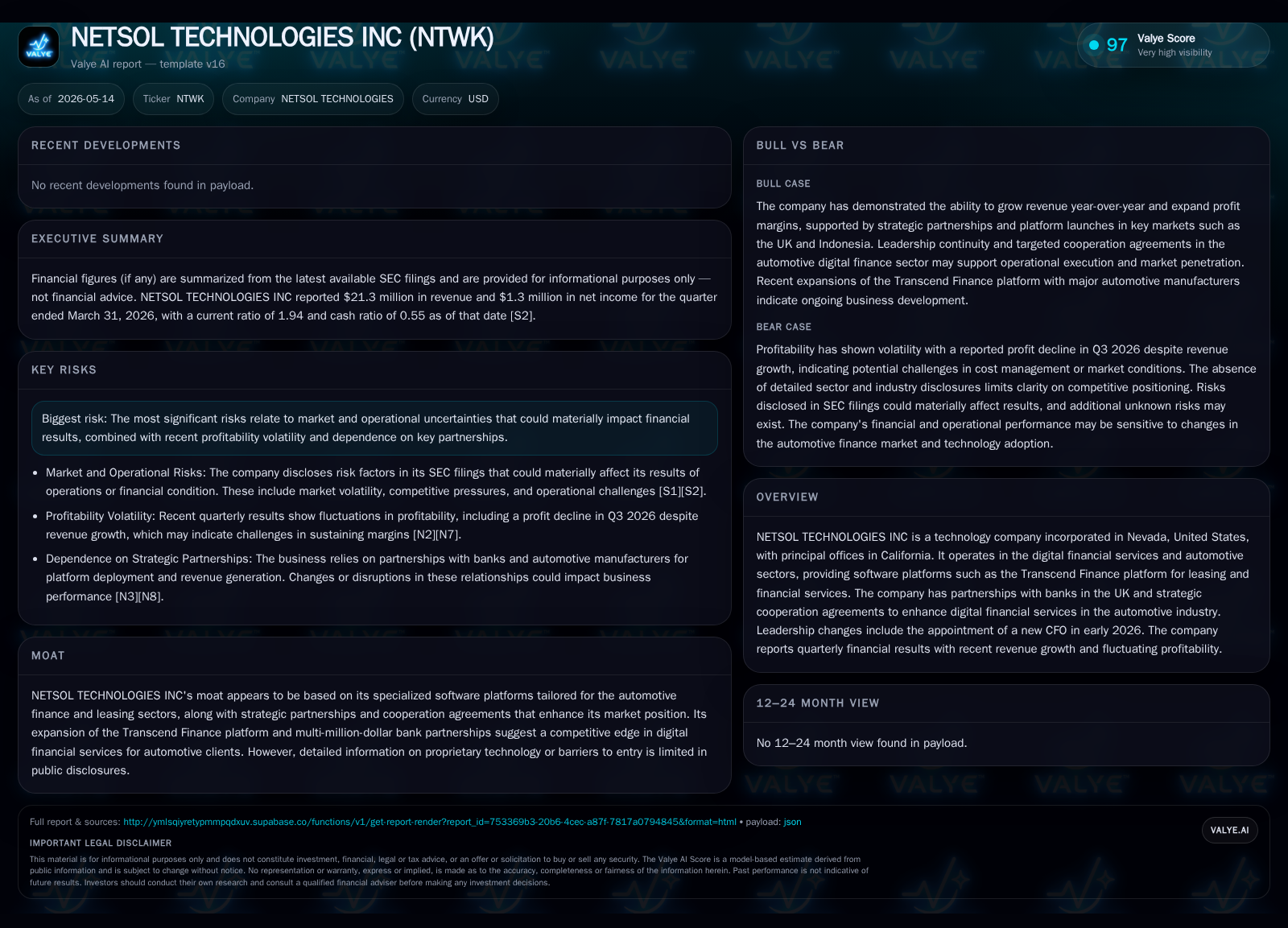
NETSOL Technologies' latest quarterly filing reveals continued top-line growth fueled by its Transcend Finance platform and strategic banking alliances, notably within the UK. However, profitability declined due to operational dynamics and subsidiary earnings variability. The company’s specialized automotive finance software and deepening bank partnerships underpin its moat. Growth hinges on further platform adoption and geographic expansion, while risks stem from profit volatility and dependency on key partners.
Latest Quarterly Operating Performance Highlights
NETSOL Technologies’ Q3 2026 ended with a continuation of revenue growth as disclosed in its May 14, 2026 Form 10-Q [S2]. While total revenues advanced relative to prior periods, operating income showed a decline reflecting increased operating expenses and mixed contributions from its Pakistani subsidiary, NetSol Technologies Ltd., whose separate Q2 results were publicly posted April 2026 [S3]. This subsidiary’s results are segmented but affect consolidated figures due to integration of financial services offerings across geographies.
Despite the top-line expansion, profitability faced headwinds, which has been a feature of recent quarters marked by fluctuating operating margins as reported in the earnings call transcript [N1] and highlighted in media coverage noting a drop in net profit for the period [N3]. These dynamics underscore transitional costs linked with scaling platform functionality and integrating enhanced bank partnerships.
NETSOL's Business Model and Product Offering Excellence
NETSOL operates primarily as a software-as-a-service provider specializing in digital financial services tailored for the automotive industry. Its flagship offering, the Transcend Finance platform, focuses on automating leasing processes alongside supporting backend financial operations for banks and lenders servicing auto buyers [S1].
Revenue generation is linked tightly to subscription fees charged to institutional customers including banks and fleet operators who rely on NETSOL’s cloud-based platforms for credit scoring integrations, contract management, payment processing, and risk analytics. This SaaS delivery model enables recurring revenue streams with usage or contract renewal acting as volume drivers. The firm’s ability to customize interfaces to client credit systems creates considerable switching costs.
The company also organizes cooperative agreements facilitating end-to-end workflows between financiers and dealers — critical in accelerating loan approvals within automotive ecosystems [S14]. This specialization provides tangible differentiation versus generic fintech providers.
Competitive Positioning within Automotive Finance Software
The space NETSOL competes in is fragmented but competitive with notable global players focusing on automotive lease management software tailored to banks or captive finance arms of automakers. Unlike horizontal financial software firms, NETSOL’s niche caters specifically to leasing workflows requiring regulatory compliance across jurisdictions.
Typical switching costs arise from embedded credit decision engines interlinked with client bank lending protocols; as such transitions involve complex data migration and training. Pricing tends toward contractually fixed SaaS fees supplemented by variable licensing tiers based on transaction volumes or user numbers.
Regulatory changes concerning consumer financing disclosures or digital lending standards represent potential disruptors but also barriers that favor established providers capable of fast compliance updates. Capacity to onboard new clients scales with cloud infrastructure without proportionate cost increases indicating leverage potential within existing setups.
Foundations of NETSOL’s Market Moat: Platform and Partnerships
NETSOL’s moat is anchored less in proprietary code secrecy than in its finely tuned alignment to automotive finance workflows married with extensive partner ecosystems. The recent multi-million-dollar extension of UK bank partnerships reported April 2026 exemplifies how these collaborations deepen client stickiness [N2]. Such strategic agreements embed NETSOL software into critical lending operations creating high barriers for competitors.
These partnerships often involve joint development efforts enhancing platform capabilities designed explicitly for regional automotive finance regulations. Furthermore, recurring contract renewals reinforce revenue visibility and set pathways for upselling additional modules or analytics services.
This embeddedness across banking and auto sectors limits customer churn risk while positioning NETSOL as a preferred technology integrator in digital transformation initiatives within automotive financing.
Drivers Fueling NETSOL’s Growth Outlook
Key growth catalysts lie in geographic expansion beyond core markets through intensified sales efforts aimed at additional banks seeking digitized leasing solutions [S2]. The scalable architecture of Transcend Finance facilitates relatively rapid deployment into new regions where rising digitization demands prompt migration from legacy systems.
Upselling opportunities stem from increasing demand for analytics-driven risk assessment tools embedded within existing platforms enabling lenders to refine underwriting standards with real-time data feeds. This argues for improved SaaS margin profiles as higher-value service layers are rolled out.
Moreover, ongoing industry shifts towards electric vehicle financing present fresh avenues for tailored financing products rendered through NETSOL’s platforms. Management remarks during the May earnings call emphasized pipeline opportunities with European financial institutions seeking these specialized applications [N1].
Risks and Constraints on Sustained Expansion
The principal risks revolve around operational volatility influencing profitability as seen in recent quarters [N3], potentially driven by integration challenges with subsidiaries or timing mismatches on contract renewals reflected in fluctuating quarterly income statements [S4]. High dependence on a relatively small number of key banking partnerships exposes NETSOL to negotiation leverage pressures or client attrition risks.
In addition, technology disruption from emerging fintech entrants leveraging AI or blockchain could pressure incumbents lacking equivalent innovation speed or scale. Regulatory shifts impacting consumer credit digitalization might impose compliance burdens raising ongoing development costs.
No material changes have been reported recently regarding risk factors compared to previous annual disclosures [S4], signaling stable but persistent uncertainties requiring close monitoring.
Key Upcoming Milestones and Strategic Watchpoints
Upcoming quarters should be evaluated against execution progress on expanding UK bank partnerships per the April extension announcement [N2] along with potential announcements of new customer wins or geographical market entries cited by management during recent investor calls [N1].
Product-wise, the rollout of enhanced Transcend Finance functionalities aimed at accelerating loan origination throughput will be a key factor determining future revenue uplift trajectories [S2].
Investors should track forward guidance updates scheduled around future quarterly filings for signs of stabilized profitability post-investment phase alongside possible commentary on competitive dynamics.
Financial Snapshot: Liquidity and Profitability Context
Latest financial snapshot
| Metric | Value | Period |
|---|---|---|
| Cash & equivalents | $15mm | |
| 2026-03-31 | ||
| Total debt | $249799 | |
| 2026-03-31 | ||
| Net debt | $-14mm | |
| 2026-03-31 | ||
| Current assets | $52mm | |
| 2026-03-31 | ||
| Current liabilities | $27mm | |
| 2026-03-31 | ||
| Current ratio | 1.94x | |
| 2026-03-31 |
Source: SEC companyfacts cache [F1].
| Metric | Value |
|---|---|
| Cash & Equivalents | $14.7M |
| Total Debt | $0.25M |
| Current Assets | $52.3M |
| Current Liabilities | $27.0M |
| Current Ratio | 1.94 |
| Net Debt | -$14.5M |
NETSOL maintains a strong liquidity position with nearly $14.7 million in cash equivalents as of March 31, 2026, against minimal total debt under $250 thousand [F1]. The resulting current ratio near 1.94 underlines solid short-term financial health supportive of ongoing investments despite recent profitability fluctuations [S2].
This net cash balance provides flexibility to fund strategic initiatives including R&D enhancements in Transcend Finance or expanded marketing efforts behind new bank partnerships without immediate refinancing concerns.
This analysis synthesizes details from NETSOL TECHNOLOGIES INC's most recent SEC filings supplemented by contemporaneous news sources to present an informed perspective grounded strictly in disclosed evidence without extrapolation beyond cited data.
Disclaimer: This is research-only, informational analysis and not investment advice. It may include AI-generated interpretation and general industry context. Always verify important details using primary sources.

Comments