
Cell Source Advances Immunotherapy Trials with Veto Cell Technology, Faces Funding Challenges
Cell Source progresses clinical development of its proprietary immune tolerance technology while contending with significant liquidity concerns.
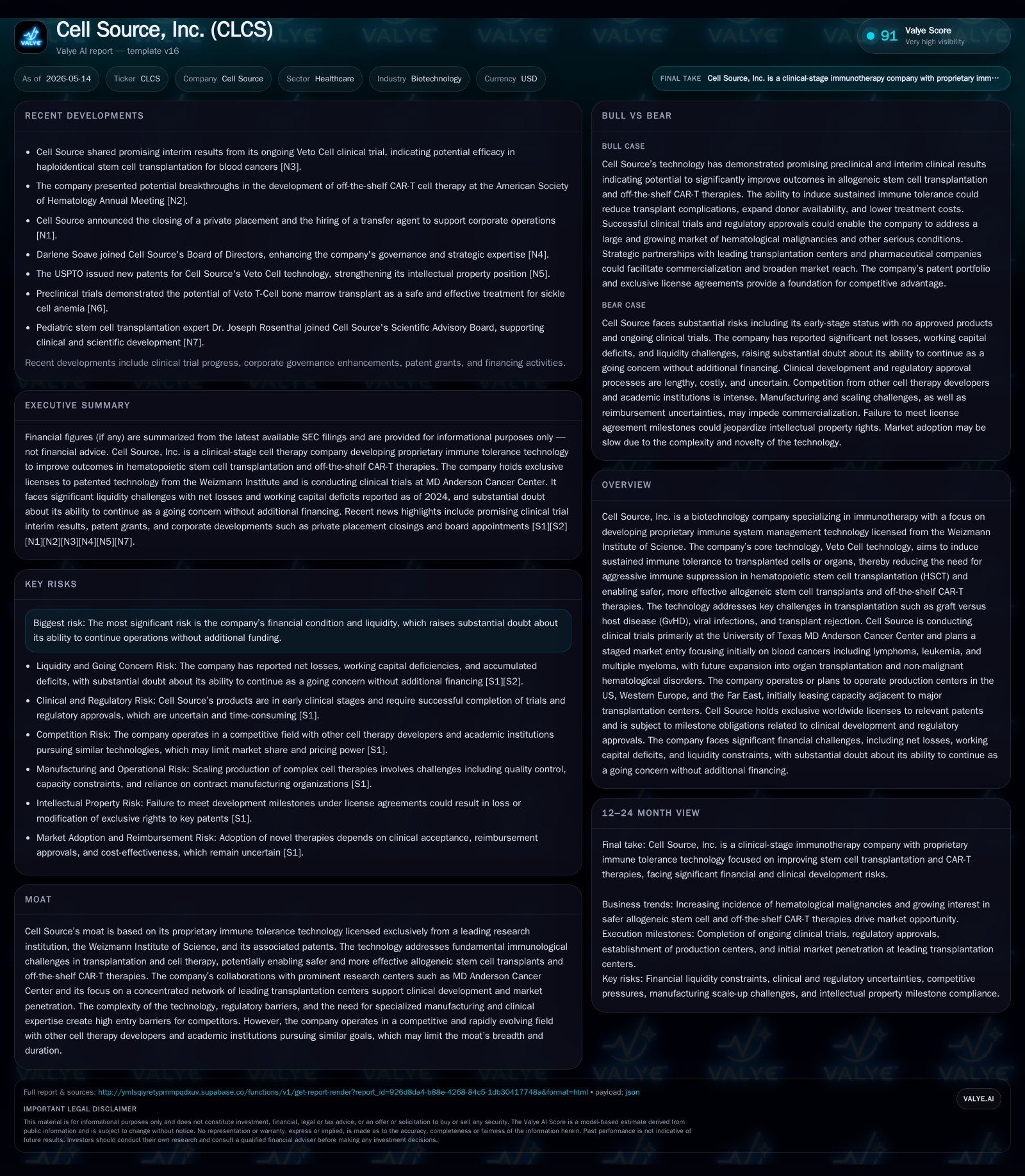
In its latest quarterly filing dated May 14, 2026, Cell Source detailed ongoing clinical trials utilizing its exclusive Veto Cell technology at MD Anderson Cancer Center, showing advancement in immunotherapy for hematopoietic stem cell transplantation and allogeneic CAR-T therapies. The company’s business model centers on licensing pioneering immune tolerance technology from the Weizmann Institute and leveraging collaborations with key transplantation centers globally. Despite promising scientific and operational progress, Cell Source grapples with substantial liquidity constraints raising significant going concern risks. Upcoming milestones focus on pivotal clinical data readouts and regulatory steps essential for commercialization in blood cancers, though funding challenges present a critical growth barrier.
Latest Quarterly Operating Update: Clinical Advances and Operational Focus
In its most recent Form 10-Q filing dated May 14, 2026 [S2], Cell Source reported continued progress in clinical development centered at the University of Texas MD Anderson Cancer Center. This ongoing trial employs the company's proprietary Veto Cell technology designed to induce immune tolerance after haploidentical hematopoietic stem cell transplants (HSCT), aiming to diminish graft-versus-host disease (GvHD) and reduce dependency on aggressive immune suppression. The report indicates that patient enrollment remains active under a mild conditioning regimen to facilitate sustained chimerism — a critical immunological state where donor cells co-exist with host cells without eliciting rejection.
Operationally, the company maintains focus on outsourcing manufacturing capacity through contract manufacturing organizations (CMOs) located adjacent to major hospital centers. This approach aims to ensure GMP-compliant production of Veto Cells while controlling quality during early commercial stages [S1]. No new revenue generation or product commercialization is reported yet; trials remain the centerpiece of operational focus.
The update reiterates funding needs amid intensifying R&D activities but provides no new financing arrangements within this quarter. Clinical progress thus far underscores incremental validation of the platform but remains contingent on expanded data readouts.
Business Model: Proprietary Immune Tolerance Technology and Pipeline Overview
Cell Source operates as a biotechnology firm specializing in immunotherapy predicated on an exclusive worldwide license from Yeda Research & Development Company Limited—the commercial arm of Israel's Weizmann Institute of Science—covering its patented Veto Cell technology [S1],. This technology addresses a pivotal challenge in transplantation immunology: tuning recipient immunity to tolerate beneficial foreign cells (transplants) while maintaining vigilance against pathogens and malignancies.
The company targets hematologic malignancies like lymphoma, leukemia, and multiple myeloma as initial focus areas where allogeneic HSCT is clinically relevant yet fraught with GvHD risk. The core innovation enables sustained immune tolerance (chimerism) through use of Veto Cells that abrogate host T-cell mediated rejection with only mild immune suppression, potentially overcoming the limitations of aggressive immunosuppressants that elevate infection risks [S1]. Concurrently, incorporating Veto Cells into CAR-T cell therapy platforms (VETO CAR-T) aims to render off-the-shelf cancer immunotherapies safer by mitigating host immune counteractions.
Manufacturing this sophisticated cell therapy involves high-complexity processes requiring cGMP compliance and specialized facilities staffed by experienced personnel—a factor shaping their staged production strategy that initially leverages external CMO sites near large cancer centers [S1]. Sales channels are planned around direct relationships with key transplantation centers globally initially in the U.S., Western Europe (likely Germany), and Far East markets.
Competitive Industry Positioning: High Barriers and Emerging Cell Therapy Landscape
Cell Source’s competitive advantage largely stems from proprietary rights secured through Yeda’s licensed patents, which are deeply embedded in next-generation immune tolerance mechanisms essential for successful allogeneic transplants. Unlike many cell therapy ventures limited by off-the-shelf immunogenicity problems or transient efficacy, Veto Cell technology’s promise lies in durable chimerism enabling safer haploidentical transplants—a rapidly growing segment due to scarcity of fully matched donors.
The field itself is highly dynamic with biopharma players exploring diverse approaches including gene-editing based universal CAR-T cells and alternative immunomodulatory platforms; however, few competitors have entered human trials targeting the specific mechanism of inducing sustained immune tolerance via veto activity. Regulatory complexity poses another barrier: FDA and EMA frameworks impose stringent safety/efficacy thresholds coupled with rigorous cGMP manufacturing conditions that can delay commercialization [S4], [S7].
As a niche player without owned patents but reliant on licensed IP agreements (including obligation to fund patent maintenance fees), Cell Source must also vigilantly safeguard intellectual property exclusivity while navigating competitive patent landscapes to prevent infringement litigation risks [S9], [S27].
Growth Drivers: Clinical Trial Timelines, Collaborations, and Market Entry Plans
Key growth drivers hinge on advancing clinical trials from Phase 1/2 safety evaluations at MD Anderson toward proof-of-concept efficacy data supporting regulatory submissions [S1], [S2]. Patient accrual rates and demonstration of reduced GvHD incidence alongside robust hematopoietic reconstitution represent crucial measurable KPIs. Encouraging interim results could catalyze broader investigator interest increasing referral volumes via opinion-leader adoption dynamics.
Strategic partnerships with premier transplant centers serve dual roles as both trial sponsors and initial commercial customers once regulatory approvals are obtained. Outsourcing production proximate to these centers facilitates logistical integration enhancing treatment throughput efficiency.
Market rollout is planned in stages: initial focus on blood cancers in major markets including the U.S., Western Europe (Germany prioritized), and China before expanding indications to solid tumors, non-malignant hematologic diseases like sickle cell anemia or beta thalassemia, and solid organ transplantation contexts [S1], [S26]. This phased approach tempers capital expenditure while allowing iterative product refinement based on early market feedback.
Pricing considerations align with existing cell therapy cost structures but potentially benefit from volume scale effects inherent in “off-the-shelf” VETO CAR-T formulations [S26].
Risks and Constraints: Regulatory Hurdles, Funding Dependencies, and Development Uncertainties
Regulatory approval represents a monumental hurdle characterized by an extended timeline—up to 18 months post submission for standard FDA reviews—and added uncertainty given possible data sufficiency challenges or manufacturing compliance issues that can trigger delays or complete denials [S4], [S7], [S13]. Differing global regulatory agency standards require adapting clinical dossiers per jurisdiction compounding complexity.
Manufacturing dependency on CMOs presents supply chain vulnerability risks including capacity bottlenecks or quality control lapses potentially impacting trial continuity or eventual scale-up capability.
Financial risk is acute; the company has disclosed substantial doubt concerning its ability to continue operations absent immediate capital infusion [S6]. Operating losses persist without revenue generation jeopardizing ongoing R&D investment intensity if funding falters.
Development risk also includes potential adverse clinical outcomes such as toxicity signals or insufficient immune tolerance induction failing to meet primary endpoints that would halt regulatory momentum or necessitate costly supplementary trials [S8], [S13]. Intellectual property dependence on license agreements further introduces termination risks undermining freedom-to-operate should disputes arise [S9], [S27].
Key Upcoming Milestones: Clinical Data Readouts, Regulatory Submissions, and Capital Raising
Upcoming inflection points include interim safety and efficacy data presentations from MD Anderson trials expected within the next year per development timelines outlined internally though not explicitly scheduled publicly [S2], [S1]. Positive data could support Investigational New Drug (IND) updates advancing later phase assessments.
Progression of manufacturing partnerships transitioning CMOs from pilot scale to higher throughput capacity will be critical operational milestones enabling anticipated market launch phases post-regulatory approval.
Capital raising events loom imperative; management intends continued equity/debt financings or potential strategic collaborations with global pharma players as documented previously although no finalized transactions were disclosed this quarter [S6], [S16]. These funding activities will determine ability to sustain exploratory programs beyond pilot projects.
Financial Context: Liquidity Concerns Amid Intensified R&D Investment
Per publicly accessible financial metadata compiled through June 2023 end-period snapshots supplemented by the latest SEC disclosures through April 2026 filings [F1], Cell Source holds approximately $22k in cash equivalents. The company has disclosed substantial doubt regarding going concern viability absent successful fundraising endeavors soon [S6], exposing the firm to existential risks that could disrupt continuous product development despite promising scientific underpinnings.
Operating losses exceeding $4 million annually reinforce dependency on external financing sources typical for pre-commercial biotech companies but elevate urgency for capital deployment efficiency aligned strictly with attainment of value-generating milestones rather than premature scale investments.
This analysis is based solely on reported SEC filings and publicly available financial metadata as of mid-2026. It does not constitute investment advice or recommendations but aims to provide an informed industry overview contextualized within recent corporate disclosures.
Disclaimer: This is research-only, informational analysis and not investment advice. It may include AI-generated interpretation and general industry context. Always verify important details using primary sources.

Comments