
Bakkt's Stablecoin Expansion Hinges on DTR Integration and Regulatory Compliance
Bakkt’s first-quarter 2026 update spotlights integration challenges of its newly acquired stablecoin platform amid complex regulatory landscapes.
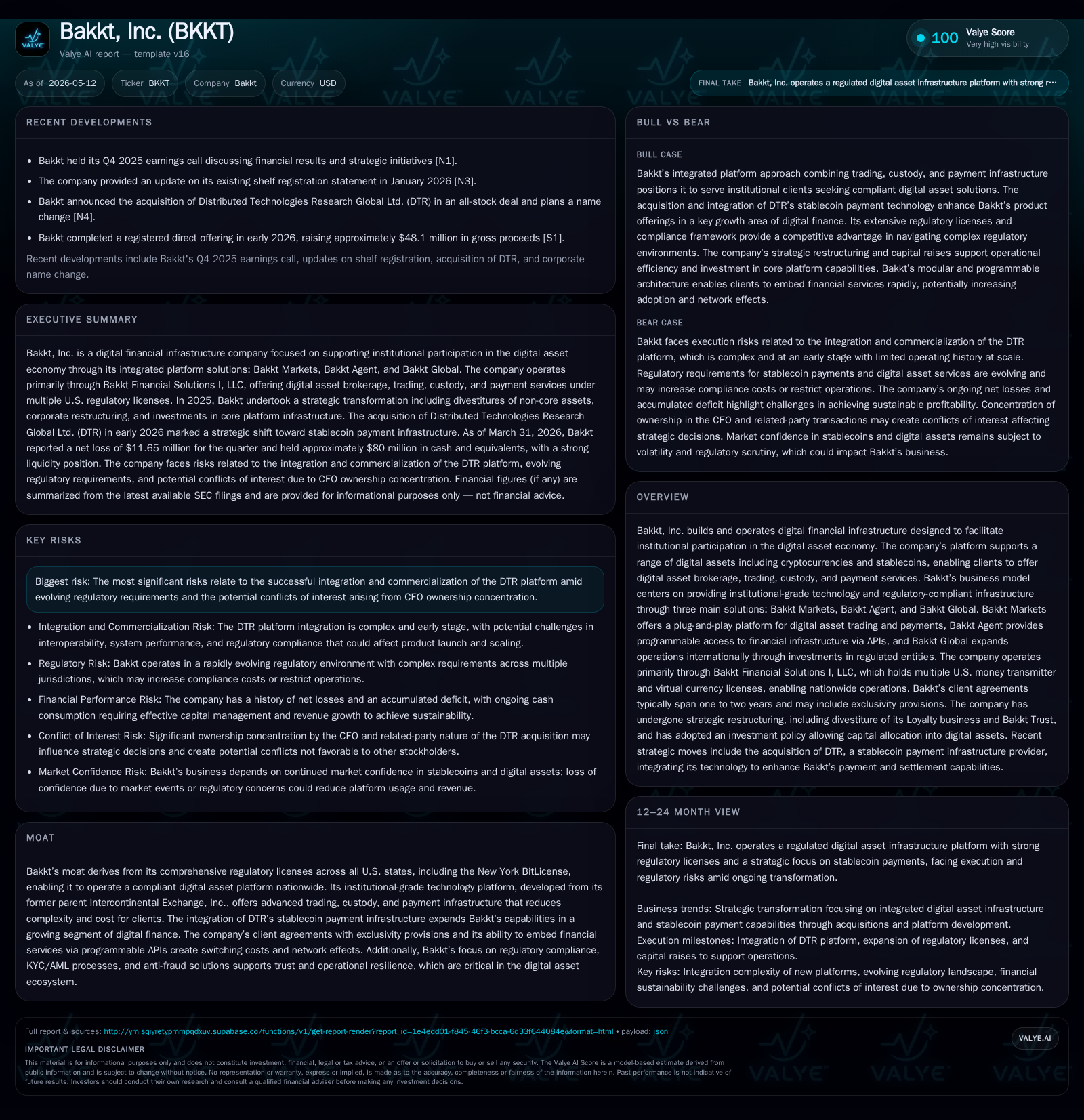
Bakkt, Inc. released its Q1 2026 results emphasizing the strategic pivot toward stablecoin-based payments through the acquisition of Distributed Technologies Research Global Ltd. (DTR). This shift underpins a broader transformation from traditional digital asset brokerage to an institutional-grade, compliant infrastructure platform. However, integration of DTR’s nascent technology presents operational and regulatory risks that could affect growth trajectories and profitability. Bakkt’s regulatory licenses and legacy infrastructure provide a moat, but execution on the DTR platform and evolving multi-jurisdictional regulations remain key watchpoints.
Recent Operating Update: Q1 2026 Highlights and Why They Matter
Bakkt filed its latest 10-Q on May 11, 2026 [S2], revealing that the company’s primary near-term focus is the integration and commercialization of Distributed Technologies Research Global Ltd. (DTR), acquired earlier this year. This acquisition signals an explicit strategic pivot toward stablecoin-based payment infrastructure and expands Bakkt's service offerings beyond its traditional digital asset trading platforms. The Q1 update illustrates significant operational demands due to architectural differences between DTR systems and Bakkt's legacy technology stack; these require extensive coordination across engineering, compliance, risk management, and operations.
Stablecoins now represent a core thrust of Bakkt’s growth strategy amidst a global trend favoring programmable money forms offering lower latency settlement and broader financial utility [S2]. Yet this shift introduces exposure to emerging regulatory frameworks that are complex and vary widely by jurisdiction. Moreover, toxicities inherent in nascent products mean DTR offerings have limited operating history at scale, heightening commercial execution risk.
The company reported cash & equivalents of approximately $80 million as of Q1-end [F1], with no current debt [F1], reflecting a healthy liquidity position to fund ongoing integration and product development efforts despite recent operating losses reported in previous periods [F1].
Alongside the quarterly report, an 8-K filing issued contemporaneously underscored Bakkt's intent to leverage proceeds from a stock offering completed early in 2026 to fuel new product activations and general corporate needs [S3]. This financial flexibility supports Bakkt's ability to innovate within an evolving competitive landscape.
Business Model: How Bakkt Makes Money and Strategic Strengths
Bakkt earns revenue primarily by providing regulated digital asset infrastructure services to large institutional clients including financial institutions, merchants, retailers, and third-party partners rather than direct retail consumers [S1]. Its platform supports brokerage, trading execution, custody solutions, stablecoin on/off ramps, and payment capabilities through:
- Bakkt Markets: A plug-and-play platform enabling clients to deploy secure digital asset trading with integrated custody and liquidity,
- Bakkt Agent: API-driven programmable access allowing clients to embed digital asset capabilities within their existing financial products,
- Bakkt Global: Drives international expansion via regulated partnerships focused on localized digital asset services.
The company's model features exclusive client agreements restricting referrals to competing platforms enhancing client stickiness. By holding all digital assets in omnibus wallets via Fireblocks Vault service under license agreements [S1], Bakkt controls custody securely while maintaining compliance with rigorous KYC/AML standards. This institutional-grade infrastructure reduces complexity and cost for customers seeking regulated participation in the digital asset economy.
Integration of the DTR stablecoin payment system is repositioning Bakkt further toward settlement solutions entwined with traditional finance systems but leveraging blockchain-native features for real-time clearing.
Industry Structure and Competitive Position
Bakkt occupies a mid-tier position within a highly fragmented but rapidly consolidating digital asset infrastructure industry dominated by key incumbents such as Coinbase Institutional Services, Fidelity Digital Assets, Paxos Trust Company, and Binance US (non-U.S.-regulated).
Its comprehensive array of U.S. state-level money transmitter licenses — notably including New York's BitLicense — differentiates Bakkt as one of few enterprises able to offer nationwide regulated services spanning exchanges, custody, payments, and treasury integrations [S10]. Originating from Intercontinental Exchange technology heritage confers operational robustness favored by institutional clients wary of security breaches or regulatory noncompliance.
The ongoing industry evolution favors platforms embedding AI-driven decision-making tools combined with multi-asset class trading support. Bakkt’s roadmap to integrate such capabilities positions it competitively yet depends crucially on execution pacing.
Growth Drivers
Several fundamental trends underpin growth opportunities:
- Institutional Adoption: Financial institutions seek regulated entry points into digital assets backed by trustable compliance frameworks—an area where Bakkt already has traction with its licensed architecture.
- Stablecoin Payment Expansion: With annualized transaction volumes exceeding $10 trillion industry-wide recently, stablecoins increasingly serve as critical rails for corporate treasury management and cross-border settlements; Bakkt bets heavily here via DTR.
- API Programmability & AI Integration: Enabling clients to embed sophisticated financial products powered by artificial intelligence within existing workflows opens novel revenue streams.
- International Expansion: Regulatory-outbound investments through Bakkt Global allow access to external markets requiring local licenses but offering untapped customer bases.
Risks / Watchpoints / Growth Constraints
Despite compelling prospects, several headwinds could impede execution:
What To Watch Next
Investors will want to monitor:
- Progress milestones on fully integrating DTR’s payment rails into Bakkt’s platform,
- Updates on obtaining additional regulatory licenses or clarifications especially regarding stablecoins across multiple jurisdictions,
- Client onboarding numbers for new stablecoin-enabled offerings post-integration,
- Revenue composition shifts reflecting growth in payment vs. trading segments,
- Legal resolution developments pertaining to Loyalty business sale disputes,
- Management commentary during next quarterly earnings on profitability improvement timelines given current operating losses,
- Stability trends in major stablecoin issuers affecting transactional volumes using Bakkt’s infrastructure.
Financial Profile Summary (Latest Quarter Context)
Latest financial snapshot
| Metric | Value | Period |
|---|---|---|
| Cash & equivalents | $80mm | |
| 2026-03-31 | ||
| Current assets | $125mm | |
| 2026-03-31 | ||
| Current liabilities | $30mm | |
| 2026-03-31 | ||
| Current ratio | 4.13x | |
| 2026-03-31 |
Source: SEC companyfacts cache [F1].
- No updated debt data was reported; prior filings indicate zero debt [F1].
Disclaimer: This analysis is based solely on information publicly available as of May 12th, 2026 from SEC filings and company disclosures cited herein. It does not constitute investment advice or recommendations for any securities mentioned.
Disclaimer: This is research-only, informational analysis and not investment advice. It may include AI-generated interpretation and general industry context. Always verify important details using primary sources.

Comments