
Sonida Senior Living Expands Portfolio Through CHP Merger Amid Rising Leverage and Operational Challenges
The recent CHP merger significantly reshapes Sonida’s asset base and capital structure, impacting near-term operations and growth prospects.
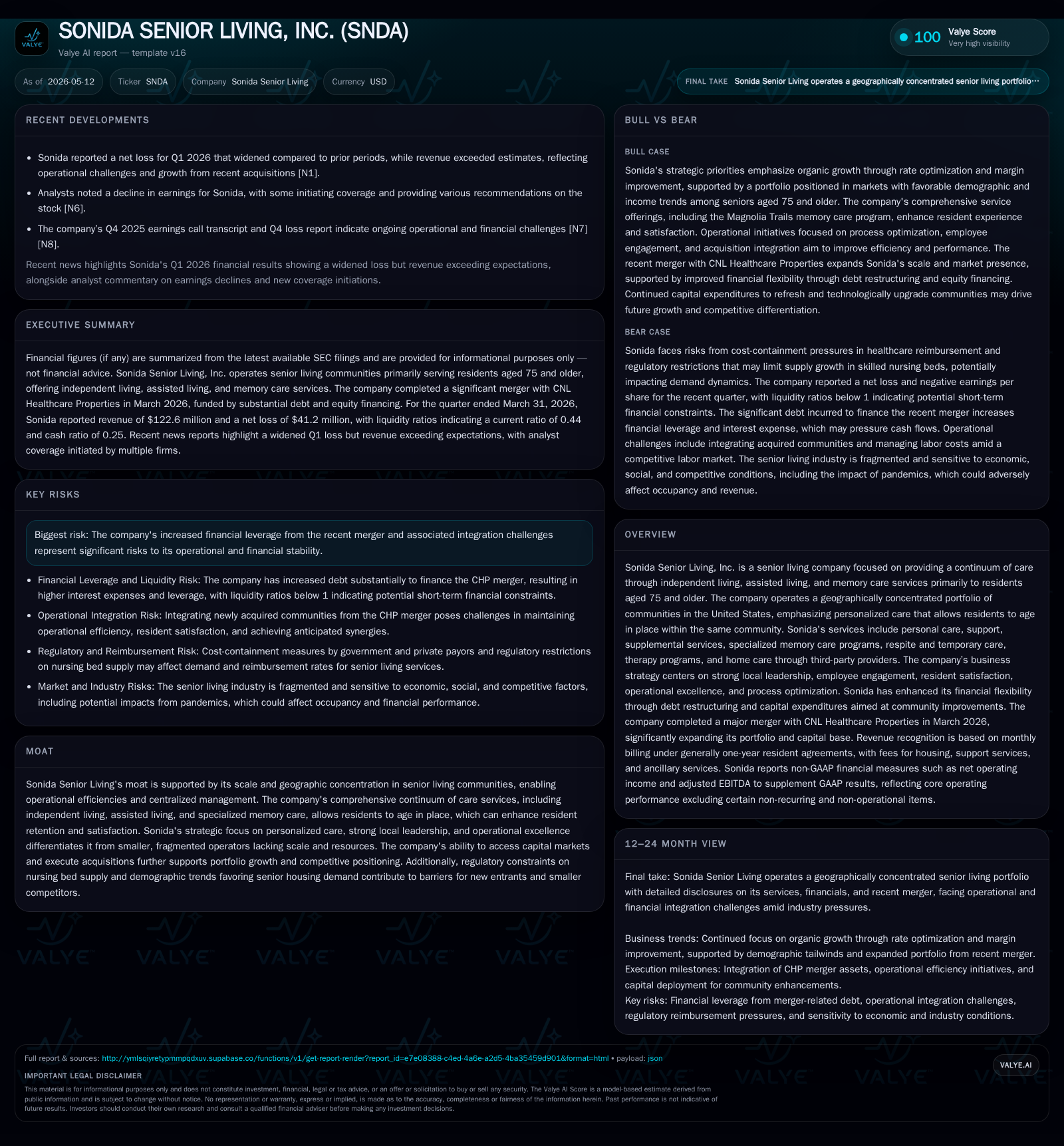
Sonida Senior Living, Inc. reported a transformative first quarter following its acquisition of CNL Healthcare Properties (CHP), integrating a large portfolio that dramatically increased its scale and leverage. The company’s business model hinges on providing a continuum of senior care services that allow residents to age in place, leveraging geographic concentration and operational efficiencies. While the merger enhances market presence and offers growth avenues through improved economies of scale and expanded offerings, it also introduces integration risks and elevated financial leverage that constrain liquidity and operational flexibility. Structural demand drivers in senior housing remain favorable due to aging demographics, but rising debt levels and integration execution will be critical factors to monitor.
Recent Operating Update: Transformative Merger Reshapes Sonida’s Scale and Capital Structure
Sonida Senior Living’s latest quarterly filing dated May 11, 2026 [S2] reveals a pivotal transformation stemming from its completion of the acquisition of CNL Healthcare Properties (CHP) communities earlier that quarter. The company reported cash payments totaling approximately $913 million for this acquisition after adjusting for cash acquired [S2]. This strategic move enlarged Sonida’s community footprint substantially.
The immediate operational impact was reflected in the first quarter ending March 31, 2026 results where net cash from operating activities swung sharply negative by $35.9 million versus positive cash flow of $3.8 million in Q1 2025. This deterioration primarily relates to non-cash transaction expenses tied to the merger and fluctuations in deferred resident revenue balances as operations transitioned [S2]. Meanwhile financing activities surged with over $1 billion generated mostly from new debt issuance including term loans ($550 million), bridge facility borrowings ($270 million), revolving credit enhancements ($282.5 million), alongside a private placement equity raise near $109 million to partially fund acquisition costs [S2]. Concurrently, repayments totaling over $159 million were made on existing credit lines and bridge facilities.
This dynamic underscores a phase of deliberate financial repositioning accompanying Sonida’s strategic growth pivot toward scale consolidation.
Business Model: Continuum of Senior Care Emphasizing Aging-in-Place
Sonida operates a geographically focused portfolio predominantly across U.S. regions where it deploys a continuum-of-care approach spanning independent living, assisted living, memory care services alongside respite and temporary care support [S1]. The company aims to provide personalized care models allowing residents aged mostly above 75 years to age comfortably within the same community without disruption—a value proposition driving higher resident satisfaction and retention.
Revenue streams derive primarily from monthly fees charged for housing combined with varying levels of personal care services administered by on-site staff or through third-party home care providers [S1]. Pricing reflects service intensity (e.g., memory care commands premium rates) and community amenities. Resident volume trends depend on occupancy levels supported by marketing efforts targeting seniors or their families. Contractual relationships are generally month-to-month with some longer-term accommodations for assisted or memory care.
Operational efficiency benefits from centralized management structures paired with strong local leadership teams who emphasize employee engagement to foster loyalty crucial in face of labor market tightness [S1]. Sonida routinely invests capital expenditures in community refurbishments to maintain standards demanded by residents and regulators alike.
Industry Structure and Competitive Position
Senior living represents a fragmented industry landscape dominated by regional operators yet increasingly favoring players like Sonida who achieve scale sufficient to deliver consistent service quality while controlling costs through geographic concentration. Regulatory frameworks limit nursing bed expansions thereby indirectly elevating barriers to entry for new competitors while sustaining demand for non-nursing senior living options [S1].
Sonida’s moat emanates from several factors:
- Economies derived from operating multiple proximate communities enable shared resources reducing overhead per unit.
- Comprehensive service arrays supporting aging-in-place reduce resident churn compared with specialty-only operators.
- Access to capital markets facilitates strategic acquisitions reinforcing market share.
- Focus on employee retention mitigates one of the largest cost variability sources—staff turnover.
Competitors range from smaller local entities lacking extensive capital backing to large diversifed senior housing REITs or hospitality companies expanding into healthcare-adjacent sectors.
Growth Drivers
Several key forces underpin Sonida’s growth outlook:
Demographic tailwinds: The U.S. population segment aged 75+ continues expanding structurally due to aging Baby Boomers creating sustained demand for senior living solutions offering security plus healthcare support.
Aging in place strategy: Delivering integrated living options increases resident duration within communities thus stabilizing occupancy rates which traditionally fluctuate with health status transitions requiring moves.
Capital reinvestment program: Ongoing refurbishments address competitive pressures around physical appearance, amenities quality improvement which directly influence resident attraction/retention.
Acquisitive expansion: The CHP merger exemplifies Sonida’s ability to execute accretive portfolio growth enlarging footprint while leveraging fixed-cost infrastructure/tools/services across a broader base.
Operational excellence initiatives: Process optimization efforts target labor cost controls amidst wage inflation pressures while maintaining service quality crucial for reputation score enhancement.
These dynamics collectively forecast top-line growth potential moderated by operational execution on margins.
Risks and Growth Constraints
While opportunities abound, notable risks temper near-term outlook:
Elevated financial leverage: As of March 31, 2026 end of quarter balance sheet data shows total debt exceeding $1.63 billion against cash reserves below $85 million implying net debt near $1.55 billion with current ratio at 0.44—a liquidity metric signaling tight short-term asset coverage [F1]. This high leverage heightens vulnerability to interest rate hikes or economic shocks that could impair refinancing capacity or increase funding costs. Covenant compliance presents an ongoing watchpoint given cross-default provisions exist.
Integration complexity: Merging CHP communities involves consolidating operational cultures, IT systems, workforce realignment alongside regulatory compliance adjustments which may temporarily disrupt service delivery or inflate costs beyond expectations [S13].
Market cyclicality: Although demographic drivers are structurally positive long-term, occupancy rates can remain sensitive to economic downturns influencing affordability or consumer confidence impacting demand acceleration/deceleration cycles.
Regulatory environment: Variations in state Medicaid provider rules or licensure requirements may necessitate costly upgrades or constrain community operations adding overhead burdens.
Labor market tightness: Managing workforce shortages especially caregiving roles remains challenging requiring ongoing investment in training plus retention programs which if unsuccessful inflate margin pressures [S1].
What to Watch Next
Investor focus should track several indicators:
- Post-merger occupancy trends across combined portfolio signaling integration success versus attrition risks.
- Progress against operational cost control goals including labor expense ratios relative to revenue growth.
- Refinancing moves as bridge loan matures in March 2027; any upward pressure on interest rates could affect cost profile materially.
- Updates on covenant compliance status particularly liquidity thresholds given tight current ratio metrics [F1].
- Capital expenditure spend pacing tied to property improvements influencing resident satisfaction scores over upcoming quarters.
- Resident retention rates within memory care segments where pricing premiums heavily depend on service quality differentiation.
- Management commentary on pipeline possibilities for further bolt-on acquisitions enhancing concentrated market footprint.
Financial Profile Snapshot (as of March 31, 2026)
Latest financial snapshot
| Metric | Value | Period |
|---|---|---|
| Cash & equivalents | $84mm | |
| 2026-03-31 | ||
| Total debt | $1637mm | |
| 2026-03-31 | ||
| Net debt | $1552mm | |
| 2026-03-31 | ||
| Current assets | $147mm | |
| 2026-03-31 | ||
| Current liabilities | $334mm | |
| 2026-03-31 | ||
| Current ratio | 0.44x | |
| 2026-03-31 |
Source: SEC companyfacts cache [F1].
| Metric | Value | Period End |
|---|---|---|
| Cash & Equivalents | $84.3 million | |
| 2026-03-31 | ||
| Total Debt | $1.64 billion | |
| 2026-03-31 | ||
| Net Debt (approximate) | $1.55 billion | |
| 2026-03-31 | ||
| Current Assets | $146.7 million | |
| 2026-03-31 | ||
| Current Liabilities | $333.7 million | |
| 2026-03-31 | ||
| Current Ratio | 0.44 | |
| 2026-03-31 |
The balance sheet reflects substantial debt load largely stemming from the recent acquisition financing combined with limited short-term liquidity cushion implying careful cash flow management is critical going forward [F1],[S2],[S3]. Higher interest expense associated with increased borrowings exerts pressure on profitability margins amid still recovering operating results post-merger [S22].
Disclaimer
This analysis is for informational purposes only and does not constitute investment advice or a recommendation regarding any securities issued by Sonida Senior Living, Inc., nor does it express any opinion on valuation merits. Users should perform their own due diligence before making any financial decisions.
Disclaimer: This is research-only, informational analysis and not investment advice. It may include AI-generated interpretation and general industry context. Always verify important details using primary sources.

Comments