
Harrow Navigates Pricing Pressures and Expands Ophthalmic Portfolio Amid Strategic Acquisitions
Harrow's latest quarterly filing reveals challenges in reimbursement alongside growth initiatives driven by product launches and a full acquisition of Melt Pharmaceuticals.
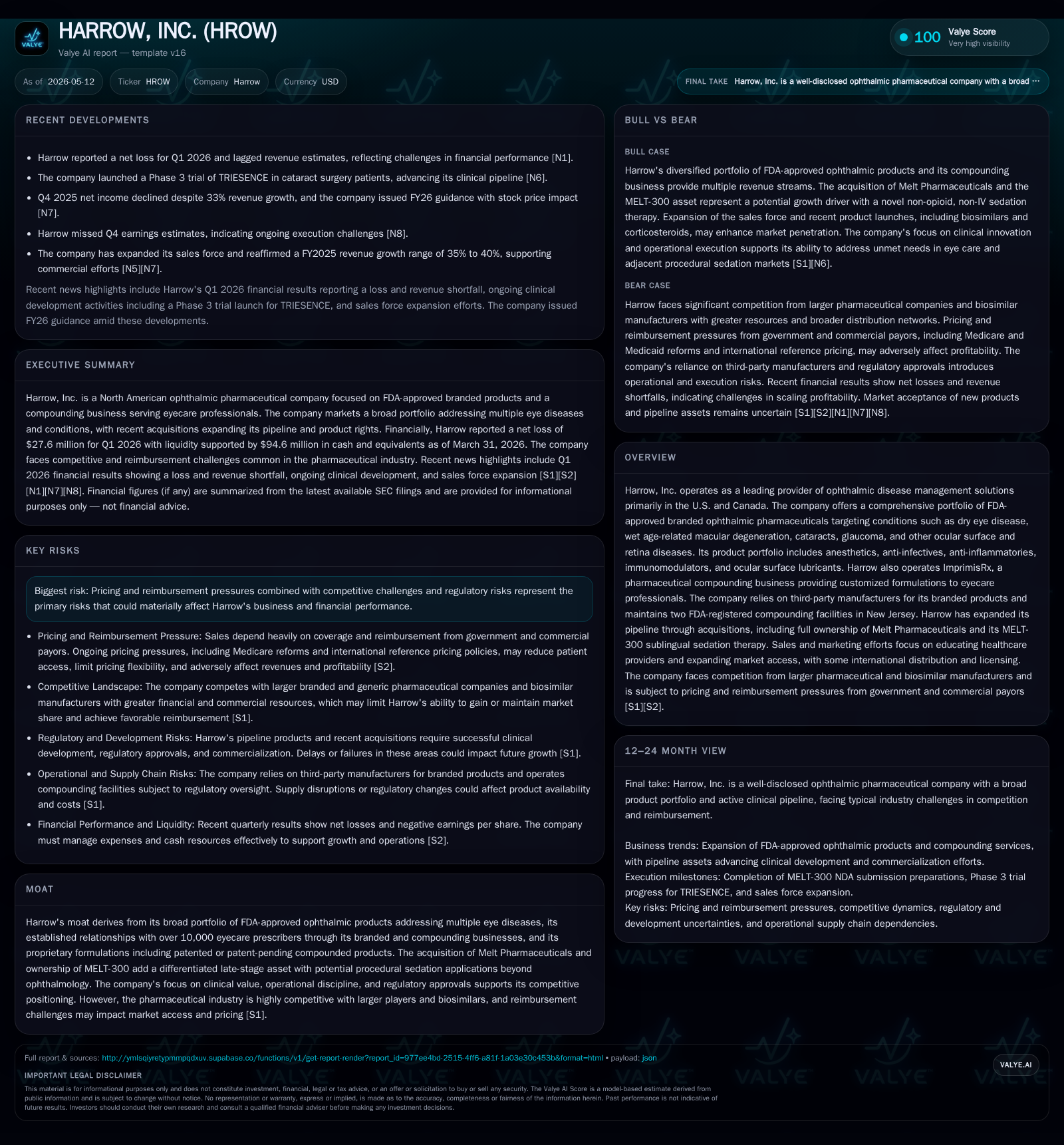
In its 2026 Q1 report, Harrow, Inc. disclosed ongoing pricing and reimbursement headwinds affecting revenue growth, while strategically expanding its FDA-approved ophthalmic portfolio and compounding capabilities. The company completed the full acquisition of Melt Pharmaceuticals late in 2025, gaining control of MELT-300, a late-stage sedation asset outside ophthalmology that could diversify future revenue streams. Harrow remains focused on scaling branded sales in the U.S. and Canada despite competitive and regulatory pressures prevalent in the ophthalmic pharmaceuticals sector.
Recent Operating Update: Q1 2026 Highlights
Harrow, Inc.’s latest quarterly filing (10-Q as of May 11, 2026) signals a mixed near-term operating environment marked by continued reimbursement pressures impacting profitability [S2]. The company reported Q1 losses that trailed some analysts’ revenue expectations according to market commentary [N1]. Management reiterated exposure to payor-driven cost containment tactics such as prior authorizations and formulary restrictions that directly limit patient access and curb price increases for its branded ophthalmic pharmaceuticals [S2]. These reimbursement challenges are compounded by legislative initiatives targeting drug prices under Medicare Part B—including application of international reference pricing frameworks—which could raise expected rebate obligations over the medium term.
Concurrently, Harrow issued an updated corporate presentation (8-K also filed May 11) reinforcing its strategy to leverage recent product launches and pipeline expansion from the Melt Pharmaceuticals acquisition completed in November 2025 [S3]. The Melt deal gave Harrow full ownership of MELT-300, a proprietary non-intravenous sedation agent targeting procedural sedation markets beyond traditional ophthalmology use cases—a potential diversification play.
Business Model: Revenue Mechanics and Strategic Positioning
Harrow's business model revolves around developing, acquiring, marketing, and selling FDA-approved branded ophthalmic pharmaceuticals primarily in the U.S. and Canadian markets [S1]. Revenue is generated through wholesale distribution networks that supply these products to pharmacies and eyecare professionals. The company’s offerings span several therapeutic categories including anesthesia (IHEEZO), dry eye disease (VEVYE), steroids (TRIESENCE), immunomodulators, anti-infectives, ocular lubricants, and more recently biosimilars for wet age-related macular degeneration (BYOOVIZ) and diabetic retinal diseases (OPUVIZ).
By owning the U.S. commercial rights to these key products, Harrow monetizes both volume sold—driven by growing physician adoption—and pricing influenced heavily by coverage policies dictated by third-party payors. Product mix enhancements from proprietary technologies such as VEVYE’s novel water-free vehicle provide differentiation versus generic alternatives [S1]. Margins derive from manufacturing outsourcing combined with internally operated compounding facilities through its ImprimisRx subsidiary. This unit produces customized formulations—though not FDA-approved themselves—that address unmet clinical needs when standard therapies fall short or require off-label modification [S15].
This hybrid business model combining branded pharmaceuticals with a compounding pharmacy platform underpins Harrow’s operational leverage but also exposes it to regulatory complexities affecting compounding activities especially as federal and state oversight evolve [S22].
Industry Structure and Competitive Position
The ophthalmic pharmaceuticals segment is characterized by high regulatory barriers due to FDA approval requirements and complex reimbursement environments influenced by public programs like Medicare/Medicaid alongside commercial payors. Competition includes large pharmaceutical companies marketing well-established brands alongside biosimilars entering key retina indications. Harrow’s acquisitions strategy enables rapid portfolio breadth expansion but places it against entrenched incumbents with deeper resources.
Harrow maintains relationships with over 10,000 eyecare prescribers across both its branded product sales and compounding business—an important moat given physician prescribing behavior trends toward innovative formulations that improve patient compliance or clinical outcomes [S1]. Its proprietary compounded formulations benefit from patent protection or pending patents while its branded approved drugs leverage traditional patent life cycles plus regulatory exclusivities to defend against competition.
However, payor-driven pricing scrutiny intensifies pressure on gross-to-net realizations and compresses margins industry-wide [S2]. Furthermore, legal risks persist as manifested by ImprimisRx’s ongoing appeal process following a trademark infringement trial win with OSRX which could affect brand positioning or operational continuity should adverse rulings emerge [S9].
Growth Drivers
Product Launches and Pipeline Expansion
Key upcoming catalysts stem from commercial launches of biologic biosimilars BYOOVIZ (ranibizumab) expected mid-2026 and OPUVIZ (aflibercept) targeted for mid-2027 [S1]. These launches address sizable retina disease markets traditionally served by blockbuster originators Lucentis® and Eylea® but face competitive pricing expectations.
Further upside is anticipated from milestone achievements around MELT-300’s regulatory approvals outside ophthalmology as Harrow aims to expand beyond strictly eye care into sedation therapeutics—leveraging Melt Pharmaceuticals’ proprietary non-intravenous delivery technology [S1][S14].
Market Penetration & Physician Adoption
The company’s extensive engagement programs aimed at educating physicians and surgery centers on product benefits constitute a structural advantage enabling faster adoption curves relative to smaller or less specialized competitors. Sales efforts also focus on ambulatory surgery centers (ASCs), increasingly important venues for eye surgeries where perioperative inflammation control agents like BYQLOVI can command premium positioning once launched.
Compounding Business Expansion
ImprimisRx continues advancing customized formulations that supplement branded product revenue while mitigating generic substitution risks. Operating two FDA-registered compounding facilities allows scale-up potential within current regulatory frameworks if demand expands without incremental fixed costs disproportionate to volumes [S15].
Risks & Watchpoints
Pricing & Reimbursement Constraints
Government action on drug pricing—including under Medicare Part B mechanisms proposing international reference pricing—poses substantial risk to achievable net prices for key ophthalmic products given their inclusion in demonstration models like GLOBE and GUARD affecting rebate obligations [S2][S22]. Commercial insurer adoption of utilization management tools further limits volumes reimbursed.
Regulatory & Legal Uncertainty
Compounded product categories require vigilant compliance with evolving state/federal laws which may disrupt production or restrict market access for certain formulations impacting ImprimisRx revenue streams. Additionally, the ongoing OSRX trademark litigation appeal injects legal risk unpredictability despite favorable jury findings previously recorded [S12].
Competitive Intensity & Innovation Pace
Biosimilar entrants into retina treatment markets could induce price erosion beyond projections challenging gross margins on newer product launches. Larger pharma rivals wield significant R&D budgets to develop next-generation therapies potentially overshadowing Harrow's incremental innovation trajectory.
Leverage & Financial Flexibility Constraints
With approximately $250 million total debt outstanding at end-2025 offset partially by $94.6 million cash reserves resulting in net debt around $155 million [F1], the company’s debt profile demands effective cash flow management especially if margin pressures intensify or milestone payments related to Melt acquisitions accelerate ahead of proportional revenue gains.
What to Watch Next
- Initial market uptake metrics for BYOOVIZ following mid-2026 launch including physician prescribing penetration versus established Lucentis brand benchmarks.
- Regulatory milestone progress and commercialization planning updates for OPUVIZ scheduled for mid-2027.
- Industry or CMS announcements clarifying operational details or expanded scopes regarding Medicare Part B drug pricing reforms impacting ophthalmology agents.
- Outcomes of OSRX litigation appeal which may influence trademark enforcement strength or competitive positioning within compounded formulation segment.
- Quarterly updates on ImprimisRx production capacity utilization amid any new state or federal compounding regulations.
- Further integration outcomes post-Melt acquisition including R&D pipeline developments for sedation therapeutics beyond ophthalmology.
- Cash flow generation versus debt service needs signaling financial health given reported net losses in recent periods [F1].
Financial Profile Brief Snapshot
Latest financial snapshot
| Metric | Value | Period |
|---|---|---|
| Cash & equivalents | $95mm | |
| 2026-03-31 | ||
| Total debt | $250mm | |
| 2025-12-31 | ||
| Net debt | $155mm | |
| 2025-12-31 | ||
| Current assets | $226mm | |
| 2026-03-31 | ||
| Current liabilities | $91mm | |
| 2026-03-31 | ||
| Current ratio | 2.48x | |
| 2026-03-31 |
Source: SEC companyfacts cache [F1].
As of March 31, 2026, Harrow held $94.6 million in cash & equivalents against total debt near $250 million as of December 31, 2025 leading to net debt approximating $155 million [F1]. Current assets stood at $226 million versus current liabilities near $91 million yielding a healthy current ratio of approximately 2.48 indicating solid short-term liquidity coverage under normal operations [F1]. Despite a net loss position recorded at fiscal year-end 2025 [-$5.14 million] offsetting prior operating income gains [$30.51 million] reflects ongoing investment phases particularly post-Melt acquisition integration [F1]. Margin resilience amid reimbursement challenges will be critical going forward alongside disciplined expense control.
This analysis is based exclusively on publicly filed documents as of May 11–12, 2026 ([S1]–[S3]) supplemented by validated numeric facts ([F1]) and relevant industry context. It does not constitute investment advice or reflect recommendations but aims to provide a detailed operating and strategic appraisal grounded strictly in disclosed company information.
Disclaimer: This is research-only, informational analysis and not investment advice. It may include AI-generated interpretation and general industry context. Always verify important details using primary sources.

Comments