
Veradermics Advances Oral PHL Therapy with Trial Progress and Strategic Positioning
Latest quarterly filings confirm full enrollment in pivotal trials of oral minoxidil candidate VDPHL01, setting the stage for regulatory submissions and commercial readiness.
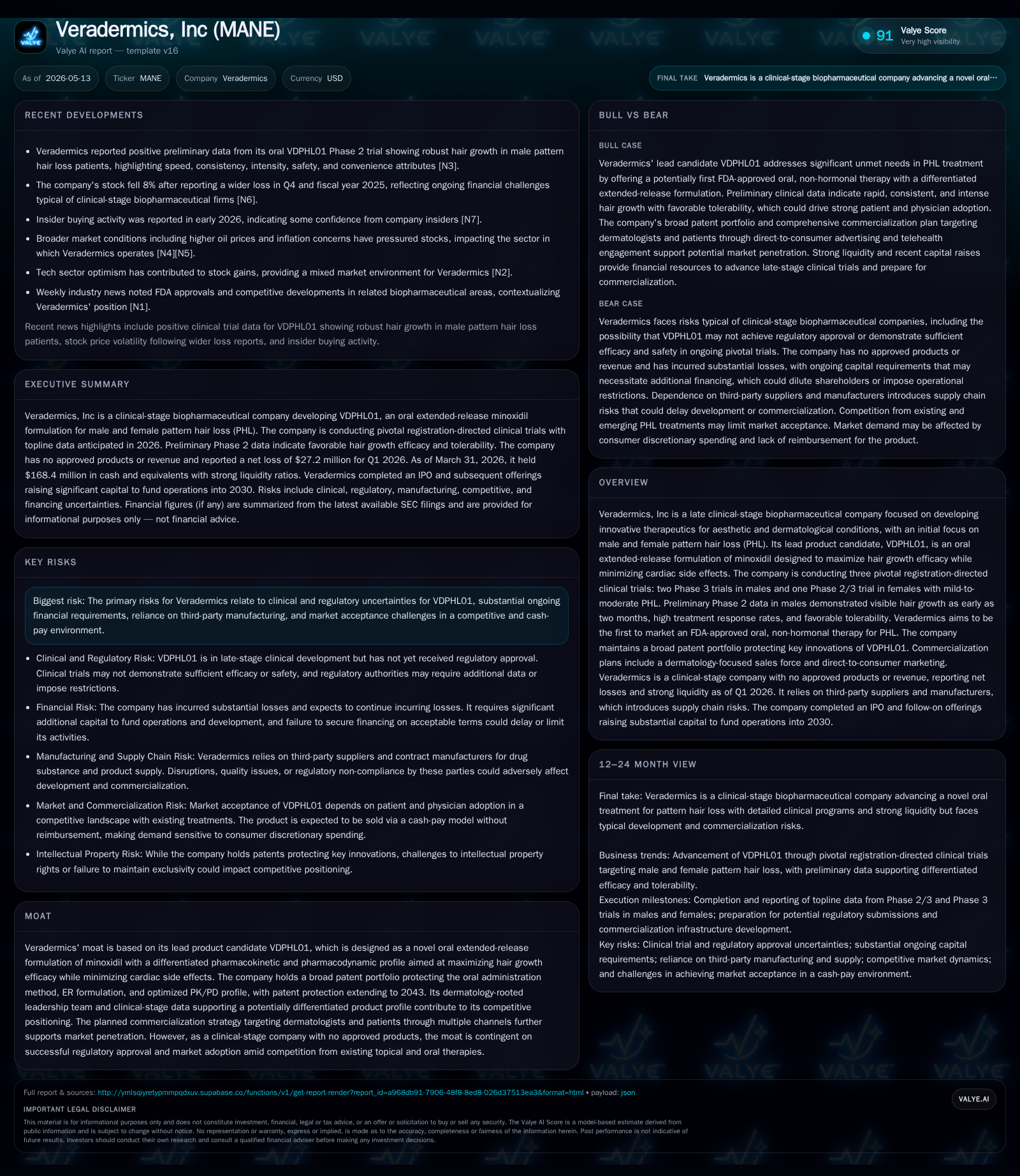
In its Q1 2026 update, Veradermics announced the completion of enrollment across all registration-directed clinical trials for its lead product candidate VDPHL01, an innovative oral extended-release minoxidil formulation targeting pattern hair loss (PHL). This milestone advances the company toward planned FDA submissions for both male and female PHL populations. Veradermics’ unique pharmacokinetic design and broad patent protection underpin a differentiated positioning in a market dominated by topical treatments with significant limitations. Growth is poised to be driven by upcoming top-line data from Phase 3 studies, a comprehensive direct-to-consumer marketing strategy, and an expansive addressable market, albeit tempered by clinical, regulatory, and reimbursement risks inherent to late-stage biopharma development. The company's strong cash position supports ongoing pivotal trial execution and progression toward commercialization.
Quarterly Operating Milestones and Regulatory Trajectory
Veradermics’ May 12, 2026 Form 10-Q [S2] marks a critical juncture as the company reported completing enrollment for its three pivotal registration-directed clinical trials of VDPHL01 — two Phase 3 trials in males totaling over 1,000 patients combined and one Phase 2/3 trial in females involving more than 500 subjects [S2][S3]. The enrollment closure reflects readiness to progress toward data analysis phases essential for New Drug Application (NDA) submission under the FDA’s 505(b)(2) pathway. This development sharpens previous timing assumptions anchored on trial completions in mid-2026 or shortly thereafter.
Notably, the aggregate trial design encompasses multi-center randomized double-blind placebo-controlled methodologies assessing dual dosing regimens tailored to mild-to-moderate pattern hair loss (PHL). Completing these enrollment milestones reduces one principal uncertainty vector — patient recruitment speed — providing a clearer line of sight on regulatory engagement scheduling. In parallel with data cut-offs anticipated within this calendar year or soon after, Veradermics can refine strategies for launch preparation contingent on positive efficacy and safety outcomes [S2][S3].
Innovative Therapeutics Model: VDPHL01’s Formulation and Differentiators
At the foundation of Veradermics’ value proposition is VDPHL01 — an oral extended-release (ER) minoxidil formulation leveraging proprietary pharmacokinetic (PK) optimization designed to enhance follicular saturation duration while curtailing systemic cardiac stimulation risks intrinsic to immediate-release (IR) formulations traditionally prescribed off-label [S1]. Importantly, IR oral minoxidil was originally indicated for resistant hypertension with observed hair growth as a side effect but suffered from rapid clearance requiring low dosing to mitigate cardiac adverse effects — hampering its therapeutic ceiling in hair follicle targeted applications.
VDPHL01's ER formulation extends plasma exposure without peak-associated adverse events via controlled minoxidil release kinetics. As such, it aims to elevate total plasma concentrations implicated in hair regrowth efficacy while managing pharmacodynamic tolerability specifically related to cardiac side effects. This nuanced delivery profile represents a critical differentiation point relative to existing topical therapies marred by inconvenient administration patterns and incomplete compliance.
Complementing this mechanistic innovation is Veradermics' extensive patent portfolio protecting the ER formulation technology, methods of oral administration specific to PHL treatment, and optimized PK/PD profiles — collectively underpinning exclusivity through at least 2043 [S1]. The dermatology-rooted leadership’s expertise further reinforces development execution capabilities aligned with creating a first-to-market FDA-approved oral non-hormonal therapy addressing substantial unmet medical need.
Competitive Landscape and Industry Dynamics in PHL Treatment
The pattern hair loss treatment industry remains fragmented with a heavy reliance on topical options such as topical minoxidil products that require daily scalp application often associated with undesirable side effects like scalp irritation or cosmetic dissatisfaction. Hormonal therapies remain another pillar but are primarily prescribed for men due to female safety concerns. Generic oral medications sometimes used off label lack formal regulatory endorsement impeding mainstream adoption among physicians.
Veradermics’ strategy banking on FDA approval for an oral non-hormonal agent positions it uniquely to overcome these entrenched limitations [S1]. However, competitive threats emerge not only from existing generics but also alternative pipeline entrants aiming at diverse mechanisms or modalities. Payor pressures compound these challenges; third-party payors increasingly scrutinize drug price justification mandating cost-effectiveness data which may necessitate expensive pharmacoeconomic studies beyond clinical trials [S1]. Market acceptance will partly hinge on physician education efforts underscored by scientifically substantiated safety-efficacy balances distinct from off-label contemporaries.
Drivers of Growth: Clinical Progress, Market Demand, and Commercial Strategy
Robust preliminary phase 2 data demonstrating visible hair regrowth as early as two months into treatment combined with high response rates substantiate early indicators of VDPHL01's therapeutic potential validated across genders [N5][S1]. These developments serve dual roles: bolstering internal confidence ahead of pivotal readouts while fueling external stakeholder interest.
The addressable U.S. market exceeds approximately 80 million individuals affected by PHL including both males (50 million) and females (30 million), underscoring considerable revenue opportunity should adoption barriers be surmounted [S1]. Veradermics’ commercialization blueprint incorporates comprehensive direct-to-consumer (DTC) digital advertising spanning social media platforms alongside targeted search engine marketing aimed at high-incidence demographics known for active health information seeking behaviors—a modernized approach likely more cost-efficient than conventional channels [S1].
Moreover, dermatologist engagement remains central given their gatekeeper role influencing prescribing patterns and patient management recommendations; effective provider outreach paired with demonstrable real-world evidence will be crucial levers.
Patent longevity through mid-century further secures exclusivity enabling distinct premium positioning pending sustained efficacy demonstration coupled with safe tolerability profiles [S1][N5].
Key Risks and Structural Constraints Affecting Veradermics’ Advancement
Veradermics faces classical late-stage biopharmaceutical risks encompassing uncertainty over final phase trial outcomes which could delay or negate FDA approvals despite encouraging earlier phase signals [S2][S4]. Regulatory review timelines themselves may extend unexpectedly due to agency resource constraints or evolving standards adding unpredictability.
Financially, the company reports significant quarterly losses driven largely by high clinical trial expenses related to multiple concurrent late-stage programs representing standard clinical-stage burn characteristics [F1][S2]. Although cash reserves were robust at $168.4 million at quarter-end March 31, 2026 against nominal short-term liabilities indicating sufficient runway near term [F1], sustained capital requirements persist notably ahead of commercialization infrastructure buildout preparations including sales forces deployment.
Third-party contract manufacturing dependencies introduce potential production bottlenecks or compliance challenges under cGMP rules which could impede timely product availability post-approval [S8]. Furthermore, reimbursement environment complexity—in particular prevalent reliance on self-pay aesthetic markets rather than comprehensive insurer coverage—could constrain uptake velocity imposing real-world economic barriers [S1]. Intellectual property litigation risks remain present although less emphasized at this juncture provided defense resources remain adequate [S12][S22]. Cybersecurity threats towards sensitive trial data pose ancillary operational vulnerabilities warranting ongoing vigilance [S15].
Upcoming Catalysts to Monitor for Development and Commercial Execution
Investors will closely track the anticipated topline readouts from the ongoing Phase 3 male PHL trials plus the Phase 2/3 female study potentially beginning in late 2026 or early 2027 per prior company guidance context; these datasets will heavily influence NDA filing strategies including possible simultaneous submissions across genders or staggered approaches based on data maturity timelines [S2][S3][S6].
Additionally important will be progress around formal interactions with the FDA regarding pre-NDA meetings confirming approval pathways and necessary post-marketing commitments if any arise. Concurrently monitoring any expansion announcements relating to commercial infrastructure establishment particularly hiring sales/medical field teams or rollout pilots will shed light on go-to-market execution preparedness.
Potential inking of licensing or partnership agreements could also reshape resource allocation dynamics while signaling third-party validation of the asset’s commercial promise.
Financial Snapshot: Evaluating Capital Position and Investment Needs
Latest financial snapshot
| Metric | Value | Period |
|---|---|---|
| Cash & equivalents | $168mm | |
| 2026-03-31 | ||
| Current assets | $397mm | |
| 2026-03-31 | ||
| Current liabilities | $7mm | |
| 2026-03-31 | ||
| Current ratio | 59.12x | |
| 2026-03-31 |
Source: SEC companyfacts cache [F1].
As of Q1 end March 31, 2026, Veradermics reported cash & equivalents totaling $168.4 million supported by current assets of $397.1 million against only $6.7 million in current liabilities yielding an exceptionally strong current ratio of approximately 59x underscoring minimal short-term liquidity strain [F1].
This financial posture supports continued operations through expected completion points for pivotal program data generation but will require additional capital infusions aligned with transitioning toward commercial activities including marketing spend escalation noted in forward-looking commentary [S2][S25]. Net losses continue reflecting burn consistent with intensive clinical development outlays recorded at $27.2 million in Q1 alone versus $12.4 million year-over-year earlier quarter illustrating acceleration of resource deployment typical at this late clinical stage [F1][S2].
This report is based exclusively on publicly available information including SEC filings through May 12, 2026 ([S1], [S2], [S3], etc.) and corroborating news sources where specified ([N5]). It does not offer investment advice or recommendations.
Disclaimer: This is research-only, informational analysis and not investment advice. It may include AI-generated interpretation and general industry context. Always verify important details using primary sources.

Comments