
GrowGeneration Faces Margin and Inventory Pressures Despite Market Consolidation and Proprietary Brand Expansion
GrowGeneration's Q1 2026 report highlights ongoing restructuring benefits on margins but rising operating cash demands and supply-chain cost pressures amid a competitive hydroponics market.
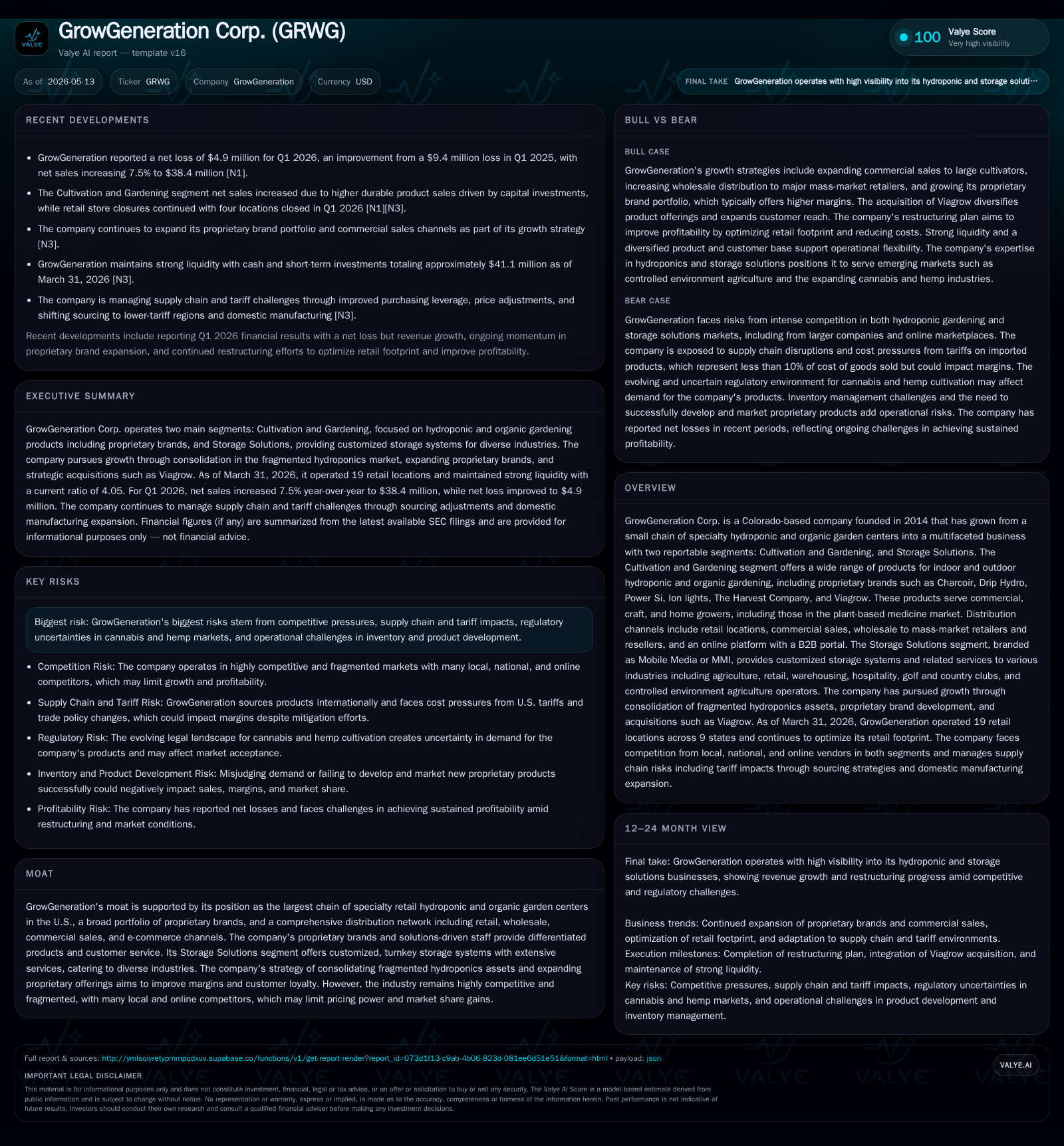
GrowGeneration continues to advance its growth by consolidating a highly fragmented hydroponics industry and expanding proprietary product offerings, targeting improved gross margins. The latest quarterly filing shows modest working capital decline due to operating cash use though liquidity remains solid with significant cash reserves. Key challenges include tariffs raising input costs, stiff competition limiting pricing power, and inventory management complexities. The company’s diversified distribution, growing proprietary brand portfolio, and focus on commercial growers provide differentiation in a large but competitive sector. Future growth hinges on optimizing product mix, successfully developing new proprietary products, and capitalizing on emerging markets such as cannabis cultivation while managing regulatory and supply risks.
Recent Operating Update
In its latest quarterly filing dated May 12, 2026 [S2], GrowGeneration reported working capital of $75.1 million as of March 31, 2026, down from $77.8 million at the close of 2025. This $2.7 million decrease was primarily attributed to net cash used in operating activities, reflecting ongoing investments in inventory and receivables management [S2]. The company held $41.1 million in combined cash, cash equivalents, and marketable securities at quarter-end [S2], maintaining a strong liquidity position with no known extraordinary claims or commitments against this capital.
Furthermore, GrowGeneration announced that its restructuring efforts had largely concluded by early 2025 after incurring about $3.5 million in related costs, including $1.1 million recognized in Q1 2025 [S2]. These restructuring initiatives centered on closing redundant or underperforming retail stores (over 19 closures since mid-2024), workforce reductions, and streamlining inventory procedures to improve efficiency [S2][S12]. The company expects these measures to deliver approximately $12 million in annualized savings going forward.
Operationally, the first quarter witnessed elevated cash flow consumption relative to prior year periods due to timing differences in receivables collections and inventory sell-through patterns [S11]. However, management affirmed sufficient liquidity without immediate financing needs for the next twelve months [S11].
Business Model
GrowGeneration operates through two primary segments: Cultivation and Gardening; and Storage Solutions [S1][S2].
The Cultivation and Gardening segment supplies an extensive range of products tailored for indoor/outdoor hydroponic and organic horticulture. Its product suite includes nutrients, lighting systems, environmental controls, irrigation components, growing media, and more [S1][S18]. A core strategic pillar is the proliferation of proprietary brands such as Charcoir coir mediums, Drip Hydro nutrient lines, Ion lighting solutions, PowerSi monosilicic acid supplements, The Harvest Company’s gardening tools, Viagrow supplies acquired in mid-2025 [S22], among others. These bespoke brands differentiate GrowGeneration’s offerings through enhanced product quality while yielding higher gross margins compared to third-party products [S18][S27].
Distribution is multi-channel: physical retail outlets (19 locations across nine states as of March 2026), commercial sales teams delivering ‘white glove’ services for large cultivators especially in cannabis/hemp markets, wholesale partnerships with mass-market retailers and independent resellers, plus a robust e-commerce platform featuring a B2B portal tailored for commercial/wholesale customers [S1][S18]. This channel diversity supports broad market reach from home gardening enthusiasts to industrial-scale cultivators.
The Storage Solutions segment markets customizable benching/racking/storage systems under the Mobile Media/Mobile Media Innovations (MMI) brand. These solutions target vertical space optimization across diverse industries beyond horticulture—ranging from controlled environment agriculture facilities to warehousing operations [S1][S18]. Although competitive pressures exist from both regional specialists and large generalist distributors alike, MMI differentiates through turnkey service offerings encompassing design consultation through installation [S18].
Revenue is principally driven by sales volume across these segments with pricing influenced by raw material costs (notably exposed to tariff fluctuations), product mix shifts favoring proprietary brands over lower-margin third-party merchandise, utilization rates of commercial services teams (influencing average revenue per customer), plus direct-to-consumer channel strength impacting unit velocity [S18][S22]. Margins remain sensitive to inventory turn dynamics because misjudging supply/demand forecasts could lead to excess or obsolete stock that impairs profitability.
Industry Structure and Competitive Position
The hydroponics industry remains fragmented with many small regional operators serving niche markets alongside some sizable chains like GrowGeneration that pursue consolidation strategies [S1][N1]. GrowGeneration claims the largest footprint in specialty hydroponic/organic garden centers nationwide with over half a million square feet allocated across retail stores plus warehousing/distribution hubs strategically positioned for speed-to-customer delivery [S18].
Nonetheless, barriers to entry are moderate: companies outside the traditional gardening space can pivot or expand into hydroponic supply given sufficient capital resources; likewise manufacturers might bypass intermediaries altogether by selling direct online or via broad-market retailers [S1][S14]. Competition also arises from local hydroponic shops providing personalized expertise plus lower overhead cost structures potentially allowing aggressive pricing.
GrowGeneration’s moat is anchored partly on scale advantages—bulk purchasing power reducing unit costs—and partly on its proprietary brand portfolio that aligns closely with customer needs gleaned from its own grower-origin management team who understand evolving technology trends within horticulture [S18]. Proprietary brands also foster switching costs since customers accustomed to specific nutrient formulas or lighting modules are less likely to move.
On the Storage Solutions side, competitors vary widely by scale; some may compete mainly through price while others emphasize service breadth or customization capabilities [S18]. MMI’s focus on comprehensive project delivery adds differentiation but cannot fully insulate against larger well-capitalized distributors who can bundle offerings.
Growth Drivers
Key growth avenues identified include:
Consolidation of Fragmented Hydroponics Retail: Continuing acquisitions or opening new centers helps build density advantages driving operational leverage alongside augmented geographic coverage especially in states with burgeoning cannabis markets [S6][N1].
Expansion of Proprietary Branded Product Sales: Increasing the proportion of revenue derived from higher-margin own-brand products improves overall gross margins while strengthening brand equity critical for repeat customers [S1][S18][S24].
Development of Commercial Sales Channel: Strengthening ‘white glove’ sales services for craft and commercial cultivators captures a specialized high-value segment requiring tailored solutions not offered by pure retail or wholesale players [S18][N1].
E-Commerce Platform Growth: Enhancing online B2B portal functionality facilitates broader reach into remote or smaller growers who require access yet lack local store options; better digital tools also improve ordering efficiency which can support margin gains indirectly via lower fulfillment costs [S18][N1].
Supply Chain Localization: Mitigating tariff impacts by shifting sourcing towards domestic manufacturing or low-tariff regions (e.g., Southeast Asia) reduces input cost volatility supporting more stable pricing structures [S22][S18].
Risks / Watchpoints / Growth Constraints
Several headwinds bear watching:
Tariff & Supply Chain Volatility: Tariffs implemented under recent U.S. trade policy changes have raised certain import costs by approximately 10% affecting key components sourced overseas including coir substrates and lighting parts. While offset strategies are underway they add complexity and risk margin erosion if not fully successful [S2][S22][S18].
Competitive Pricing Pressure: Although proprietary brands provide some insulation against discounting wars, overall pricing power remains limited due to both low switching costs at commodity levels and potential new entrants from larger distribution players with deep pockets entering this growing segment [S14][N1].
Inventory Management Challenges: Demand estimation is inherently uncertain amid regulatory flux affecting cannabis/hemp cultivation volumes; poor forecasts may lead to excess inventory write-downs or stock shortages dampening customer satisfaction and revenue stability [S14][S19].
Regulatory Uncertainties: Changes in federal/state legalization status or enforcement practices surrounding cannabis pose risks affecting end-market demand variability plus compliance requirements that could raise costs or limit certain products' saleability [S19][N1].
Product Development Execution Risk: Expanding proprietary brand offerings necessitates continuous R&D investment along with intellectual property protections; failure here could weaken differentiation resulting in margin pressure or loss of market share [S14].
Litigation Exposure: Ongoing legal matters primarily involve employment class actions or vendor disputes with no expected material financial effects so far but unresolved litigation always carries uncertainty for operational disruption or reputational impact over time [S9][S19].
What To Watch Next
Stakeholders should monitor:
- Quarterly updates on revenue mix shifts favoring proprietary brands versus third-party sales as an indicator of margin improvement.
- Progress in e-commerce platform enhancements particularly increasing B2B order volume metrics.
- Commercial sales channel penetration growth measuring new client acquisition among craft/commercial cultivators.
- Inventory turn rates signaling effectiveness of supply chain adjustments amid tariff-induced cost pressures.
- Any management commentary addressing ongoing legal contingencies or possible new acquisitions advancing the consolidation strategy.
- Regulatory developments impacting cannabis cultivation markets which significantly underpin demand drivers.
- Guidance revisions issued post-Q1 earnings reflecting updated outlooks on macroeconomic factors influencing grower spending behavior.
Financial Profile (Latest Snapshot)
Latest financial snapshot
| Metric | Value | Period |
|---|---|---|
| Cash & equivalents | $22mm | |
| 2026-03-31 | ||
| Current assets | $100mm | |
| 2026-03-31 | ||
| Current liabilities | $25mm | |
| 2026-03-31 | ||
| Current ratio | 4.05x | |
| 2026-03-31 |
Source: SEC companyfacts cache [F1].
The balance sheet reflects strong liquidity supported mainly by cash reserves exceeding near-term liabilities by over four times. Minimal reported debt exposure was last disclosed at approximately $158 thousand as of December 2021, with no newer total debt disclosures available [F1][S2]. This financial flexibility positions GrowGeneration reasonably well for near-term operational funding needs despite negative adjusted EBITDA resulting from ongoing strategic investments.[S17]
Operating losses continued in Q1 ($4.9M net loss) but showed improvement year-over-year pointing toward incremental progress from restructuring benefits offsetting top-line pressures experienced during challenging macros conditions impacting discretionary consumer spending within specialty gardening categories.[N1] Adjusted EBITDA was reported at negative $1.6M for Q1 2026 compared with negative $4M a year prior indicating trend toward operational stabilization post-restructuring[S17].
This analysis focuses on GrowGeneration Corp.'s operational developments centered on its business strategy execution within a complex industry environment marked by evolving regulation and tariff influences. Readers should consider this report informational rather than prescriptive regarding investment decisions.
Disclaimer: This is research-only, informational analysis and not investment advice. It may include AI-generated interpretation and general industry context. Always verify important details using primary sources.

Comments