
FACT II Acquisition Corp. Advances Merger Strategy with Precision Aerospace Deal
FACT II Acquisition Corp. solidifies its strategic trajectory via a definitive merger agreement with Precision Aerospace & Defense Group, emphasizing experienced leadership and poised capital deployment.
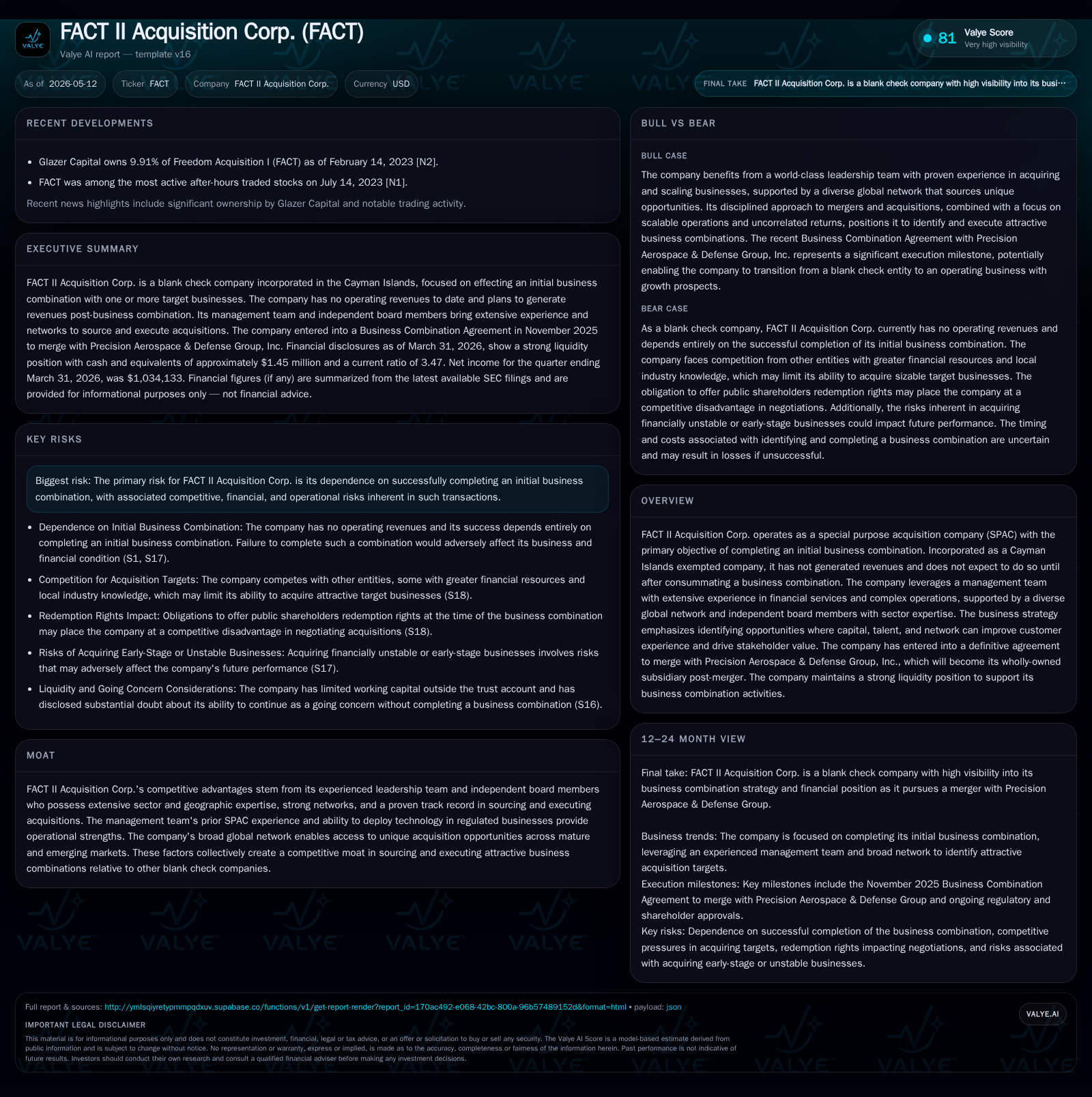
The latest quarterly filing updates FACT II Acquisition Corp.'s operational status, confirming the definitive business combination agreement with Precision Aerospace & Defense Group (PAD). As a SPAC, FACT has yet to generate revenue but plans to unlock value post-merger through capitalizing on PAD's aerospace and defense market position. The company's competitive moat rests on a seasoned management team and robust global networks facilitating access to differentiated acquisition opportunities. Key growth drivers stem from strategic synergies unlocked by the merger and market expansion potential. Execution risks remain primarily tied to the completion of the business combination and navigating shareholder redemption dynamics.
Latest Operating Update: Merger Agreement Anchors Outlook
FACT II Acquisition Corp.'s latest quarterly report filed May 11, 2026 ([S2]) confirms the execution of a definitive business combination agreement with Precision Aerospace & Defense Group (PAD). This transaction marks a pivotal operational milestone for FACT, transitioning it from a dormant SPAC structure toward an active operating company.
The filing outlines that following regulatory approvals and shareholder consent, FACT will domesticate from the Cayman Islands to Delaware before merging PAD as its wholly owned subsidiary. No revenues are anticipated prior to consummation of this merger since FACT currently operates solely as a blank check company without active business lines or sales ([S1]). This development importantly delineates FACT's trajectory: moving from capital accumulation and target evaluation into an actively managed industrial business post-merger.
No material changes have occurred in risk factors since the prior annual report ([S2]), though emphasis remains on successful deal execution as the primary near-term operational variable affecting outlook.
Business Model: SPAC Structure and Post-Merger Revenue Prospects
FACT II Acquisition's business model reflects classic SPAC dynamics. Incorporated as a Cayman Islands exempted company with no historical revenue or operating subsidiaries ([S1]), its principal activity is effecting an initial business combination—merging with or acquiring an unidentified operating company.
Revenue generation will commence only once this combination closes and PAD begins operational activities under FACT's ownership. Until then, the firm functions largely as a financial vehicle managing trust-held cash raised from its IPO and private placements. Public shareholders retain redemption rights at transaction time, which can influence net proceeds available for acquisition consideration ([S1]).
Sponsors play an outsized role in driving value creation via deal sourcing and structuring. FACT’s sponsors—leveraging substantial prior experience in complex financial services environments—support strategic diligence while ensuring aligned incentives through restrictions on founder-share redemptions ([S1]). The post-merger economic model hinges on deploying combined capital, management talent, and network reach to expand revenues and profitability at PAD.
Competitive Moat: Experienced Management and Network Advantages
FACT differentiates itself amid a crowded SPAC marketplace through leadership credentials highlighted in both its filings ([S1]) and Valye’s independent analysis. The management team includes professionals seasoned in scalable global financial services enterprises with demonstrated ability to navigate evolving regulatory regimes.
Complementing management, FACT’s independent board members bring domain expertise essential for identifying compelling acquisition targets within aerospace/defense verticals—a sector demanding significant technical knowledge and operational insight ([S1]). Their broad networks span senior executives, investment bankers, private equity funds, venture capitalists, and private business owners worldwide.
This layered experience underpins FACT’s ability to source differentiated targets less accessible to less connected peers. The proven track record of executing complex transactions adds credibility both with shareholders wary of typical SPAC risks and target companies seeking knowledgeable partners.
Industry Environment: SPAC Sector Dynamics and Regulatory Landscape
The broader SPAC ecosystem continues facing pressure from investor skepticism regarding deal quality, heightened SEC scrutiny of disclosure standards ([S1], risk factors), and intensified competition for attractive acquisition candidates ([S6]).
FACT confronts typical challenges including limited financial firepower relative to larger SPAC sponsors or traditional private equity firms. Further constraints arise from shareholder redemption provisions limiting available cash at closing—a dynamic that can deter some sellers seeking certainty.
Regulatory risks persist given ongoing SEC enforcement trends focused on transparency mandates around conflicts of interest and financial projections associated with de-SPAC transactions ([S1]). These conditions collectively elevate execution complexity versus other corporate acquisition avenues.
Growth Drivers: Capital Deployment, Market Access, and Strategic Synergies
Post-merger growth at FACT is predicated on leveraging PAD’s existing aerospace & defense platform augmented by institutional capital infusion enabled through the transaction (,[S1]). The management team aims to accelerate organic growth via operational efficiencies while complementing this with targeted bolt-on acquisitions facilitated by their extensive industry contacts.
Factoring in PAD’s positioning in both mature defense markets and emerging geographies provides multi-front expansion vectors. FACT’s strategy also includes utilizing technological differentiation inherent in PAD’s portfolio alongside scale benefits from merger integration efforts (). This creates potential for sustainable margin improvement coupled with revenue diversification.
FACT also emphasizes acquiring companies characterized by stable demand profiles with limited cyclicality risk—a prudent approach given macroeconomic volatility impacting many sectors presently ([S1]). This focus supports predictability in cash flows critical for durable value creation.
Risks and Constraints: Dependence on Successful Business Combination and Sponsor Conflicts
Like most SPACs, FACT's foremost risk centers on consummating the initial business combination within prescribed timelines to avoid liquidation or loss of investor capital ([S1],[S2]). Shareholder redemption rates pose liquidity constraints that could reduce available deal funding or necessitate alternative capital sources if redemptions exceed expectations.
Potential conflicts of interest arise from sponsor affiliations with other ventures potentially competing for overlapping acquisition opportunities or differing tactical priorities ([S1]). While mechanisms limit certain redemption privileges for insiders, sponsors may still face incentives aligned imperfectly between themselves and public investors during deal negotiations.
Moreover, regulatory delays or adverse conditions imposed by authorities could impede closing schedules or increase costs beyond pro forma estimates. Given aerospace & defense’s heavily regulated nature broadly corroborated by accompanying risk disclosures ([S6]), these factors merit close monitoring.
Key Metrics and Milestones to Monitor Next
Several upcoming catalysts warrant attention as indicators of execution progress:
- Completion of FACT's Domestication process transferring corporate domicile from Cayman Islands to Delaware ahead of closing [S2]
- Outcome of shareholder votes approving the merger proxy materials expected subsequent to filing Form S-4 registration statement
- Receipt of requisite regulatory approvals including SEC review completions
- Closing date announcements as final confirmation of business combination consummation [S2]
- Material shifts in public share redemption levels impacting transaction economics [S2]
- Any supplemental financing arrangements announced pre-closing to augment trust account proceeds if needed [N/A but inferred] These milestones collectively form critical checkpoints assessing transactional momentum versus potential delay risks.
Financial Snapshot: Liquidity Supports Transaction Execution
Latest financial snapshot
| Metric | Value | Period |
|---|---|---|
| Current assets | $480974 | |
| 2026-03-31 | ||
| Current liabilities | $138741 | |
| 2026-03-31 | ||
| Current ratio | 3.47x | |
| 2026-03-31 |
Source: SEC companyfacts cache [F1].
A snapshot of key balance sheet metrics as of March 31, 2026 underscores financial readiness:
| Metric | Value (USD) | Period Ending |
|---|---|---|
| Cash & Equivalents | 480,974 | |
| 2026-03-31 | ||
| Current Assets | 480,974 | |
| 2026-03-31 | ||
| Current Liabilities | 138,741 | |
| 2026-03-31 | ||
| Current Ratio | 3.47 | |
| 2026-03-31 | ||
| These figures illustrate a strong current ratio providing sufficient liquidity buffers as FACT progresses towards closing activities requiring operational expenditures on due diligence costs, travel related expenses, legal fees, underwriting payments among others ([F1],[S2]). |
Disclaimer: This analysis is provided solely for informational purposes without any investment advice or recommendation. All data presented is sourced directly from SEC filings dated up to May 11, 2026. Investors should perform independent due diligence before making any decisions.
Disclaimer: This is research-only, informational analysis and not investment advice. It may include AI-generated interpretation and general industry context. Always verify important details using primary sources.

Comments