
HF Foods Group Launches State-of-the-Art Distribution Center as Operating Losses Persist
HF Foods Group expands its national footprint with a new Georgia warehouse, counterbalanced by ongoing profitability and liquidity challenges.
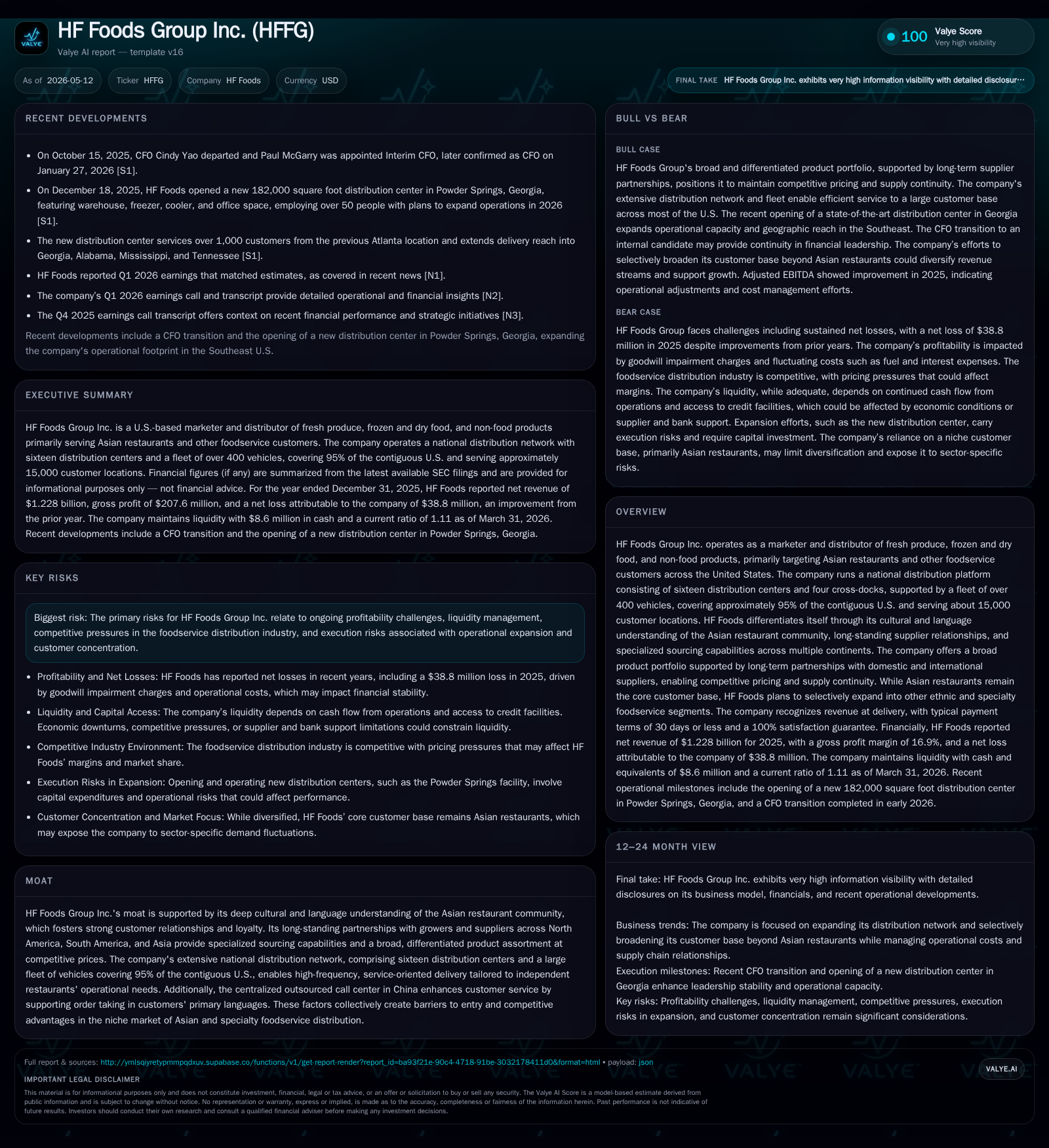
In Q1 2026, HF Foods Group Inc. opened a cutting-edge distribution center in Powder Springs, Georgia, enhancing its logistical capabilities in the Southeastern U.S. Despite this operational expansion, the company continues to face significant headwinds including sustained net losses and goodwill impairments, reflecting ongoing profitability pressures. HF Foods leverages deep cultural ties to the Asian restaurant segment and an extensive distribution network covering 95% of the contiguous U.S., but growth is constrained by competitive pressures and capital intensity.
Recent Operating Update
HF Foods Group Inc. reported its latest quarterly results in May 2026 [S2], alongside the simultaneous disclosure of an event filing that reiterated these updates [S3]. The company’s headline operational development is the December 2025 inauguration of a new state-of-the-art distribution warehouse located in Powder Springs, Georgia [S1]. Spanning roughly 182,000 square feet, this facility incorporates automated material handling and advanced warehouse management systems designed to bolster operational efficiency. It replaces a previous Atlanta location and services over 1,000 customers from that region with plans to extend reach into neighboring states including Alabama, Mississippi, and Tennessee. This strategic investment signals HF Foods’ commitment to deepening its presence in the Southeastern U.S., leveraging technology to optimize delivery frequency and product availability across its network.
Simultaneously, financial disclosures reveal ongoing challenges. Though the company operates a broad footprint with sixteen distribution centers and four cross-docks supporting over 400 vehicles across approximately 95% of the contiguous United States [S1], it continues to report sizable net losses—over $38 million for FY 2025—driven largely by business operational costs and impairment charges [F1]. These impairments stem from goodwill write-downs totaling $38.8 million in 2025 following an earlier $46.3 million charge in 2024 [S21], reflecting market valuation pressures despite efforts at strategic expansion.
Business Model
HF Foods Group earns revenue by marketing and distributing fresh produce, frozen/dry foods, and non-food items primarily tailored for Asian restaurant operators across the U.S. Their operating model emphasizes high-frequency delivery tailored for independent restaurateurs who demand timely restocking with culturally specific products. Revenue mechanics depend on net sales volume influenced by customer count (~15,000 locations), order size (average basket), product mix shifts including inflation-adjusted pricing, and supplier agreements offering competitive pricing and supply stability [S1,S22].
Margins hinge heavily on gross profit which factors in both product costs (subject to commodity price fluctuations) and logistics expenses such as fuel and fleet maintenance. Distribution costs reflect significant truck fleet operations optimized through route planning but vulnerable to diesel price volatility [S19]. The company’s outsourced call center in China enhances ordering accuracy and retention through cultural/linguistic alignment with customer bases—a distinct service element strengthening switching costs within a fragmented clientele.
Strategically important are long-standing supplier partnerships spanning North America, South America, and Asia that enable access to a differentiated product portfolio not easily replicated by competitors lacking similar sourcing breadth or cultural expertise [S1]. These relationships mitigate supply chain disruptions while helping negotiate pricing concessions.
Industry Structure and Competitive Position
HF Foods operates within the highly competitive foodservice distribution industry characterized by several large scale incumbents alongside numerous regional players targeting niche ethnic segments. Competitors often have deeper capital pools enabling aggressive acquisition strategies or technology investments. In contrast to generalist broadline distributors, HF Foods' moat derives from specialized knowledge of Asian culinary ingredient demands combined with linguistic service advantages giving it leverage among independent restaurateurs who value personalized support.
The company’s national network—with sixteen DCs covering roughly half the states—positions it as one of the more expansive specialty ethnic distributors nationally; however, standalone scale still remains smaller than major players dominating broader foodservice channels. Capital intensity in warehouse automation deployment combined with rising labor costs presses margins.
Despite structural advantages tied to culture-based customer intimacy and diversified multinational sourcing channels reducing supply risks relative to some peers, HF Foods faces pressure both from margin compression due to competitive pricing battles and continual need for capex refreshes such as the Powder Springs facility rollout [S9,S13].
Management commentary from recent earnings calls [N2] may provide incremental color on navigating competitive hurdles or leveraging technology investments.
Financial Profile (Latest Snapshot)
| Metric | Value | Period |
|---|---|---|
| Total debt | $101mm | |
| 2026-03-31 | ||
| Net debt | $88mm | |
| 2026-03-31 | ||
| Current assets | $192mm | |
| 2026-03-31 | ||
| Current liabilities | $172mm | |
| 2026-03-31 | ||
| Current ratio | 1.11x | |
| 2026-03-31 |
Source: SEC companyfacts cache [F1].
The financials illustrate a solid asset base supporting working capital needs but underscore persistent operating losses that constrain cash flow generation needed for debt servicing and reinvestment capacity. The maturity ladder for long-term debt extends through 2030.
This analysis synthesizes recent regulatory filings along with operational disclosures without projecting forward-looking investment outcomes. It highlights structural positioning within the niche foodservice distribution industry alongside executional realities reflected in financial results.
Disclaimer: This is research-only, informational analysis and not investment advice. It may include AI-generated interpretation and general industry context. Always verify important details using primary sources.

Comments