
Heron Therapeutics Strengthens Position Through Technological Edge and Patent Defenses
Heron Therapeutics leverages proprietary drug delivery technology and robust patent outcomes to navigate competitive acute care and oncology markets.
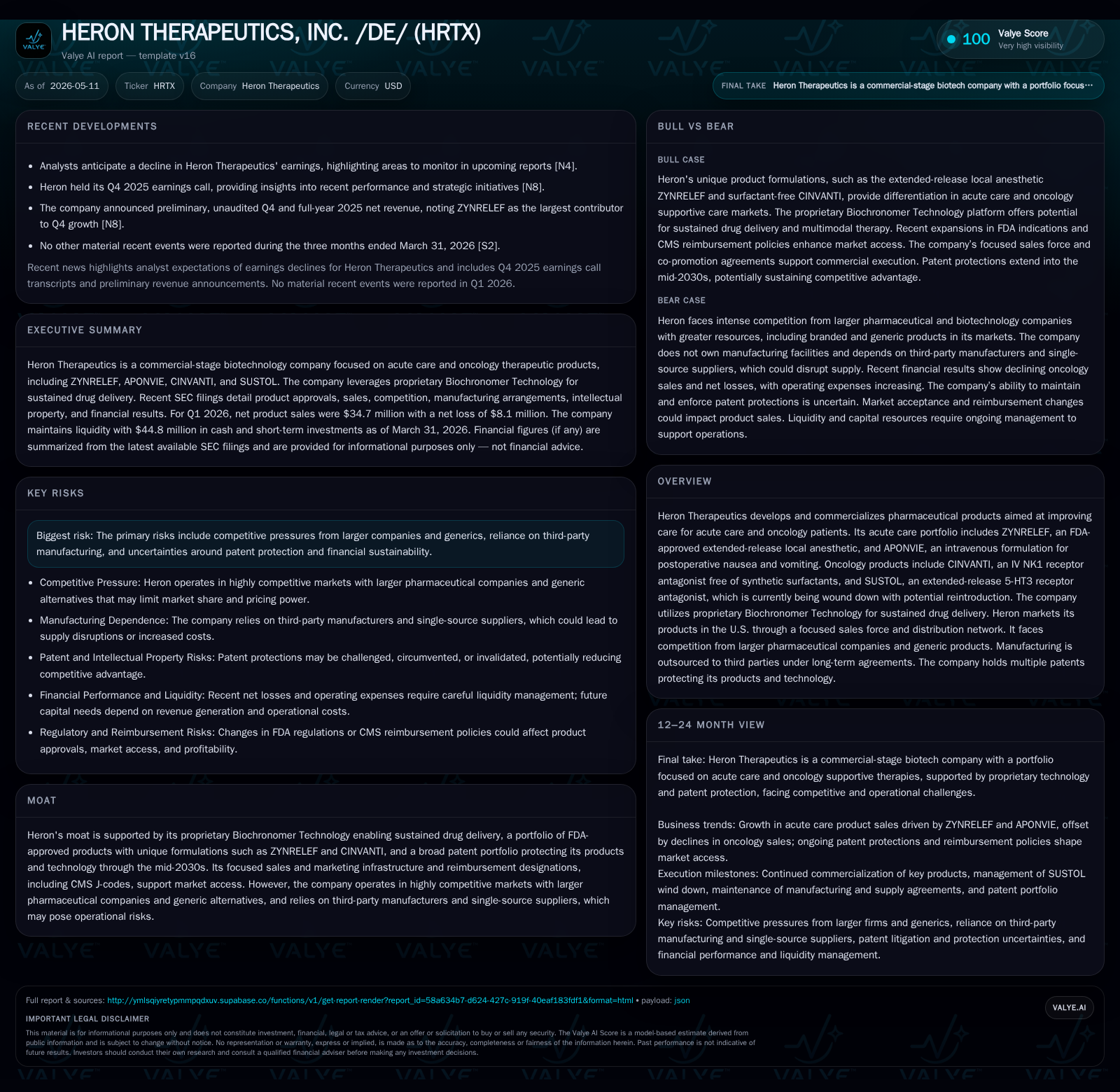
Heron Therapeutics reported its Q1 2026 results highlighting increased operating expense efficiency, ongoing liquidity management, and solid patent litigation verdicts preserving exclusivity for key products. The company’s proprietary Biochronomer Technology underpins a differentiated portfolio including ZYNRELEF and CINVANTI, supported by favorable FDA designations and reimbursement pathways. While competition from generics and reliance on third-party manufacturers remain risks, Heron’s commercial focus and recent developments position it for growth in acute pain management and oncology supportive care.
Latest Quarterly Operating Update Shapes Near-Term Outlook
Heron Therapeutics' Q1 2026 filing ([S2]) reveals evolving expense dynamics with research and development costs increasing by $0.1 million or 4.7%, primarily due to timing of contract services. Contrarily, general and administrative expenses decreased by $0.6 million or 4.4%, attributed notably to lease terminations reducing rent expense by $1 million and lowered legal expenses by $0.9 million as litigation activities moderated.
Liquidity remains a focal point amid operating losses; at quarter-end March 31, 2026, Heron held $26.1 million in cash and equivalents with current assets totaling approximately $229 million versus current liabilities around $90.5 million — translating to a current ratio of 2.53 [F1]. Despite this buffer, management cautions that assumptions underpinning these figures may prove overly optimistic, foreshadowing potential accelerated capital consumption that could materially impact operations [S2]. Moreover, a new office lease in Cary, North Carolina is set to commence imminently with optional extensions but has yet to be recognized in the balance sheet [S2][S17].
Proprietary Technologies Define Heron’s Commercial Edge
Central to Heron's value proposition is its proprietary Biochronomer Technology—a polymer-based platform enabling sustained drug delivery through controlled hydrolysis releasing encapsulated pharmacological agents over days or weeks from a single administration [S15]. This technology facilitates multimodal therapy applications allowing multiple active agents within one formulation.
ZYNRELEF represents a marquee example: an FDA-classified extended-release local anesthetic combining bupivacaine with meloxicam demonstrated in Phase 3 trials to significantly reduce pain and opioid usage over the critical early postoperative period relative to standard bupivacaine. The extended-release classification by FDA uniquely positions ZYNRELEF as differentiated in an otherwise crowded local anesthetic market plagued by generics [S1]. Additionally, the technology’s intellectual property coverage extends well into the mid-2030s providing a structural moat.
Supportive reimbursement mechanisms like CMS’s adoption of permanent Healthcare Common Procedure Coding System (HCPCS) J-code for ZYNRELEF effective October 2025 enhance market access—they allow separate Medicare payment outside bundled surgical fees aligned with the Non-Opioids Prevent Addiction in the Nation (NOPAIN) Act mandates [S1].
Acute Care and Oncology Portfolios: Product Quality and Market Positioning
Heron’s acute care arsenal primarily comprises ZYNRELEF and APONVIE: the latter is an intravenous formulation targeting postoperative nausea and vomiting (PONV). Both leverage clinical differentiation—ZYNRELEF’s opioid-sparing profile addresses growing demand amid heightened opioid stewardship while APONVIE targets an unmet need in nausea management.
In oncology supportive care, CINVANTI stands out as an intravenous NK1 receptor antagonist formulated without synthetic surfactants—a distinction aimed at mitigating hypersensitivity reactions common among competitors like fosaprepitant combinations. Commercial traction here is buoyed by patent protections validated through protracted legal battles notably against Fresenius Kabi ([S10]).
The company has announced winding down SUSTOL commercialization within the next year but remains open to reintroducing enhanced formulations subject to development milestones and regulatory approvals potentially as early as late 2027 ([S12]). These portfolio dynamics underscore Heron's adaptability amidst intensifying competitive pressures.
Industry Dynamics: Competition, Patents, and Reimbursement Drivers
The therapeutic segments served are competitive landscapes featuring established incumbents such as Pfizer (Marcaine), Pacira Biosciences (Exparel), Fresenius Kabi (Naropin), and generics saturating local anesthetics and antiemetics [S1]. Heron's substantial patent portfolio underpins exclusivity particularly for CINVANTI through court rulings affirming validity against ANDA challenges until at least 2035 ([S10]). This legal success delays generic substitution risk—a critical commercial safeguard.
Reimbursement also shapes adoption curves. Notably, CMS's integration of ZYNRELEF within NOPAIN legislation ensures separate outpatient reimbursement through at least end-2027 via new J-codes allowing treatment economics favorable to hospitals outside surgical bundles—an advantage many non-opioid competitors struggle to match ([S1]). This reflects broader payer shifts encouraging opioid alternatives for pain mitigation.
Growth Opportunities: Market Expansion and Pipeline Potential
Heron leverages expanding indications for ZYNRELEF approved through December 2023 into additional orthopedic procedures avoiding direct articular cartilage exposure ([S1]). The potential tapping into ambulatory surgery center growth trends forms another secular tailwind with outpatient surgical volumes rising nationally.
Innovation via the Biochronomer platform continues enabling pipeline candidates capable of sustained delivery of alternate drugs or combination therapies designed to address acute care or oncology needs with improved compliance or efficacy profiles ([S6]). While specific pipeline disclosures remain limited publicly, this platform gives Heron flexibility over competitors reliant solely on immediate-release formulations.
Risks and Operational Challenges to Monitor
Competition from generics post-patent expiry remains a significant threat particularly if patent challenges intensify or exclusivity is circumvented despite recent courtroom victories ([S10]). Manufacturing risks also loom large given Heron’s dependence on third-party suppliers under contractual frameworks expiring end-2026; any disruptions here could delay production or inflate cost structures ([S15]).
Financial sustainability represents another watchpoint; recurring operating losses coupled with negative cash flow have resulted in an accumulated deficit nearing $1.9 billion ([F1]), though management believes current funds suffice for approximately one year barring material operational shifts ([S2]). Rising interest expenses related to debt refinancings completed in 2025 further pressure net results ([S4]). Extended delays accessing new capital could impair R&D or commercialization efforts.
Regulatory risks linked to FDA approvals for label expansions or new formulations continue representing execution uncertainties alongside payer policy changes that may alter reimbursement eligibility or rates ([S19],[S26]).
Key Upcoming Catalysts and Performance Metrics to Watch
Near-term markers include FDA feedback or approvals relating to expanded ZYNRELEF indications or any formulations advancing SUSTOL reintroduction plans ([N4],[S12]). Monitoring commercial uptake trends through sales volumes for ZYNRELEF, APONVIE, and CINVANTI offers tangible demand insights reflective of clinician adoption beyond initial launch phases ([N4]).
Reimbursement pathway developments post-2027 regarding CMS codes remain critical since loss of separateness would materially impact hospital economics supporting Heron's pricing model ([S1],[N4]). Continued surveillance of patent infringement litigations potentially involving other generic entrants besides Fresenius Kabi also remains warranted given revenue sensitivity tied to exclusivity duration.
Quarterly guidance updates incorporating these factors will provide useful barometers of execution momentum or risk shifts heading into later halves of fiscal years.
Current Financial Health and Liquidity Snapshot
Latest financial snapshot
| Metric | Value | Period |
|---|---|---|
| Cash & equivalents | $26mm | |
| 2026-03-31 | ||
| Current assets | $229mm | |
| 2026-03-31 | ||
| Current liabilities | $91mm | |
| 2026-03-31 | ||
| Current ratio | 2.53x | |
| 2026-03-31 |
Source: SEC companyfacts cache [F1].
Though Heron's cash position offers decent short-term relief amid ongoing investment in R&D ($2.38 million Q1’26) and elevated sales & marketing expenses ($14.3 million Q1’26) (>40% of sales), the net losses persist raising sustainability questions should revenue not grow sufficiently fast [S14][F1]. Refinancing costs incurred in recent periods have increased interest expense materially relative to prior years affecting net results further ([S4]).
Disclaimer: This is research-only, informational analysis and not investment advice. It may include AI-generated interpretation and general industry context. Always verify important details using primary sources.

Comments