
Mammoth Energy's Portfolio Pivot Sets Stage for Efficiency Amid Industry Challenges
Mammoth Energy Services completes strategic divestitures to focus on core energy services supported by solid liquidity and a refined operational footprint.
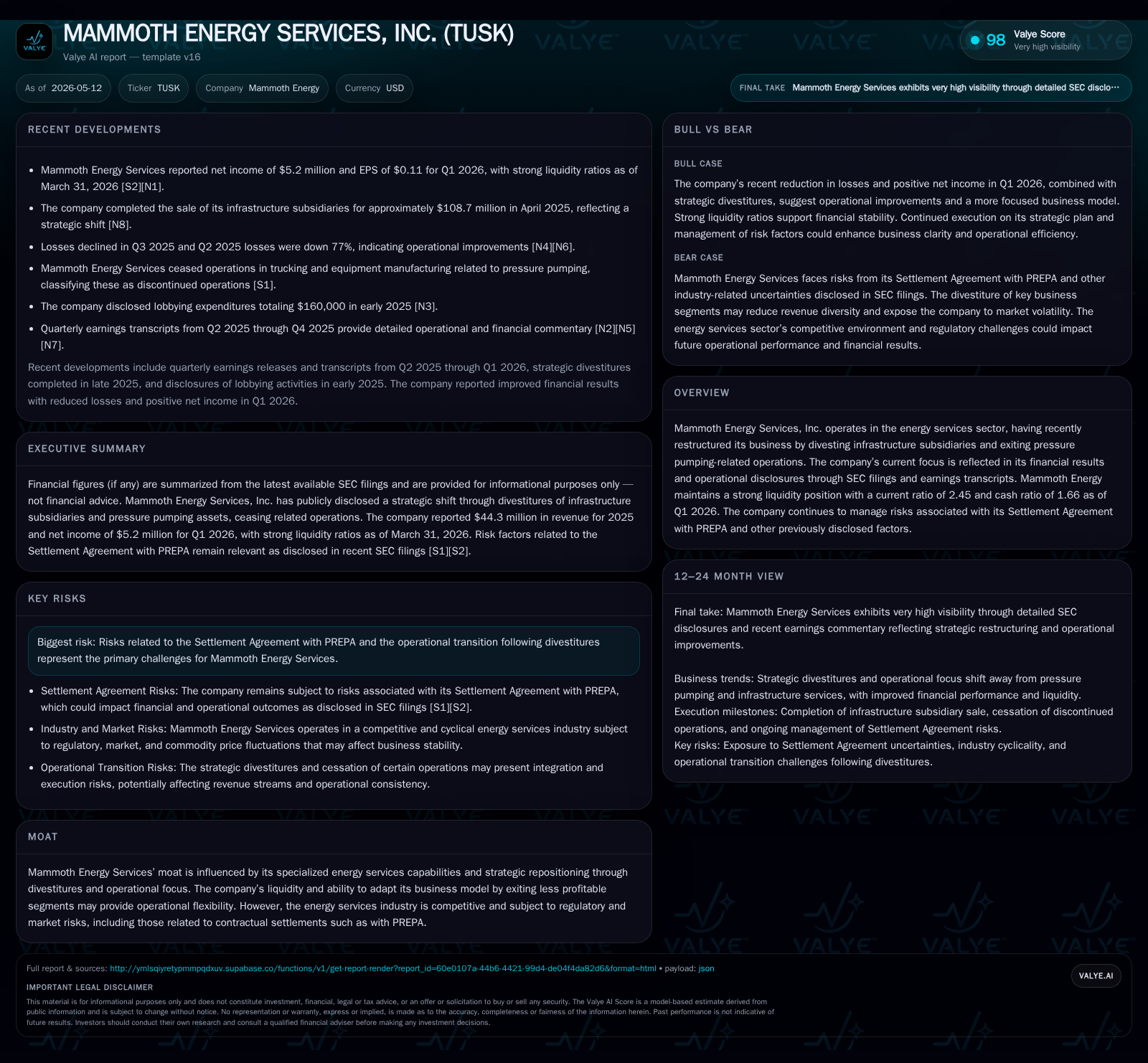
In its latest Q1 2026 filing, Mammoth Energy Services finalized the sale of infrastructure subsidiaries and exited its pressure pumping operations, marking a clear shift toward a streamlined energy services portfolio. This pivot emphasizes rental services, natural sand proppant, and directional drilling as core growth areas supported by substantial liquidity and operational expertise. Yet risks tied to customer concentration and the PREPA settlement remain key watchpoints as the company navigates competitive pressures and industry cyclicality.
First Quarter 2026 Update: Strategic Shift Solidified
Mammoth Energy Services’ first quarter 2026 10-Q filing dated May 11 firmly establishes its new operational landscape following large-scale portfolio restructuring efforts executed through late 2025 [S2]. The company completed the sale of its infrastructure services subsidiaries (Aquawolf) for approximately $30 million in December 2025, while simultaneously exiting all pressure pumping-related operations including trucking and equipment manufacturing associated with that segment [S5]. These businesses are now classified as discontinued operations in financial statements indicating a decisive break from prior capital-intensive service lines.
This portfolio pivot is underpinned by a strong liquidity profile as Mammoth reports $92.7 million in cash & equivalents with current assets totaling $184.8 million against $75.3 million current liabilities, yielding a healthy current ratio of 2.45 as of March 31, 2026 [F1]. The robust cash position affords the company operational flexibility in optimizing asset utilization while managing the transition away from less profitable segments. Management commentary during the Q1 earnings call highlights a renewed emphasis on capital efficiency and margin expansion within the streamlined business model centered on higher-return service lines [N1][S3].
Business Model and Service Quality Post-Restructuring
Post-divestiture, Mammoth Energy presents as an integrated energy services provider focused primarily on rental services, natural sand proppant production, directional drilling services, and select infrastructure engineering support — minus the discontinued pressure pumping activities [S1]. Rental services dominate strategically, encompassing a diversified equipment fleet used across oilfield operations, construction, and particularly aviation sectors where aircrafts provide capital-efficient fleet flexibility for operators without residual value risks.
The natural sand proppant segment leverages growing fracturing activity in unconventional plays, producing high-purity sand critical for hydraulic fracturing's effectiveness. This ties directly to the company’s directional drilling expertise which supports precise wellbore placement within narrow geologic formations like those found in the Marcellus Shale or SCOOP/STACK regions—key oil & gas basins served via Mammoth’s facility network spanning Ohio to West Texas and Oklahoma [S1].
Cross-selling opportunity arises organically given the complementary nature of rental equipment provision alongside drilling services; customers benefit from consolidated service packages grounded in Mammoth’s operatorship experience averaging nearly three decades per executive team member. Such depth bolsters execution quality and cultivates stickier client relationships amidst competitive market dynamics [N1][S1].
Competitive Environment and Industry Dynamics
Mammoth operates within a fragmented but intensely competitive energy services sector where pricing leverage is constrained by customer bargaining power and supply availability. Customer concentration remains elevated—the top five clients contributed approximately 55-58% of revenues—exposing Mammoth to considerable revenue volatility if any significant contracts lapse or payment delays occur [S1]. Credit risk assessment remains a cornerstone due to economic fluctuations impacting these major operators.
Regulatory uncertainty, notably related to Mammoth’s significant Settlement Agreement with Puerto Rico Electric Power Authority (PREPA), adds an overlay of financial risk stemming from PREPA’s bankruptcy proceedings. Payment reliability hinges on external FEMA or governmental funding inflows; failure to realize expected funds could materially disrupt Mammoth’s cash flow profile [S1]. Such exposures underscore cautious capital allocation amid broader geopolitical headwinds influencing global oil price volatility.
Growth Drivers: Focused Rental and Sand Proppant Services
Despite prior contractions, Mammoth’s near-term growth thesis centers on expanding its rental services footprint—particularly aviation assets that offer operators flexible capital deployment without residual asset risks—and scaling its sand proppant business which benefits structurally from persistent hydraulic fracturing demand economics [S1][N1].
Rising well completions in core basins energize proppant volumes while aviation rental aligns with industry trends favoring off-balance-sheet asset utilization models. Monitoring asset utilization rates within rental fleets alongside incremental regional penetration metrics will prove pivotal in assessing momentum.
Potential recommencement of idled service lines like cementing or acidizing remains contingent on improving upstream activity levels; management flagged this adaptive capacity but prudently avoids premature reactivation absent supportive market conditions [S1][N1].
Key Risks and Operational Constraints
The Settlement Agreement with PREPA continues as one of Mammoth’s principal risk vectors given lingering uncertainties about receivable collectability from this counterparty under bankruptcy protection [S1][S2]. Counterparty credit concentration extends beyond PREPA risk as Mammoth’s top clients represent a majority share of revenue; any non-payment or reduced rig activity among them could depress earnings materially.
Industry cyclicality imposes inherent volatility risks; shifts in crude oil prices tied to geopolitical instability—such as Russia-Ukraine conflict reverberations or Middle East tensions—directly affect customer capital expenditures impacting Mammoth’s service demand elasticities. Exiting pressure pumping operations reduces operational complexity but correspondingly narrows revenue diversification.
Pricing pressure limits upside margins despite efforts at asset utilization optimization; maintaining profitability requires balancing operational scale with stringent cost control measures post-restructuring [S2][S19].
Upcoming Milestones and What to Watch For
The forthcoming quarters will be telling regarding Mammoth’s ability to translate its strategic repositioning into improved profitability metrics. Detailed management commentary during subsequent earnings releases may provide further color on execution progress and market receptivity [N1][S2].
Latest Financial Snapshot
Latest financial snapshot
| Metric | Value | Period |
|---|---|---|
| Cash & equivalents | $93mm | |
| 2026-03-31 | ||
| Current assets | $185mm | |
| 2026-03-31 | ||
| Current liabilities | $75mm | |
| 2026-03-31 | ||
| Current ratio | 2.45x | |
| 2026-03-31 |
Source: SEC companyfacts cache [F1].
| Metric | Amount (USD) |
|---|---|
| Cash & Equivalents | $92.7 million |
| Total Debt | $49.3 million |
| Current Assets | $184.8 million |
| Current Liabilities | $75.3 million |
| Current Ratio | 2.45 |
This snapshot evidences a net cash position when considering debt offset against cash reserves (approximate net debt negative $43.4 million based on best-effort June 2024 debt data) allowing for strong short-term liquidity management even amidst ongoing operational transitions [F1].
Disclaimer: This analysis is for informational purposes only based on publicly available SEC filings and news transcripts as of May 2026. It does not constitute investment advice or recommendations.
Disclaimer: This is research-only, informational analysis and not investment advice. It may include AI-generated interpretation and general industry context. Always verify important details using primary sources.

Comments