
Spectral AI Advances DeepView System Amid Regulatory and Commercialization Milestones
Spectral AI's latest quarterly report underscores progress towards FDA clearance and commercialization readiness of its multispectral imaging platform for burn diagnostics.
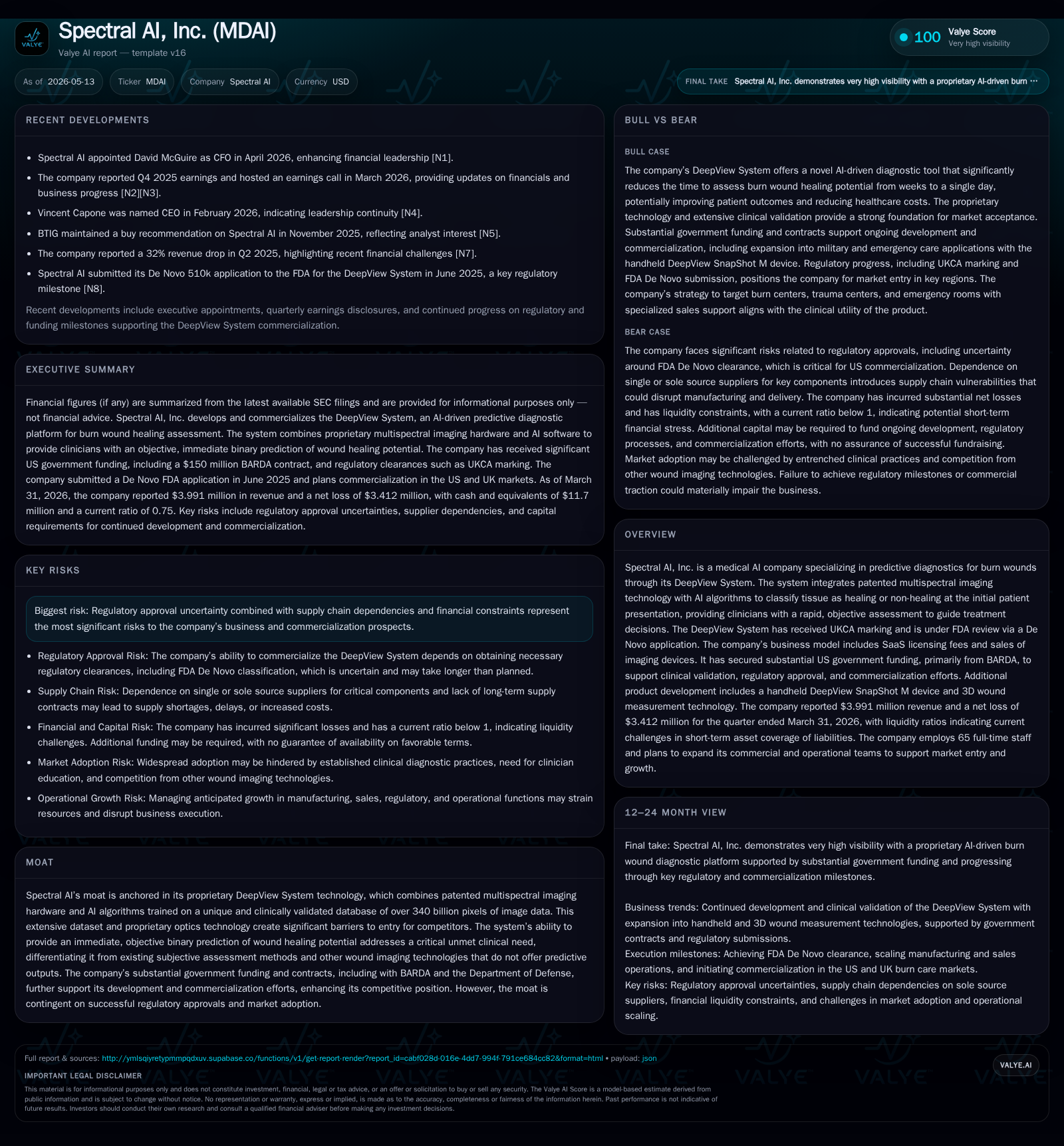
In its May 2026 10-Q, Spectral AI detailed ongoing efforts to secure FDA De Novo classification for its DeepView System following UKCA marking achieved last year. The company continues to develop adjunctive handheld and 3D wound measurement technologies, backed by significant government funding primarily from BARDA. Despite meaningful clinical validation with a large patient database and encouraging operational progress, regulatory uncertainties and financial constraints persist as key risks. Spectral AI’s dual revenue streams—device sales and SaaS licensing—position it strategically within the predictive medical diagnostics space contingent on regulatory success.
Recent Operating Update
Spectral AI's latest quarterly filing dated May 13, 2026, reconfirms its steady progress toward the FDA market clearance of its DeepView System through the pending De Novo application submitted in June 2025 [S2]. While the company reported no material changes in risk factors since its March annual report, it continues to meet important development milestones under contracts with BARDA and other government entities supporting both regulatory and commercialization activities. Leadership updates from recent filings indicate strategic prioritization of executive stability, exemplified by CEO Capone's employment agreement detailed in April 2026 [S3].
This quarter has seen refinement in operational execution focused on completing clinical validation endpoints essential for regulatory review. The company is preparing for anticipated post-market studies in the UK following its earlier UKCA marking completion in early 2024 and plans for entry into U.S. commercialization during 2026 aligned with BARDA’s procurement objectives [S1][S13].
Business Model
Spectral AI monetizes its offerings via a dual-revenue stream model encompassing hardware sales and software-as-a-service (SaaS) licenses. The cornerstone product, the DeepView System, integrates proprietary multispectral imaging (MSI) technology capturing tissue images across ultraviolet to near-infrared wavelengths with advanced AI-driven predictive analytics specialized to classify burns at initial presentation as healing or non-healing [S1].
Hardware sales involve direct sales of the imaging device—planned as a universal platform capable of hosting multiple indications beyond burns—offered competitively to hospitals, burn centers, clinics, and independent practices. Concurrently, the SaaS component generates recurring revenue through licensing fees covering software maintenance, image data hosting, and algorithm updates delivered via a regulatory-compliant Software as a Medical Device (SaMD) framework.
Strategically, pricing is tailored per country and service setting to optimize customer adoption rates by balancing affordability against sector-specific reimbursement dynamics. This hybrid hardware-software model leverages high switching costs due to the system’s integration into clinical workflow supported by trained personnel.
Industry Structure and Competitive Position
The medical diagnostics landscape increasingly favors AI-enabled predictive tools that can augment clinician decision-making accuracy while reducing time-to-diagnosis. Spectral AI operates at the niche intersection of advanced imaging modalities and machine learning automation targeted specifically at acute burn care—a segment characterized by unmet needs for objective wound viability assessments traditionally relying on subjective clinician judgment.
Its moat is fortified by:
- Proprietary MSI hardware combining patented optics absent in most competitor platforms.
- A uniquely large clinically validated image database exceeding 340 billion pixels aiding robust algorithm training.
- Demonstrated superior diagnostic performance over clinicians based on sensitivity and specificity metrics from multi-site U.S. studies [S13].
- Strong government partnerships providing non-dilutive capital support mitigating early commercialization risks.
Competitors offering wound imaging tools often focus solely on visualization without predictive capabilities or lack extensive clinical validation datasets which limits their adoption. However, the competitiveness remains closely tied to regulatory clearances worldwide—with FDA market authorization representing a pivotal barrier.
Growth Drivers
Key demand drivers rest primarily on achieving streamlined regulatory approvals enabling widespread protocol adoption across healthcare facilities managing burn care:
- Regulatory Milestones: FDA Class II De Novo classification would materially expand addressable market access within the U.S., driving device sales and SaaS subscriptions.
- Government Funding & Contracts: Continued milestone achievements under BARDA enable scalable clinical validation efforts and reduce financial obstacles during commercialization ramp-up phases.
- Innovative Product Extensions: Development of portable handheld DeepView SnapShot M devices enhances usability in battlefield or emergency settings while newly developed 3D wound measurement software improves spatial accuracy critical to treatment planning [S17].
- Evolving Reimbursement Policies: Increasing acceptance by payors of AI-driven diagnostics can boost customer willingness-to-pay through improved procedural coding.
- Market Education & Adoption: Expansion of specialized sales force and marketing initiatives anticipated in 2026 are designed to drive clinician awareness of objective burn assessment benefits versus current standard-of-care practices [S10].
Collectively these levers offer structural growth potential provided regulatory hurdles are cleared timely.
Risks and Watchpoints
Several critical risks shape Spectral AI’s trajectory:
- Regulatory Approval Uncertainty: Despite promising validation results, there is inherent unpredictability around timing or sufficiency of data for FDA approvals which could delay market entry [S1][S14].
- Financial Constraints: Ongoing net losses underscore reliance on capital markets or continued government funding; liquidity ratios (~0.75 current ratio) indicate working capital management challenges under current liabilities exceeding assets [F1].
- Supply Chain Dependencies: Manufacturing complexities for patented MSI devices may be vulnerable to vendor disruptions affecting delivery schedules.
- AI Regulatory Scrutiny: As global jurisdictions tighten oversight around healthcare AI technologies including data privacy, bias mitigation, and transparency requirements, increased compliance costs or technology adaptation may be necessary [S9][S23].
- Market Adoption Barriers: Entrenched clinician reliance on traditional burn assessment methods entails significant behavior change management supported by robust clinical evidence dissemination; failure here could hamper revenue ramp.
- Potential Product Liability Exposure: Given medical device usage in critically ill patients, any device malfunction or misdiagnosis potentially leads to costly litigation despite insurance coverage limitations [S11][S20].
Monitoring near-term regulatory reviews outcomes alongside capital raising capability will be critical gauges of sustainable growth potential.
What to Watch Next
Investors should track:
- FDA’s decision timeline regarding the De Novo classification application filed mid-2025.
- Progress updates under the BARDA Phase 1a contract milestones supporting deeper federal procurement engagements.
- Launch performance metrics once commercial sales commence in U.S. burn centers including SaaS subscription uptake rates.
- Development cadence for supplementary hardware like DeepView SnapShot M targeting battlefield diagnostics.
- Regulatory developments related to healthcare AI implementations that might impact operational or compliance frameworks.
- Liquidity position trends post-March quarter considering cash runway vis-à-vis operating expenses given growing headcount projections planned for sales and marketing expansion [F1][S10].
Financial Profile (Brief)
Latest financial snapshot
| Metric | Value | Period |
|---|---|---|
| Cash & equivalents | $11.7mm | |
| 2026-03-31 | ||
| Total debt | $9.25mm | |
| 2025-12-31 | ||
| Net debt | -$2.45mm | |
| 2025-12-31 | ||
| Current assets | $16.0mm | |
| 2026-03-31 | ||
| Current liabilities | $21.3mm | |
| 2026-03-31 | ||
| Current ratio | 0.75x | |
| 2026-03-31 |
Source: SEC companyfacts cache [F1].
As of March 31, 2026, Spectral AI held approximately $11.7 million in cash equivalents against total debt approximating $9.25 million recorded at year-end December 31, 2025, indicating modest net cash positioning excluding working capital liabilities which currently depress short-term liquidity ratios below unity (current ratio ~0.75) [F1]. This reflects typical early-stage medtech capital structures where upfront R&D investments precede revenue scale-up.
The latest available fiscal year top-line stood at $19.65 million with an operating loss near $8.6 million illustrating ongoing investment intensity primarily directed towards clinical validation activities and commercial infrastructure development rather than profit generation [F1].
Disclaimer: This analysis is based solely on public SEC filings and news disclosures as of May 2026. It is intended strictly as an industry-focused company evaluation without investment advice.
Disclaimer: This is research-only, informational analysis and not investment advice. It may include AI-generated interpretation and general industry context. Always verify important details using primary sources.

Comments