
CISO Global Confronts Liquidity Challenges While Advancing AI-Powered Cybersecurity Solutions
Despite innovative product launches and strategic partnerships, CISO Global faces substantial going concern risks amid financial strains.
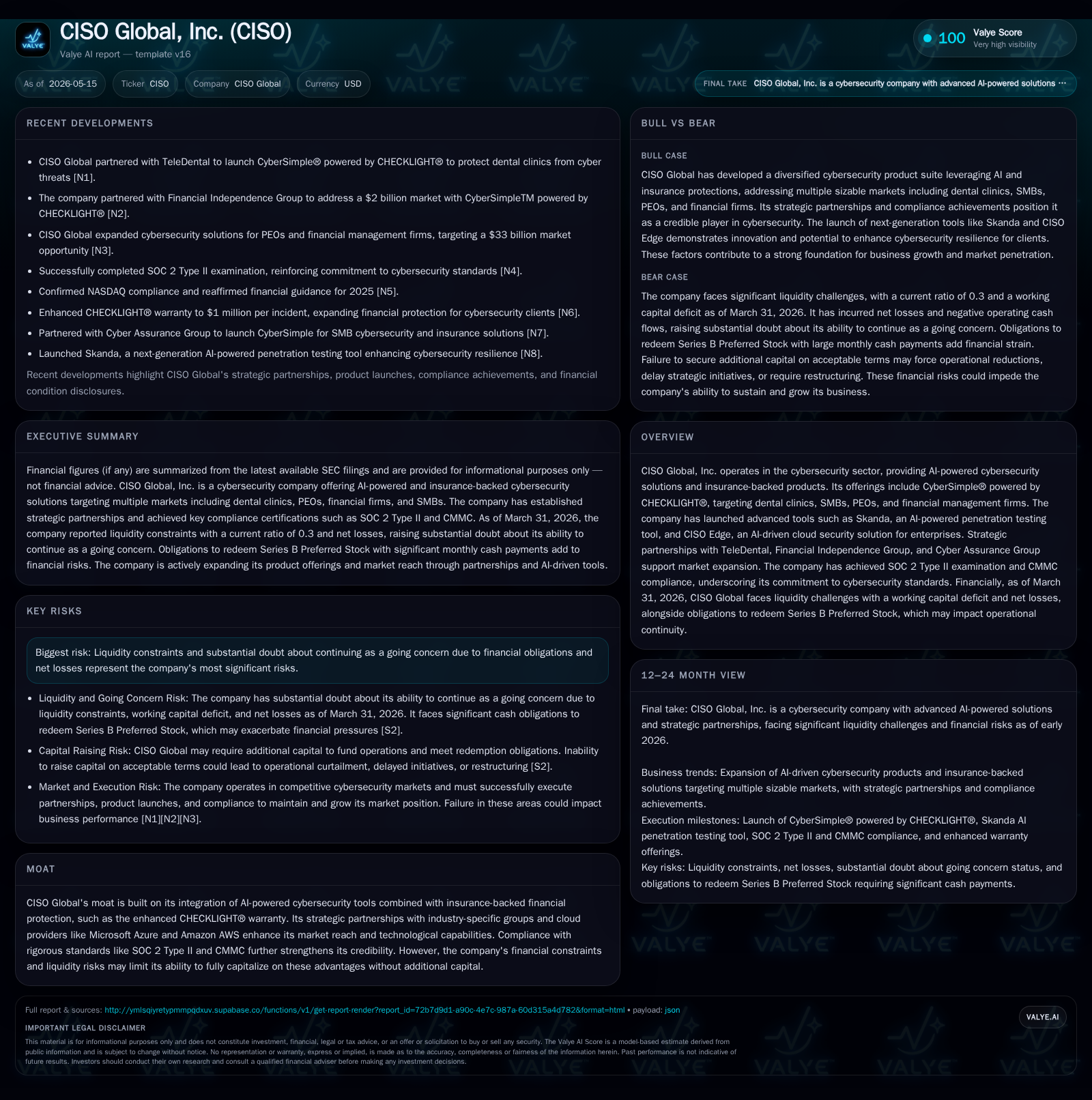
CISO Global's latest quarterly report highlights acute liquidity deficits and looming cash obligations related to Series B Preferred Stock redemption, casting doubt on the company's operational continuity. The firm specializes in AI-driven cybersecurity and insurance-backed solutions tailored to niche markets such as dental clinics and SMBs. Its competitive strength lies in integrating advanced AI tools with compliance certifications and strategic alliances. However, financial constraints threaten to restrict growth initiatives and execution pace. Monitoring capital-raising efforts and operational metrics will be key to assessing its future trajectory.
Recent Operating Update
CISO Global's most recent quarterly filing dated May 14, 2026 ([S2]) starkly underscores the financial difficulties overshadowing the business despite ongoing product innovation. As of March 31, 2026, the company held only $640,075 in cash against current liabilities of approximately $7.85 million—resulting in a working capital shortfall exceeding $5.5 million [F1]. Additionally, the April 1, 2026 conversion notice triggered a contractual obligation to redeem its Series B Preferred Stock through monthly payments starting May 1 totaling roughly $1.87 million over eleven months ([S2], [S7]). These factors collectively create substantial doubt about the company's ability to continue as a going concern without raising new capital or restructuring its obligations.
Earlier in April 2026 ([S3], [S8], [S16]), the company disclosed submission of a no-action request with the SEC regarding an Investor-Consent Share Loan Program designed to give shareholders opt-in control over securities lending—a transparency measure potentially improving investor relations but not materially alleviating liquidity risks.
Business Model
CISO Global operates at the intersection of cybersecurity technology provision and insurance-backed risk mitigation services. Revenue is generated primarily through sales of AI-powered cybersecurity solutions augmented by insurance warranties that promise financial protection against cyber breaches. The flagship offering CyberSimple® leverages CHECKLIGHT® technology targeting dentistry practices alongside SMBs, Professional Employer Organizations (PEOs), and firms specializing in financial management—verticals frequently vulnerable yet underserved by traditional cybersecurity vendors ([S1]).
The company has broadened its AI arsenal with Skanda—an automated penetration testing tool—and CISO Edge, focused on enterprise cloud security solutions utilizing AI for threat detection and remediation in multi-cloud environments ([S1]). This expanding product suite attempts to capture increasing demand for scalable next-generation security protocols that integrate seamlessly with cloud infrastructure.
Customers pay for bundled services involving ongoing software licenses often complemented by insurance products. Revenue dynamics are driven by volume (number of seats/users covered), pricing tiers linked to compliance certifications achieved (e.g., SOC 2 Type II), contract renewals influenced by customer retention efficacy, and cross-selling via partner channels.
Margins critically depend on cost controls around R&D for increasingly sophisticated AI models, cloud infrastructure expenses from providers like Azure and AWS via partnerships, as well as underwriting claims from insurance components balancing losses versus premiums ([S1]).
Industry Structure & Competitive Position
The cybersecurity sector is highly fragmented but rapidly consolidating, featuring legacy incumbents alongside innovative newcomers applying machine learning to automate threat detection and response. Insurance-backed security offerings remain less common but growing due to elevated regulatory scrutiny and cyber risk awareness.
CISO Global's moat stems from combining technical sophistication (AI-powered penetration testing plus cloud security), insurance risk transfer features (the CHECKLIGHT warranty enhancements), validated controls compliance (SOC 2 Type II examination plus Cybersecurity Maturity Model Certification or CMMC), and targeted vertical market focus ( company facts).
Strategic partnerships give CISO曝光 access into specialized markets such as dental care professionals through TeleDental alliance and financial sectors via Financial Independence Group and Cyber Assurance Group ([S1]). Additionally, integration with leading cloud service providers Microsoft Azure and Amazon AWS enables deployment scalability critical for enterprise adoption.
However, liquidity constraints dampen the scale-up potential relative to better-capitalized competitors who can invest aggressively in sales channels and continuous product innovation. Furthermore, low customer switching costs in SaaS cybersecurity products restrain pricing power if delivery or claims experience falters.
Growth Drivers
Several structural drivers underpin long-term growth potential:
- Rising Cybersecurity Awareness: Intensifying cyber threats push SMBs and niche industries towards adopting comprehensive security solutions combining AI efficiency with financial protection.
- Regulatory Compliance Requirements: Growing mandates for certifications such as SOC 2 Type II or CMMC among government contractors create stickier customer relationships due to network effects around compliance ecosystems.
- Expanding Vertical Penetration: Focus on underpenetrated segments such as dental clinics offers differentiated growth avenues beyond crowded general enterprise IT sectors.
- AI Innovation Trajectory: Continued advancement of proprietary AI models (e.g., Skanda) improves threat detection rates while lowering human analyst dependency enabling better gross margins.
- Partnership Ecosystem Expansion: Collaborations enhance market access routes reducing direct sales overheads while bolstering brand credibility through association.
However quality metrics like bookings growth, retention rates post initial deployment, monthly recurring revenue trends, or insurance claim ratios are not explicitly disclosed currently thus monitoring related filings will be instructive going forward.
Risks / Watchpoints / Growth Constraints
Key risks chiefly revolve around:
- Liquidity & Going Concern Doubts: The working capital deficit coupled with looming Series B redemption payments creates real threats of operational scaling back absent successful capital raises ([S2], [S7]).
- Market Listing Compliance Risks: The company currently trades below Nasdaq’s $1 bid price minimum triggering a grace period expiration in June 2026 which if unmet may lead to delisting affecting investor confidence ([S17]).
- Competitive Pressure: Larger vendors possess deeper pockets for R&D investment reducing relative technological edge; commoditization risks could also compress ARPU.
- Execution Risks on Strategic Initiatives: Delayed rollouts or failure to secure additional partnership agreements would limit growth leverage from sector-specific platforms.
- Customer Concentration & Retention Uncertainty: Lack of disclosed major client profiles limits visibility into revenue stability; any loss could disproportionately impact fundamentals.
What To Watch Next
Investors and analysts should prioritize:
- Updates on capital raising—equity issuance or debt restructuring—that might relieve immediate liquidity stress.
- Status reports regarding preferred stock redemption payments beginning May 2026 detailing cash burn cadence.
- Nasdaq bid price trend by late Q2 2026 indicating prospects for continued listing status vs delisting risk materialization.
- Expansion progress of partner networks especially within chosen verticals such as dentistry or finance sector alliances.
- Any further regulatory or SEC responses concerning the Investor-Consent Share Loan Program disclosure filed in April 2026 ([S3], [S16]).
- Quarterly disclosures illuminating bookings growth trajectory or improvements in customer retention/engagement rates.
Brief Financial Profile Context
Latest financial snapshot
| Metric | Value | Period |
|---|---|---|
| Cash & equivalents | $640,075 | |
| 2026-03-31 | ||
| Total debt | $2,093,063 | |
| 2026-03-31 | ||
| Net debt | $1,452,988 | |
| 2026-03-31 | ||
| Current assets | $2,325,832 | |
| 2026-03-31 | ||
| Current liabilities | $7,849,734 | |
| 2026-03-31 | ||
| Current ratio | 0.3x | |
| 2026-03-31 |
Source: SEC companyfacts cache [F1].
The March 31, 2026 balance sheet snapshot extracted from companyfacts ([F1]) shows a working capital deficit and a current ratio of 0.3x, indicating limited short-term liquidity coverage relative to current liabilities.
This analysis uses public filings up to May 14, 2026 without offering investment advice. Readers should monitor subsequent disclosures for updates on liquidity status and operational execution.
Disclaimer: This is research-only, informational analysis and not investment advice. It may include AI-generated interpretation and general industry context. Always verify important details using primary sources.

Comments