
Actelis Networks’ Strategic Shift and Outlook After Nasdaq Delisting
Following its Nasdaq delisting in early 2026, Actelis Networks faces critical liquidity challenges while pivoting toward IoT verticals to drive growth.
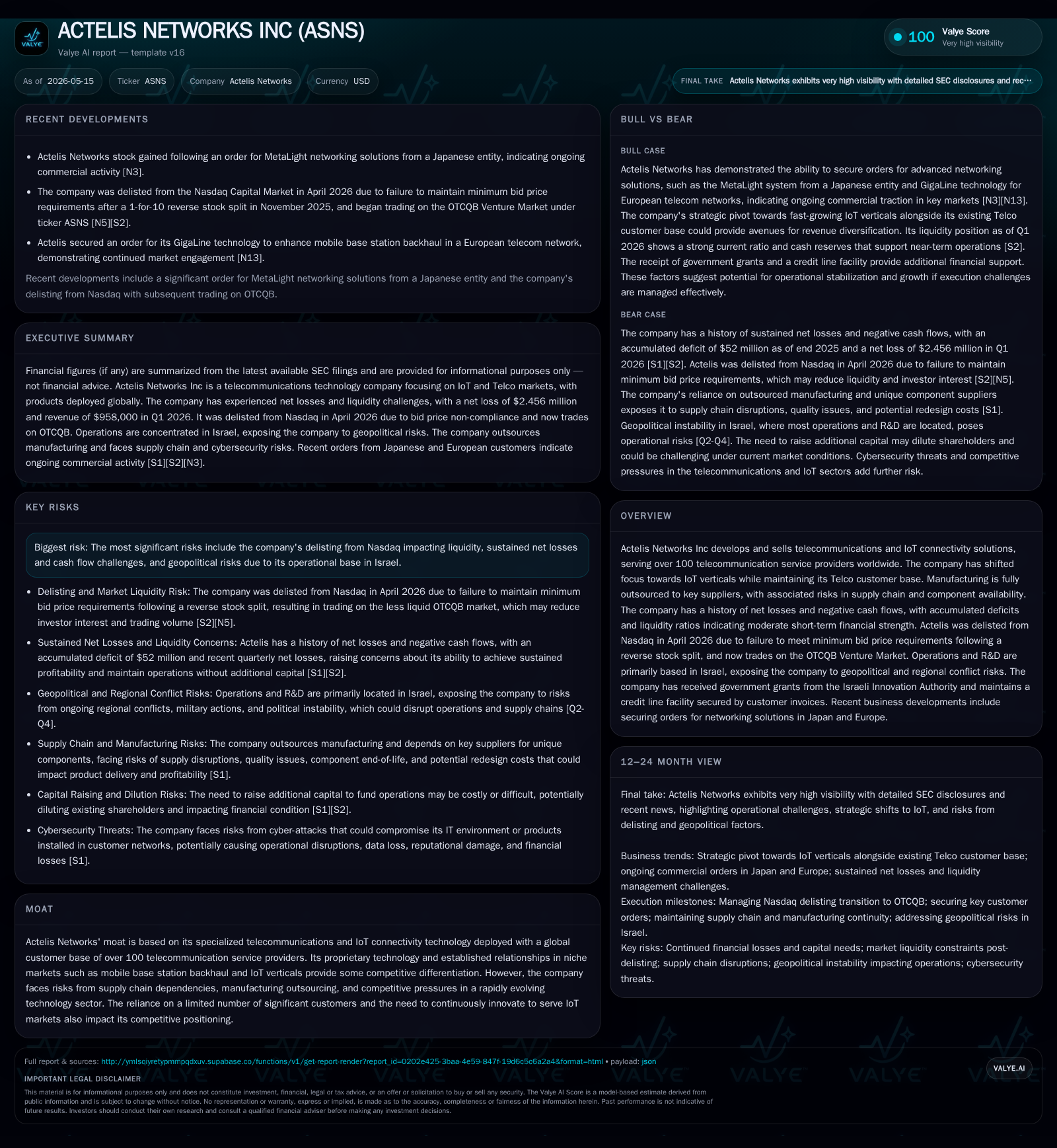
Actelis Networks was delisted from Nasdaq in April 2026 due to failing the minimum bid price rule post a reverse stock split, forcing the stock to trade on the less liquid OTCQB Market [S2]. The company continues to transition its business model by emphasizing telecommunications and industrial IoT connectivity solutions, leveraging an installed base of over 100 telecom service providers globally [S1]. Supply chain dependencies and geopolitical risks from its Israeli operations compound Actelis’s operational and financial challenges, with ongoing net losses and cash constraints underscoring the need for careful execution. Growth will hinge on expanding IoT vertical adoption and recovering investor confidence amid subdued trading liquidity.
Latest Quarterly Operating Update: Key Developments and Market Impact
In its Q1 2026 SEC filing dated May 14, Actelis Networks disclosed crucial developments impacting its capital markets profile [S2]. The company was formally delisted from Nasdaq on April 10, 2026 after failing the minimum bid price requirement under Rule 5550(a)(2). This failure followed a November 18, 2025 reverse stock split (1-for-10), which rendered Actelis ineligible for the typical 180-day compliance grace period per Nasdaq Listing Rule 5810(c)(3)(A)(iv). Despite requesting an appeal hearing that temporarily stayed delisting actions through early February 2026, the appeal was ultimately denied. Consequently, Actelis’s shares began trading on the OTCQB Venture Market on April 24 under the ticker "ASNS" [S2], marking a significant downgrade in market liquidity and visibility.
The immediate implications of this transition are material: OTCQB listings generally lead to diminished liquidity, reduced institutional investor engagement, heightened trading volatility, and potentially depressed share valuations. The company itself acknowledges these risks could impair its ability to raise capital or negotiate strategic transactions affordably or at all [S2]. This operating reality frames near-term funding constraints alongside increased scrutiny from shareholders.
Further underscoring financial pressure is an ongoing history of operational losses; the company reported net income decline with a loss of $8.26 million as of the end of calendar year 2025 [F1]. In the accompanying May 14 press release attached to its Form 8-K filing [S3], management reaffirmed its commitment to addressing these challenges through strategic pivots and operational discipline.
Actelis Networks’ Business Model and Product Portfolio Quality
Actelis Networks operates primarily as a developer and vendor of last-mile broadband access solutions targeting telecommunications carriers and increasingly Internet of Things (IoT) vertical markets worldwide. It sells advanced connectivity products used mainly for mobile base station backhaul as well as enterprise-grade network connectivity selling into over 100 telecom service providers globally [S1, S4]. This dual focus reflects a deliberate strategic shift towards higher-growth IoT sectors while preserving legacy telco relationships that still contributed roughly 27% of total revenue in FY2025 (down slightly from prior years) [S23].
The product portfolio comprises proprietary technologies enabling high-capacity Ethernet over copper or fiber infrastructures enhanced by dedicated network optimization features tailored for telecom operators' evolving needs. Although some legacy telco customers persist, expanding into industrial IoT—which demands scalable secure connectivity for sensor arrays or automated controls—represents both a growth avenue and a source of greater technical complexity requiring continuous R&D investments.
Notably, Actelis outsources all manufacturing activities extensively to key contract manufacturers and component suppliers globally—a business model that limits capital expenditure but exposes it to supply chain disruptions that have recently intensified in semiconductor availability world-wide. Unique components with single-source suppliers create additional vulnerability around pricing leverage and fulfillment reliability; any prolonged component shortage delays delivery schedules or increases costs jeopardizing customer satisfaction and margins [S23].
Revenue streams arise from product sales backed by service agreements; volume depends heavily on telecom infrastructure upgrades tied to global rollout cycles of mobile networks (e.g., 5G expansions) plus new IoT deployments. Pricing power appears constrained given competitive alternatives emerging alongside technological shifts necessitating aggressive sales efforts.
Competitive Positioning within Telecommunications and IoT Connectivity
Actelis occupies a specialized niche offering connectivity platforms optimized primarily for mobile base station backhaul applications—a critical but crowded segment amid evolving carrier requirements. Its moat rests on proprietary technology integrating broadband Ethernet over copper lines efficiently where fiber is not feasible or economical; this capability differentiates it in settings with legacy physical infrastructure constraints.
However, competitors range widely from large incumbent networking firms with broad telecom portfolios to leaner startup ventures targeting specific IoT verticals more aggressively. Pricing competition is intense given commoditization trends prevalent across many network hardware segments as global operators seek cost efficiencies. Switching costs for customers can be moderate—dependent largely on integration complexity—which puts pressure on Actelis’ ability to retain accounts without ongoing innovation cycles.
Supply chain outlook pressures competitive positioning as well; reliance on outsourced manufacturing weakens strategic control relative to vertically integrated peers who may better manage parts procurement or sudden cost inflation episodes related to semiconductor shortages or logistics bottlenecks exacerbated by geopolitical uncertainties (especially relevant due to Actelis's Israel-based R&D headquarters) [S26].
Overall, while Actelis sustains some niche differentiation through technology tailored for mobile backhaul plus emergent IoT applications with a loyal but concentrated customer set exceeding 100 telecom providers globally (~62% revenues concentrated among top ten clients) [S4], competitive pressures remain material requiring sustained capital allocation toward R&D enhancements.
Growth Drivers: Expanding IoT Verticals and Telco Customer Base
Actelis anticipates that growing adoption across industrial IoT sectors—such as utilities automation, smart cities infrastructure sensing, transportation telemetry—will drive demand for its flexible connectivity solutions capable of supporting bandwidth-heavy real-time data transmission with reliability demands unmatched by consumer-grade alternatives [Valye analysis; S1].
Government grants from Israeli Innovation Authority partially subsidize R&D enabling faster innovation pace aimed at addressing these complex vertical needs alongside traditional telecommunications services expansion plans originating from existing carrier customers undergoing network modernization cycles ().
Additional drivers include:
- Increasing replacement or augmentation requirements stemming from older copper networks migrating toward hybrid copper/fiber solutions suitable for higher broadband scalability.
- Small cell deployments related to densification in urban environments creating demand surges for resilient backhaul options.
- Potential cross-selling opportunities through existing relationships within telecommunications providers expanding into adjacent industrial markets.
Success in these growth vectors hinges strongly on executing efficient sales strategies capable of penetrating multi-tier channels including system integrators and value-added resellers specializing in IoT implementations as well as direct engagements with large telcos undergoing infrastructure upgrades [S23].
Risks and Constraints: Delisting, Supply Chain, Geopolitical Exposure
The most immediate risk shadowing Actelis is its transition from Nasdaq listing to OTCQB quotation status post-April 2026—a move which lowers liquidity markedly limiting investor access and may depress valuation multiples applicable when raising new capital or engaging strategic partners [S2]. OTCQB designation often dissuades institutional buying programs affecting trading volumes adversely.
Supply chain fragility constitutes an ongoing headwind; reliance on external contract manufacturers diminishes direct oversight over quality control processes amplifying risk of shipment delays or inferior product batches that could damage brand trust especially in mission-critical deployments ([S23]). Component shortages tied predominantly to semiconductors—a sector challenged globally by demand/supply imbalances due partly to geopolitical uncertainty—threaten timely fulfillment schedules impacting revenue recognition timing.
Geopolitical considerations further complicate outlook as primary logistics hubs reside in Israel. Regional conflicts increase risk layers spanning employee safety ramifications through possible sanctions or export restrictions affecting international operations [S1].
Financially, sustained operating losses totaling $8.3 million last fiscal year alongside negative operating cash flows place strain on balance sheet strength despite current substantial cash reserves ($7.55 million) supported by negligible debt levels ($150 thousand reported Sept 2025) yielding an enviable current ratio of approximately 4.38 as of Q1 end March ’26—the latter partially cushioning immediate liquidity concerns but not negating longer-term sustainability uncertainty without profitable operating transitions [F1].
Customer concentration remains another vulnerability; top ten clients generate over half revenues (~62% in recent years) magnifying impact if even individual accounts reduce order sizes or terminate contracts unexpectedly amid economic headwinds or competitor displacements ([S4]).
Upcoming Catalysts and Performance Metrics to Monitor
Key indicators will center on pipeline development within targeted IoT verticals reflecting traction beyond core telco base alongside metrics such as backlog growth or winning new contracts evidencing successful market shift execution. Milestone deliveries for newly developed product lines also warrant attention as proof points validating technology upgrade cycles amid tight funding conditions.
Monitoring progress toward restoring Nasdaq listing compliance conditions aligns strongly with shareholder interests focused on liquidity improvements although past attempts indicate structural pricing challenges remain substantive obstacles absent dramatic share price appreciation or strategic corporate actions ([S2], [S3]).
Financial performance updates revealing reductions in net losses or trending positive operating cash flows will be critical signals supporting viability arguments particularly within quarterly disclosures where measured operational discipline offsets cost inflations.[S2]
Watchpoints also include ongoing government grant outcomes potentially augmenting R&D budgets supporting competitive advantages along with supply chain stability markers mitigating historic procurement disruptions.[S1]
Financial Snapshot: Liquidity, Leverage, and Profitability Overview
Latest financial snapshot
| Metric | Value | Period |
|---|---|---|
| Cash & equivalents | $8mm | |
| 2026-03-31 | ||
| Current assets | $11mm | |
| 2026-03-31 | ||
| Current liabilities | $3mm | |
| 2026-03-31 | ||
| Current ratio | 4.38x | |
| 2026-03-31 |
Source: SEC companyfacts cache [F1].
Actelis enters Q2/2026 with reasonable liquidity reflected by healthy current assets surpassing liabilities nearly fourfold—a positive credit signal amidst operating difficulties. Debt remains nominal allowing financial flexibility in principle although sustained losses erode equity cushions critically necessitating accelerated revenue growth or further financing measures [F1].
This analysis synthesizes public SEC disclosures including the most recent Q1 filing alongside annual context supplemented by domain insight within telecommunications infrastructure trends relevant up through May 15, 2026. It aims strictly at informed operational evaluation rather than investment counsel.
Disclaimer: This is research-only, informational analysis and not investment advice. It may include AI-generated interpretation and general industry context. Always verify important details using primary sources.

Comments