
Piermont Valley Acquisition Corp Advances Merger Agreement Amid SPAC Lifecycle and Liquidity Challenges
The latest 10-Q filing details Piermont Valley’s merger progress with Tigerless AI Holdings and highlights liquidity dynamics typical of SPACs approaching de-SPAC transactions.
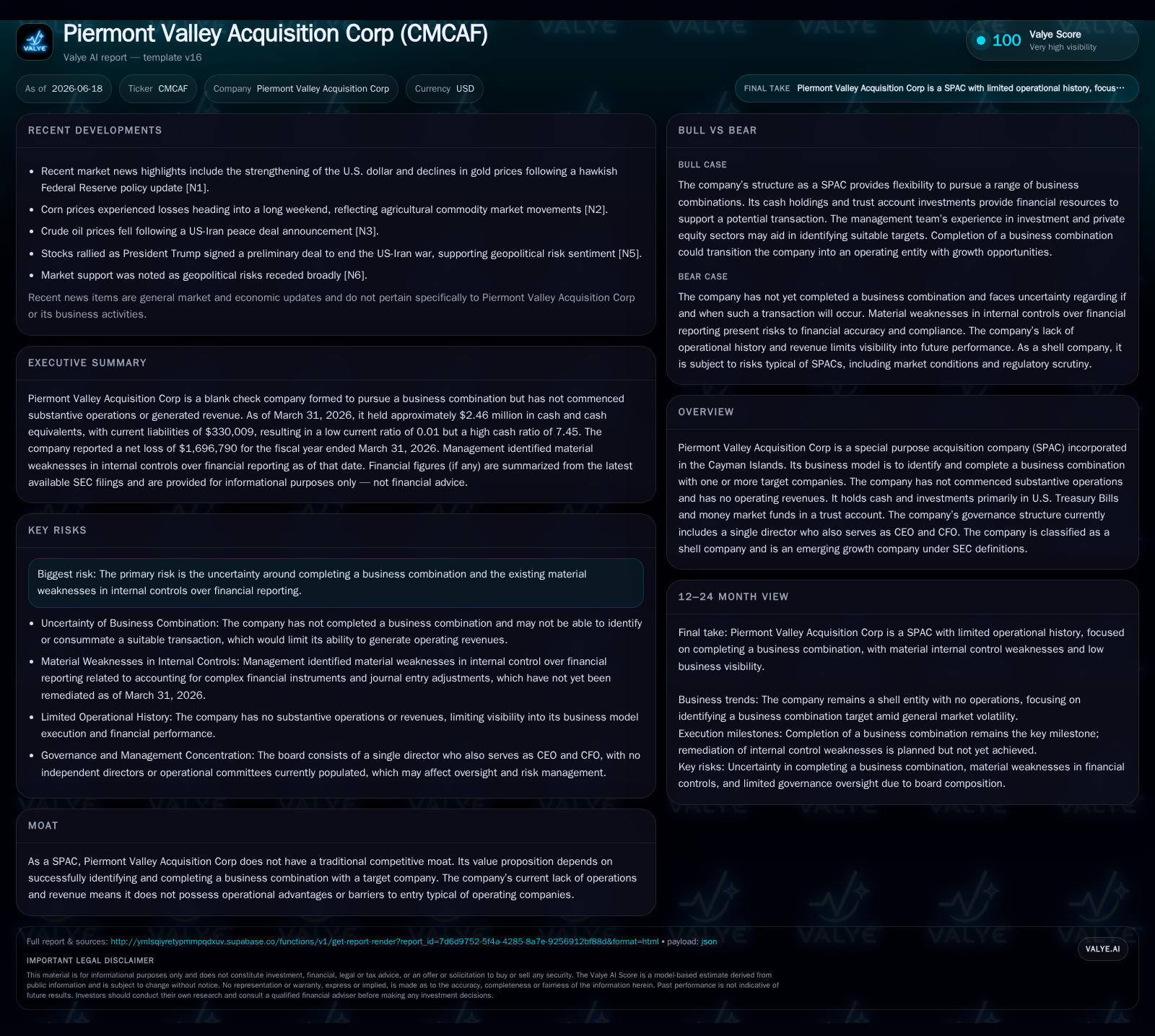
Piermont Valley Acquisition Corp has entered into a merger agreement with Tigerless AI Holdings, marking a key step toward completing its business combination. The company’s recent filings reveal ongoing liquidity management challenges, including a working capital deficit and redemption-related outflows that have reduced trust account balances. Governance remains concentrated, with the CEO also serving as director and CFO, while material weaknesses in internal controls persist. The SPAC’s capital structure involves redeemable Class A shares and warrants subject to complex accounting under ASC 480. A PIPE financing target of $5 million or more underscores reliance on external investor commitments to support the acquisition funding. Risks include execution uncertainty, dilution potential, regulatory scrutiny, and operational cash constraints typical of the SPAC lifecycle pre-combination.
Recent Operating Update: Merger Agreement Progress and Financial Position
Piermont Valley Acquisition Corp's latest quarterly report (10-Q filed February 20, 2026) confirms entry into a binding merger agreement with Tigerless AI Holdings Inc., signaling significant advancement toward executing its core SPAC objective of completing a business combination [S2][S3][S4]. The proposed transaction would result in Piermont becoming a wholly owned subsidiary of the combined entity "Pubco," subject to customary closing conditions including stockholder approvals and SEC registration effectiveness.
Financially, the company held approximately $2.46 million in cash and equivalents as of March 31, 2026, primarily within its trust account established from IPO proceeds. Despite this, it reported a working capital deficit near $325,000 due to ongoing administrative expenses incurred without generating operational revenue [F1][S2][S4]. Shareholder redemptions have materially impacted liquidity; about $11.64 million was disbursed from the trust account following redemption exercises at approximately $10.91 per share—typical behavior in the pre-business combination phase [S2].
Business Model: Capital Vehicle Without Operations
As a Special Purpose Acquisition Company (SPAC), Piermont operates as a shell entity designed exclusively to raise capital through an initial public offering by selling units comprising Class A ordinary shares and warrants. The proceeds are held securely in trust accounts invested conservatively pending identification and consummation of an acquisition target [S1]. Revenue generation is absent before the de-SPAC transaction; value realization depends entirely on successfully merging with or acquiring a private company to bring it public outside traditional IPO channels.
Class A shares are subject to mandatory redemption rights under ASC 480 accounting guidance, requiring their classification as temporary equity liabilities measured at fair value. Warrants issued alongside shares introduce additional valuation complexity given their embedded derivative characteristics and contingent exercise features typically triggered above specified price thresholds ($11.50 here) [S2]. Founder shares are restricted from redemption rights but carry voting obligations aligned with facilitating the business combination.
Operating expenses consist mainly of administrative costs related to compliance, legal matters, investor relations, and pursuit of acquisition opportunities—funded through cash held outside the trust account until deal closure or liquidation occurs per charter provisions [S1][S2]
Industry Context: SPAC Lifecycle Pressures
Piermont functions within the SPAC ecosystem as an intermediary capital vehicle bridging private companies seeking expedited public listings with investors providing speculative capital based on sponsor expertise and deal prospects. This segment faces unique pressures including strict timelines (often two-to-three years) to complete acquisitions or face liquidation; shareholder redemption activity that can reduce available acquisition capital; regulatory scrutiny increasing accounting transparency requirements; and competitive sourcing challenges dependent on sponsor reputation.
Unlike large-scale peers such as Pershing Square Tontine Holdings or Social Capital Hedosophia Holdings known for extensive capital bases or track records, Piermont operates on a smaller scale emphasizing targeted merger partnerships supported by PIPE financing commitments—a critical component underwriting acquisition funding alongside public proceeds.
Growth Drivers: Demand for Alternative Public Listing Routes
Private companies continue valuing SPACs like Piermont for faster access to public markets compared to traditional IPOs owing to negotiated valuations, less exposure to market volatility during roadshows, and regulatory environments that remain accommodating despite heightened oversight. The announced PIPE financing target exceeding $5 million concurrent with the merger agreement underscores efforts to solidify requisite capital structures supporting deal execution—mitigating risks posed by shareholder redemptions draining trust funds [S3]
Risks and Watchpoints: Execution Uncertainty and Governance Concentration
Key risks inherent in Piermont's progression include:
- Business Combination Execution: Failure to consummate a qualifying transaction within mandated deadlines could force liquidation adversely impacting investor returns; previous Nasdaq delisting notices evidence these timing pressures [S24][S25].
- Liquidity Constraints: Operating deficits amid ongoing costs coupled with redemption-driven reductions in trust account balances challenge acquisition funding capacity [F1][S2].
- Internal Control Weaknesses: Material deficiencies identified in financial reporting controls may affect disclosure reliability until remediated [S1].
- Dilution Potential: Exercise of warrants at set strike prices can dilute equity stakes post-combination.
- Regulatory Compliance: Classification under ASC 480 imposes complex accounting treatments influencing equity presentation.
- Governance Concentration: Single individual holding CEO, CFO, and director roles may pose oversight risks during critical transaction phases [S1].
What Investors Should Monitor Next
Critical forthcoming milestones include:
- Progression toward satisfying closing conditions for the Tigerless merger including securing shareholder approvals.
- Confirmation of PIPE financing commitments meeting or exceeding the $5 million target.
- Effectiveness of SEC filings such as Form S-4 enabling proxy solicitation processes.
- Changes in shareholder redemption trends impacting residual acquisition capital.
- Remediation updates regarding internal control deficiencies.
- Any amendments or extensions reflecting deal execution pacing.
Financial Snapshot Summary
As of March 31, 2026, Piermont reported approximately $2.46 million in cash equivalents predominantly held within its trust account dedicated exclusively for business combination purposes or return upon liquidation [F1][S2][S4]. Total debt was minimal at about $710 thousand based on last available data from December 2023—typical for a non-operational shell entity reliant primarily on equity capital [F1]. Operating results remain negative due to pursuit-related expenditures rather than revenues—with net losses approaching $1.7 million over the period—reflecting standard pre-combination SPAC profiles dependent on sponsor funding until transaction consummation [F1]. Current liabilities stood near $330 thousand against negligible current assets outside trust reserves producing a low current ratio underscoring tight operational liquidity outside protected funds [F1].
This financial profile aligns with industry norms where net asset value closely tracks unredeemed equity stakes adjusted for redemptions while warrant liabilities introduce valuation volatility tied to market pricing assumptions.
This analysis is based exclusively on Piermont Valley Acquisition Corp's publicly filed SEC documents including its latest quarterly (10-Q February 2026), recent event filings (8-K April 2026), annual report (10-K June 2026), supplemented by industry context relevant to Special Purpose Acquisition Companies (SPACs). It avoids speculative statements beyond documented facts.
Disclaimer: This is research-only, informational analysis and not investment advice. It may include AI-generated interpretation and general industry context. Always verify important details using primary sources.

Comments