
SL Science Holding Ltd Advances Proprietary Armed-T and Gamma Delta T Cell Therapies Following Nasdaq Listing
Completion of a business combination and Nasdaq listing marks a strategic shift to innovative cell therapies targeting hematologic and solid tumors.
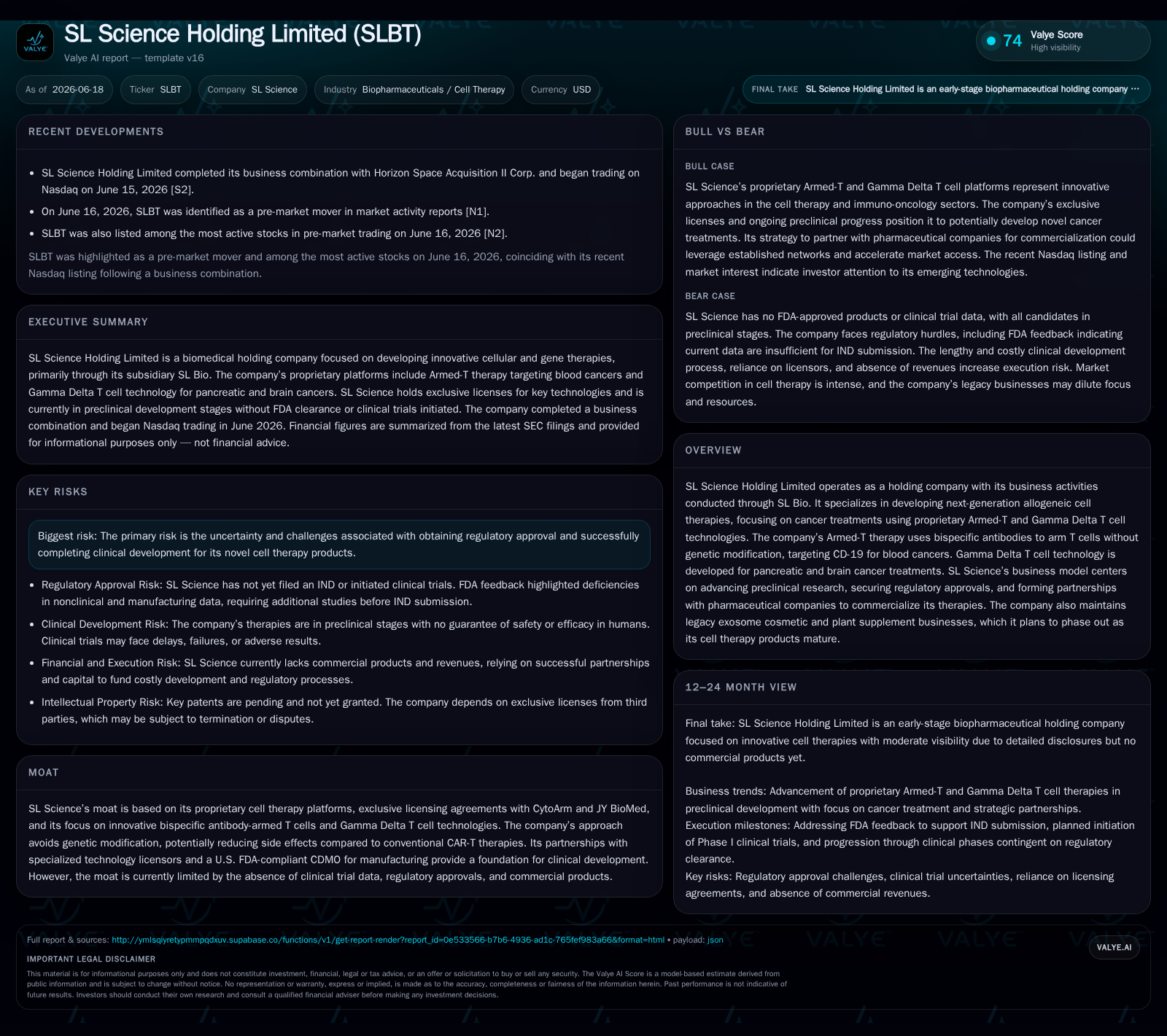
SL Science Holding Ltd has completed its business combination and commenced Nasdaq trading, signaling a transition to a publicly traded biotech focused on next-generation allogeneic cell therapies. Its core assets include exclusive global licenses for bispecific antibody-armed T cells (Armed-T) targeting blood cancers and Gamma Delta T cell therapies aimed at pancreatic and brain cancers. While continuing legacy exosome and plant extract sales in Taiwan, SL Science is prioritizing expansion in immuno-oncology through R&D investments, manufacturing process optimization, and regulatory preparations. Growth prospects hinge on clinical milestone achievements, regulatory pathways, licensing expansions, and scaling manufacturing with CDMO partners amid typical early-stage biotech risks.
Recent Operating Update: Public Listing Accelerates Development Focus
SL Science Holding Limited consummated its business combination with SL BIO Ltd. under Horizon Space Acquisition II Corp., with its ordinary shares commencing Nasdaq trading on June 15, 2026 [S2]. This transition from a private developmental stage entity to a publicly listed company provides enhanced access to capital markets intended to support the advancement of its proprietary cellular therapy platforms primarily operated through its subsidiary SL Bio.
The company’s recent disclosures highlight concentrated efforts on bispecific antibody-armed T cells (Armed-T) designed specifically for blood cancer indications via CD-19 targeting. Concurrently, it advances Gamma Delta T cell therapies addressing aggressive solid tumors including pancreatic and brain cancers. These programs are anchored by exclusive global licenses acquired from CytoArm (for Armed-T) and JY BioMed (for Gamma Delta T cells) [S1,S19].
Business Model: Licensing-Based Innovation in Cell Therapy
SL Science operates through intellectual property licensing agreements that grant exclusive rights to develop, manufacture, use, import, offer for sale, and sell its core product candidates. The model anticipates value creation through milestone payments aligned with research progress stages, royalty revenue upon commercialization, and potential direct sales or partnerships later in the product lifecycle [S1]
While the company maintains active sales of milk-derived exosome cosmetic products and plant extracts within Taiwanese markets as legacy operations, these are being strategically deprioritized in favor of resource allocation toward innovative immuno-oncology pipelines [S1]
Manufacturing partnerships with contract development and manufacturing organizations compliant with U.S. FDA standards are integral to scaling production capabilities necessary for advancing from preclinical research through clinical trials toward commercialization—a critical operational focus given the complexity inherent in cell therapy manufacture [S1]
Recent increases in operating expenses primarily reflect investments in expanding senior management personnel to enhance capabilities across product design, functional testing, manufacturing process optimization, and regulatory affairs essential for pipeline progression [S3].
Industry Context & Competitive Positioning
Within the biotechnology sector’s cell and gene therapy subsector focused on immuno-oncology applications, SL Science remains at an early stage relative to established peers such as Kite Pharma (Gilead), Fate Therapeutics, or Adaptimmune. The company’s differentiation lies in its non-genetically modified armed T cell approach using bispecific antibodies rather than gene editing techniques characteristic of CAR-T therapies—potentially offering improved safety profiles if efficacy is demonstrated.
The Gamma Delta T cell platform targets solid tumors with high unmet medical need where therapeutic options remain limited. However, SL Science’s competitive moat is currently nascent due to absence of clinical data or regulatory approvals; future value depends heavily on successful R&D milestones combined with strategic partnerships that broaden technical expertise or market reach [S1,S11].
Growth Drivers: Advancing Clinical Pipeline & Strategic Collaborations
Key growth catalysts include progressing proprietary candidates into human clinical trials which would validate therapeutic potential while unlocking additional financing opportunities through milestone payments or equity raises [S1,S11].
Strategic licensing agreements with CytoArm and JY BioMed provide robust intellectual property protection supporting a diversified pipeline spanning hematologic malignancies to difficult-to-treat solid tumors. This multi-indication approach offers optionality in addressing large oncology markets.
Process improvements enabled by CDMO collaborations aim to enhance manufacturing scalability while managing costs—an essential factor for late-stage development readiness and eventual commercialization success [S1].
Broader market dynamics such as increasing cancer incidence rates alongside growing acceptance of immuno-oncology modalities underpin long-term demand prospects for SL Science’s platforms.
Risks & Watchpoints: Early-Stage Development Challenges & Financial Dependencies
Risks typical of preclinical biotech companies apply:
- No clinical trial data yet exists to confirm safety or efficacy profiles;
- Regulatory approval pathways for novel allogeneic cell therapies remain complex with potential delays or rejections;
- Ongoing net losses require continuous capital raises; recent filings indicate recurring operating deficits necessitating funding strategies [S13];
- Reliance on third-party licensors exposes vulnerability to patent disputes or contractual breaches;
- Manufacturing scale-up must be carefully managed to avoid quality issues or timeline slippages;
- Market adoption post-approval faces competition from existing CAR-T products and checkpoint inhibitors along with reimbursement uncertainties.
Monitoring progress against IND filings or clinical trial initiations will be critical indicators of advancing beyond scientific promise toward commercial viability.
Outlook & Near-Term Milestones
Investors should watch for:
- Initiation of first-in-human clinical studies for CD-19 Armed-T candidates targeting blood cancers;
- Advancement of Gamma Delta T cell programs into preclinical toxicology studies or early-phase trials focusing on pancreatic and brain cancers;
- Progression of regulatory submissions aligned with FDA or other global authorities;
- Expansion of licensing agreements or new partnerships enhancing pipeline breadth or geographic reach;
- Demonstration of manufacturing process robustness at pilot scales consistent with regulatory expectations;
- Execution of financing plans following recent $7.8 million PIPE placement concurrent with the business combination to sustain operational funding while managing cash burn prudently.
Conclusion
SL Science Holding Ltd embarks on its public company phase positioned at a pivotal inflection point where operational execution will determine translation of proprietary bispecific antibody armed-T cells and Gamma Delta T cell technologies from promising preclinical assets into clinically validated therapeutics. Its exclusive licensing arrangements afford foundational IP protection within high-unmet need oncology segments. Nonetheless, delivering shareholder value depends critically on navigating complex clinical development pathways, securing regulatory approvals amid evolving standards for novel allogeneic therapies, scaling manufacturing capabilities effectively through CDMOs, maintaining financial resources amidst recurrent losses, and demonstrating therapeutic benefit against challenging cancer types. In a competitive landscape led by established CAR-T leaders like Kite Pharma/Gilead and emerging off-the-shelf innovators such as Fate Therapeutics, SL Science’s path is ambitious but requires disciplined execution aligned with sector best practices.
This analysis synthesizes facts drawn primarily from SLBT's latest quarterly Form 6-K filing dated June 15, 2026 [S2] alongside comprehensive disclosures in its annual Form 20-F filed mid-June 2026 [S1], without including speculative financial metrics or guidance.
Disclaimer: This is research-only, informational analysis and not investment advice. It may include AI-generated interpretation and general industry context. Always verify important details using primary sources.

Comments