
Skkynet Cloud Systems Advances Industrial AI with Government-Backed Initiative
Skkynet’s latest quarterly report reveals modest revenue and stable liquidity alongside a significant government-funded Industrial AI project aimed at expanding its SaaS offerings in the industrial automation market.
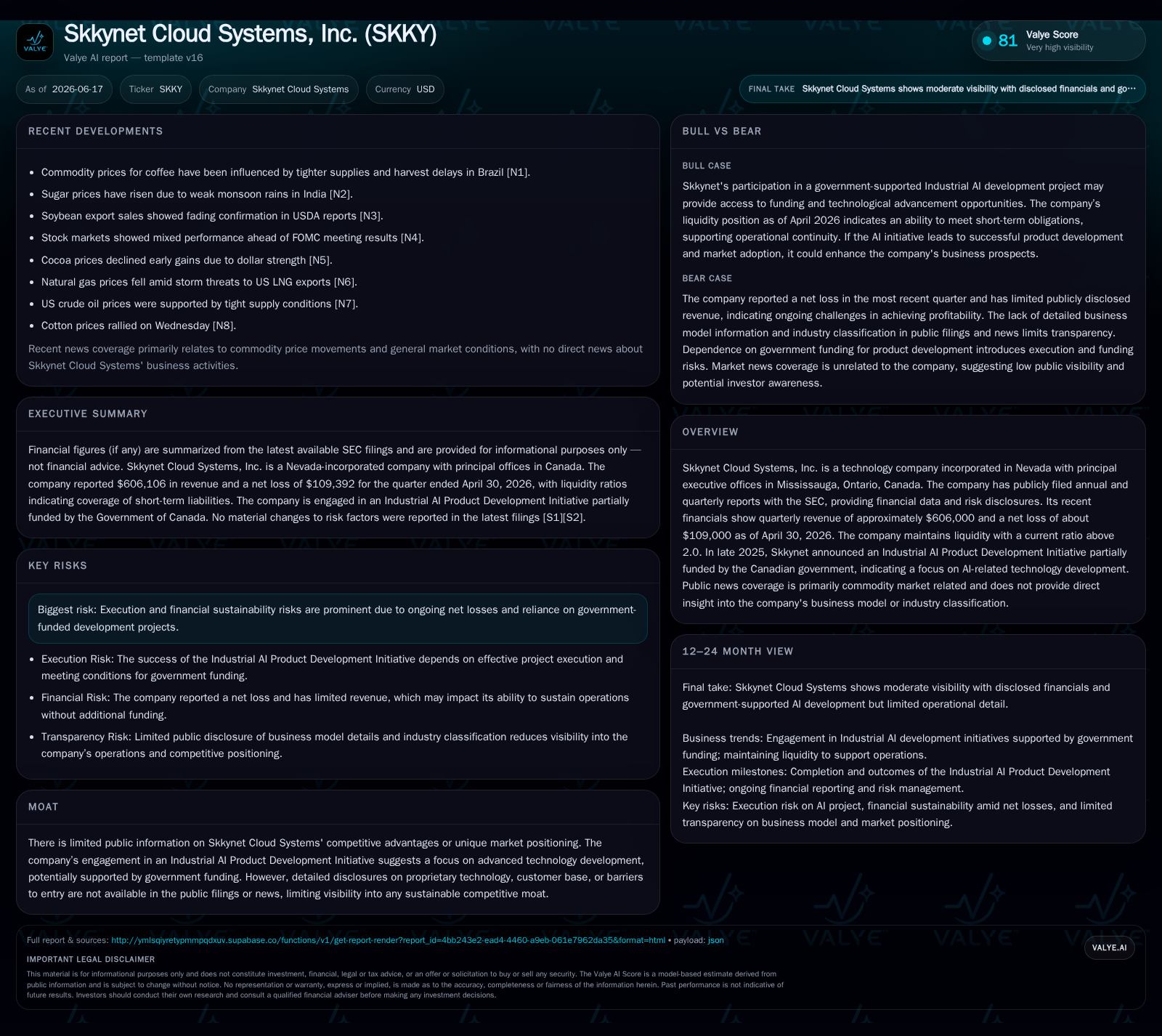
In its 2026 Q1 filing, Skkynet Cloud Systems reported approximately $606,000 in quarterly revenue and a net loss near $109,000, maintaining a current ratio above 2.0, which underscores operational continuity despite ongoing losses. The company recently secured a partially government-funded C$2.6 million initiative targeting Industrial AI product development, signaling a strategic pivot to Industry 4.0 cloud-based real-time data solutions involving edge computing and AI-enabled asset management. While Skkynet’s SaaS-centric business model targets industrial automation with real-time data software, growth challenges persist due to limited sales resources and execution risks inherent in scaling within a competitive industrial IoT landscape.
Quarterly Results Highlight Modest Revenue and Stable Liquidity
In the quarter ending April 30, 2026, Skkynet Cloud Systems reported revenue of approximately $606,000 alongside a net loss close to $109,000 as disclosed in its latest Form 10-Q [S2]. Despite these ongoing losses, the company maintains a solid liquidity position with a current ratio above 2.0 based on recent balance sheet metrics—current assets totaling roughly $1.94 million against current liabilities near $933,000 [F1]. This ratio indicates sufficient short-term asset coverage to meet liabilities and supports operational continuity amid modest revenue scales. However, sustained operating losses highlight structural challenges typical of early-stage SaaS providers in capital-intensive industrial IoT niches.
Business Model Centered on Cloud-Enabled Industrial Real-Time Software
Skkynet’s core business leverages proprietary cloud-based SaaS platforms designed for real-time data collection, distribution, visualization, and control across industrial automation environments [S1]. Revenue is largely driven by subscription licensing fees for these software offerings complemented by professional services such as system integration and customization tailored for clients operating geographically dispersed manufacturing facilities under Industry 4.0 paradigms. The company’s technology stack prioritizes edge computing capabilities facilitating remote monitoring and control of industrial assets over third-party networks — critical given shifting production geographies where centralized engineering teams must supervise offshore or low-cost production sites remotely.
The SaaS model relies heavily on expanding Monthly/Annual Recurring Revenue (MRR/ARR) through customer acquisition in manufacturing verticals increasingly adopting IIoT solutions. Yet Skkynet faces headwinds due to limited marketing and sales resources constraining its ability to scale new client engagements rapidly. This bottleneck directly impacts average revenue per user (ARPU) growth potential and prolongs typical long sales cycles seen across industrial technology deployments.
Competitive Landscape in Industrial IoT Cloud Platforms
Within the broader industrial IoT and cloud software ecosystem—characterized by players such as PTC Inc., OSIsoft (now part of AVEVA), Siemens Digital Industries Software, Honeywell Process Solutions—the competitive terrain features firms boasting deep integration capabilities spanning hardware interfaces to advanced analytics including digital twin simulations and cybersecurity solutions.
Skkynet remains comparatively small with limited public disclosure of its customer base or market share positioning [S1][F1]. Unlike these incumbents with broad horizontal and vertical integration synergies across automation hardware/software ecosystems or embedded AI platforms, Skkynet’s visibility into a sustainable moat remains unclear given its nascent commercial footprint.
Its differentiation hinges on flexibility delivered via real-time data streaming combined with emerging AI capabilities—particularly the remote edge-processing approach that aligns well with Industry 4.0’s trend toward distributed intelligence in manufacturing operations.
Growth Catalysts From Industrial AI Initiative and SaaS Expansion
A key driver on the horizon is Skkynet’s December 2025 announcement of an Industrial AI Product Development Initiative funded partially by the Canadian Government through FedDev Ontario's Regional Artificial Intelligence Initiative [S8]. The C$2.6 million (approximately US$1.9 million) funding facilitates dedicated R&D focused on developing industrial AI applications embedded within their cloud-based SaaS portfolio.
This initiative underscores the strategic pivot toward augmenting traditional IIoT offerings with AI-enabled asset management functions including predictive maintenance algorithms and advanced process analytics delivered through cloud-edge hybrid architectures. Such enhancements respond directly to manufacturing demands for reduced downtime and improved operational efficiency driven by Industry 4.0 digital transformation investments.
If execution succeeds as planned, this infusion of targeted capital will elevate Skkynet’s product relevance amidst intensifying competition while potentially enabling partnerships or co-development agreements leveraging government innovation ecosystems.
Risks Centered on Execution Challenges and Funding Dependence
Despite potential upsides from the Industrial AI Project funding, Skkynet faces considerable execution risks that temper near-term outlooks [S1][S2]. Continued net losses indicate ongoing investment requirements with uncertain timing for achieving profitability or meaningful positive cash flow.
The constrained sales force limits market penetration capability especially against large incumbents who can leverage established client relationships across diversified industrial sectors. This restricts pace of recurring revenue growth fundamental to SaaS scaling.
Additional industry risks involve cybersecurity vulnerabilities inherent to cloud-connected industrial systems requiring robust safeguards—a domain where larger peers dedicate substantial R&D investments—and integration difficulties with legacy plant equipment complicating rapid adoption cycles.
Reliance on government-backed projects also introduces dependency risks: delayed loan disbursements or shifting program priorities could impact timelines or resource availability critical to advancing innovation milestones.
"Forward View" Monitoring KPIs and Deployment Milestones
Tracking Skkynet’s progression will require close attention to several operational indicators reflective of scalable SaaS traction:
- ARR/MRR Growth: Consistent expansion here signals customer adoption momentum beyond pilot phases.
- Customer Deployment Scale: Number of active sites/assets monitored helps gauge penetration depth within existing accounts.
- R&D Expense Ratio: An increase aligned with funded AI initiatives may forecast forthcoming product feature releases.
- New Partnership Announcements: Collaborations especially involving system integrators or technology alliances could catalyze broader market access.
- Sales Pipeline Development & Customer Retention: Metrics that will elucidate resilience against competition and sales resource constraints.
The company's ability to demonstrate tangible deployments tied to its AI-enhanced platform features will be crucial for validating the strategy underpinning government-backed funding utilization.
Financial Profile Summary
As of April 30, 2026, Skkynet holds current assets worth approximately $1.94 million against current liabilities near $933,000 resulting in a current ratio of about 2.08 — indicating healthy liquidity buffering near-term obligations [F1]. Cash and equivalents remain robust at over $1.4 million providing runway to fund ongoing operations despite quarterly net losses approximating $109k [F1][S2]. The absence of long-term debt reduces financial leverage concerns but also reflects limited external capital access thus far.
Revenue levels remain modest at around $606K quarterly reflecting early commercialization stages common within specialized Industrial IoT SaaS niches dependent on protracted implementation timelines [F1][S2]. Continued investment prioritization into R&D aligned with the Industrial AI project will influence operating margins going forward.
Disclaimer: This analysis is based solely on public filings from Skkynet Cloud Systems as of June 2026 combined with contextual industry knowledge relevant to industrial IoT cloud software markets. It does not constitute investment advice or research views.
Disclaimer: This is research-only, informational analysis and not investment advice. It may include AI-generated interpretation and general industry context. Always verify important details using primary sources.

Comments