
Starlink AI Acquisition Corp's SPAC Launch and Business Combination Path
Starlink AI Acquisition Corp completed its IPO in May 2026, establishing a trust account with $100 million to pursue an initial business combination.
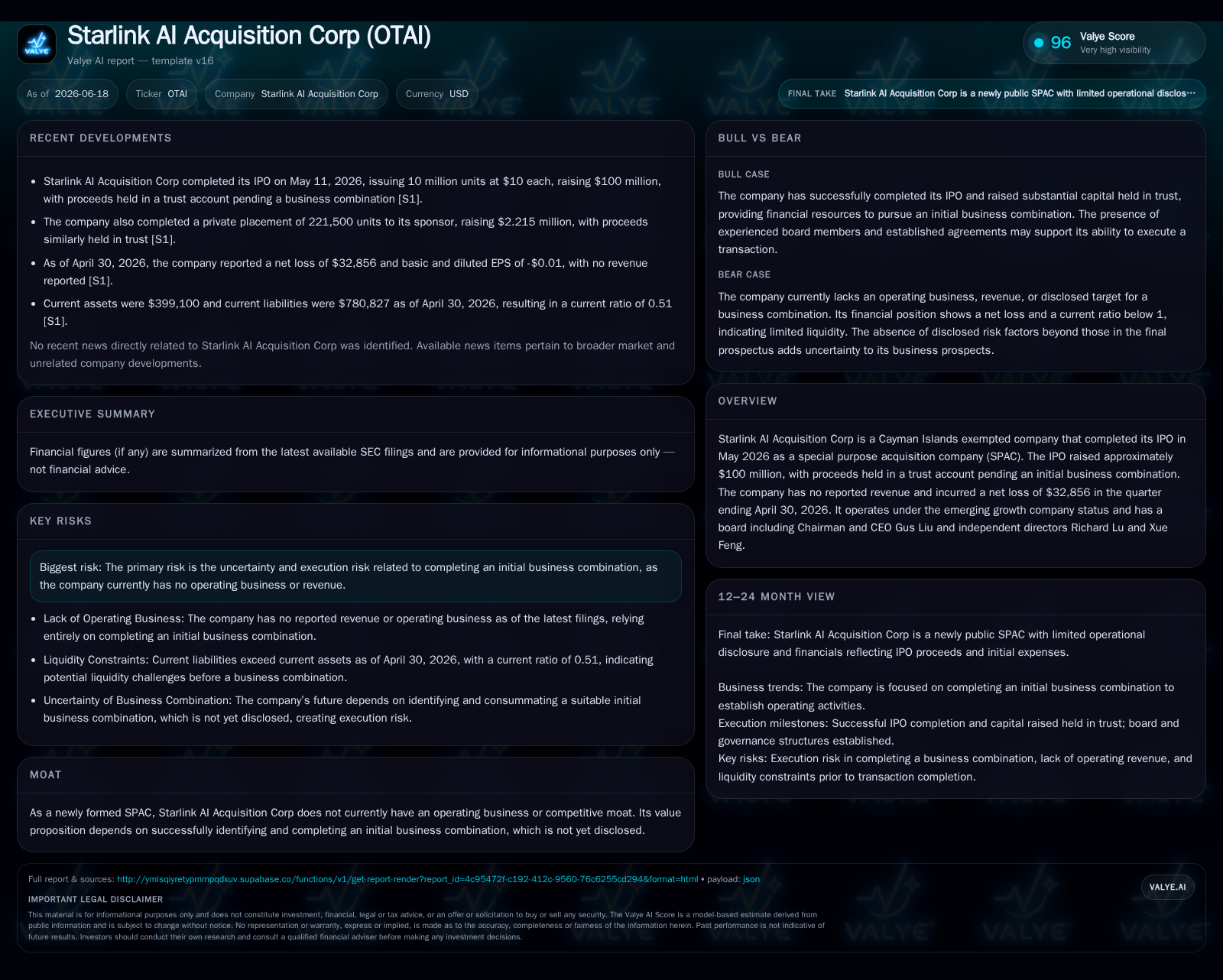
Starlink AI Acquisition Corp is a newly formed SPAC headquartered in the Cayman Islands that raised approximately $100 million through its IPO in May 2026. The latest quarterly filing dated June 18, 2026, confirms the completion of the capital raise and establishment of the trust account, with no current revenue and a net loss reflecting typical early-stage expenses. As with all SPACs, its future value hinges on identifying and executing a suitable initial business combination within prescribed timelines. The company’s sponsor and board structure support its efforts, but risks remain around deal completion, shareholder redemptions, and regulatory scrutiny.
Quarterly Update: IPO Close and Operating Snapshot
Starlink AI Acquisition Corp's latest quarterly filing (10-Q dated June 18, 2026) confirms the successful completion of its initial public offering in May 2026. The company raised approximately $100 million (before expenses) through the sale of 10 million units priced at $10 each. Simultaneously, the sponsor executed a private placement of roughly $2.2 million forming part of the initial capital structure [S2][S3]. Additional proceeds from partial exercise of the underwriters' over-allotment option boosted gross proceeds by about $5 million shortly after IPO close [S3].
The funds raised have been deposited into a U.S.-based trust account managed by Continental Stock Transfer & Trust Company. This trust holds cash or government securities earning interest but restricts use until consummation of an initial business combination or redemption events [S8][S11]. The company's current ratio stood at about 0.51 as of April 30, 2026, reflecting nominal current assets against higher current liabilities primarily associated with operating costs just beginning to accrue [F1][S2]. Despite this ratio below unity, the larger context is that operational liabilities are measured against a separately accounted trust fund holding IPO cash.
Net income showed a loss of $32,856 for the quarter ending April 30, consistent with expected minimal expenses incurred during the SPAC's formation and registration phases [F1]. Revenue remains zero as no operations beyond financial structuring have commenced.
Understanding Starlink AI's SPAC Business Model
As a special purpose acquisition company (SPAC), Starlink AI's business model revolves around raising capital from public markets through an initial public offering structured into 'units.' Each unit includes one ordinary share plus one right to receive one-fourth of an additional share upon completion of an initial business combination [S3]. This fractional right incentivizes shareholders by providing potential upside tied to successful deals.
The trust account acts as a safeguard for investors’ capital; funds cannot be withdrawn except to finance taxes or return money upon shareholder redemptions prior to completing a merger [S8]. The sponsor – JKapital Ltd. – also contributed privately purchased units aligning interests but is subject to lock-up constraints preventing early sale [S12][S14]. Additionally, administrative services agreements formalize management of operations during the pre-combination phase [S10].
Shareholders possess redemption rights allowing them to return shares for cash if dissatisfied with proposed mergers before vote approval, which impacts available deal capital and is a critical variable in negotiations. Ultimately, Starlink AI generates returns by identifying high-potential private companies willing to merge through the de-SPAC transaction route, often accompanied by PIPE financing from institutional investors enhancing deal size and credibility.
Industry Context: SPAC Market Dynamics and Peer Comparisons
Starlink AI enters the market amid fluctuating sentiment on SPACs as alternative public listing vehicles. Prominent peers like Pershing Square Tontine Holdings have shown substantial scale yet also illustrate risks around lengthy timelines and shareholder redemptions that erode deal proceeds. Social Capital Hedosophia series reinforced tech sector attractiveness but demonstrated valuation complexity post-merger.
Compared to traditional IPOs which take months to prepare with significant underwriting fees and regulatory hurdles, SPACs offer faster market entry albeit with increased execution risk concentrated on finding suitable targets timely. The redemption mechanism can significantly reduce transaction capital availability if shareholders opt out en masse or disagree with valuations.
Regulatory scrutiny from the SEC has intensified in recent years targeting disclosure practices, conflicts involving sponsors' roles, and accounting treatments affecting investor protections. These factors contribute to an evolving operating environment demanding disciplined deal sourcing and transparent shareholder engagement.
Growth Drivers: Deal Pipeline and Market Appetite
Key growth drivers for Starlink AI hinge on robust access to attractive private companies seeking expedited public market access without typical IPO complexity. This appeals especially in technology-driven sectors where speed-to-market can dictate competitive advantage.
Rising investor appetite for alternative equity vehicles supports demand for new SPAC formations when coupled with favorable macroeconomic conditions. Additionally, innovations such as PIPE financing enable larger transactions backed by institutional due diligence standards improving market confidence.
Sponsor reputation plays a pivotal role; experienced management teams can leverage networks for quality deal flow increasing likelihood of successful combinations. Regulatory clarity further supports efficient deal timing reducing execution uncertainty.
Among critical KPIs will be time-to-complete the initial business combination relative to mandated windows (typically 18-24 months post-IPO), managing redemption rates that preserve capital pool size, and ultimately delivering accretive post-merger valuation multiples that satisfy public shareholders.
Risks to Watch: Deal Completion, Redemptions, and Regulatory Hurdles
The most salient risks stem from potential failure to finalize an initial business combination within prescribed timeframes triggering liquidation events returning cash less expenses to shareholders [S2]. Such failures damage sponsor reputations and prevent value creation.
Redemption risk presents continuous uncertainty where shareholder opt-outs reduce funds available for acquisitions forcing compromises on target quality or size. Dilution from rights issuances and warrants complicate ownership structures impacting per-share economics post-merger.
Regulatory shifts impose additional compliance burdens; ongoing SEC examination necessitates stringent disclosure controls escalating operational complexities especially for new entrants without track records.
Furthermore, conflicts between sponsor incentives versus minority shareholders can arise around deal pricing or timing influencing outcomes negatively if not properly managed.
Responsiveness to these hazards alongside proactive communication is crucial for maintaining investor confidence during de-SPAC transactions.
Upcoming Milestones: Timeline for Initial Business Combination
Following its May 2026 IPO close, Starlink AI is bound by regulatory mandates typically requiring consummation of an initial merger within approximately two years after listing or liquidation must ensue [S3]
Shareholder votes will mark pivotal points wherein targeted deals undergo approval evaluating terms fairness alongside projected business synergies. Prior to these meetings, deal announcements will act as market catalysts signaling strategic direction.
PIPE financing arrangements may be announced concurrently enhancing deal funding while validating target company prospects through institutional investor participation.
Management must balance pace with rigor ensuring neither rushed nor overly delayed deals impair ultimate value creation potential.
Financial Commentary: Asset Liquidity and Pre-Combination Operations
As of late April 2026 quarter-end data shows current assets at approximately $399,000 against current liabilities close to $781,000 yielding a current ratio near 0.51 [F1]. This liquidity profile reflects nascent operational outlays such as legal fees and administrative expenses funded outside the trust account containing roughly $100 million held exclusively for merger use or redemptions [S11][S12].
The net loss recorded was about $33,000 consistent with similar fledgling SPACs incurring minimal staff or overhead costs ahead of deal activity initiation [F1][S2]. The absence of revenues is expected given no operating business exists pre-de-SPAC event.
Management’s stewardship over these funds alongside careful expense control remains vital given lack of alternative liquidity sources until transaction closure allowing scale expansion.
Disclaimer: This analysis focuses on factual disclosures from recent SEC filings without offering investment guidance or predictions about Starlink AI Acquisition Corp’s future performance or specific transaction outcomes.
Disclaimer: This is research-only, informational analysis and not investment advice. It may include AI-generated interpretation and general industry context. Always verify important details using primary sources.

Comments