
Sony Advances Strategic Ecosystem Integration and Shareholder Returns Amid Industry Headwinds
Latest quarterly disclosures underscore Sony’s dual focus on optimizing capital allocation and expanding its hardware-software-content ecosystem while navigating supply chain and impairment challenges.
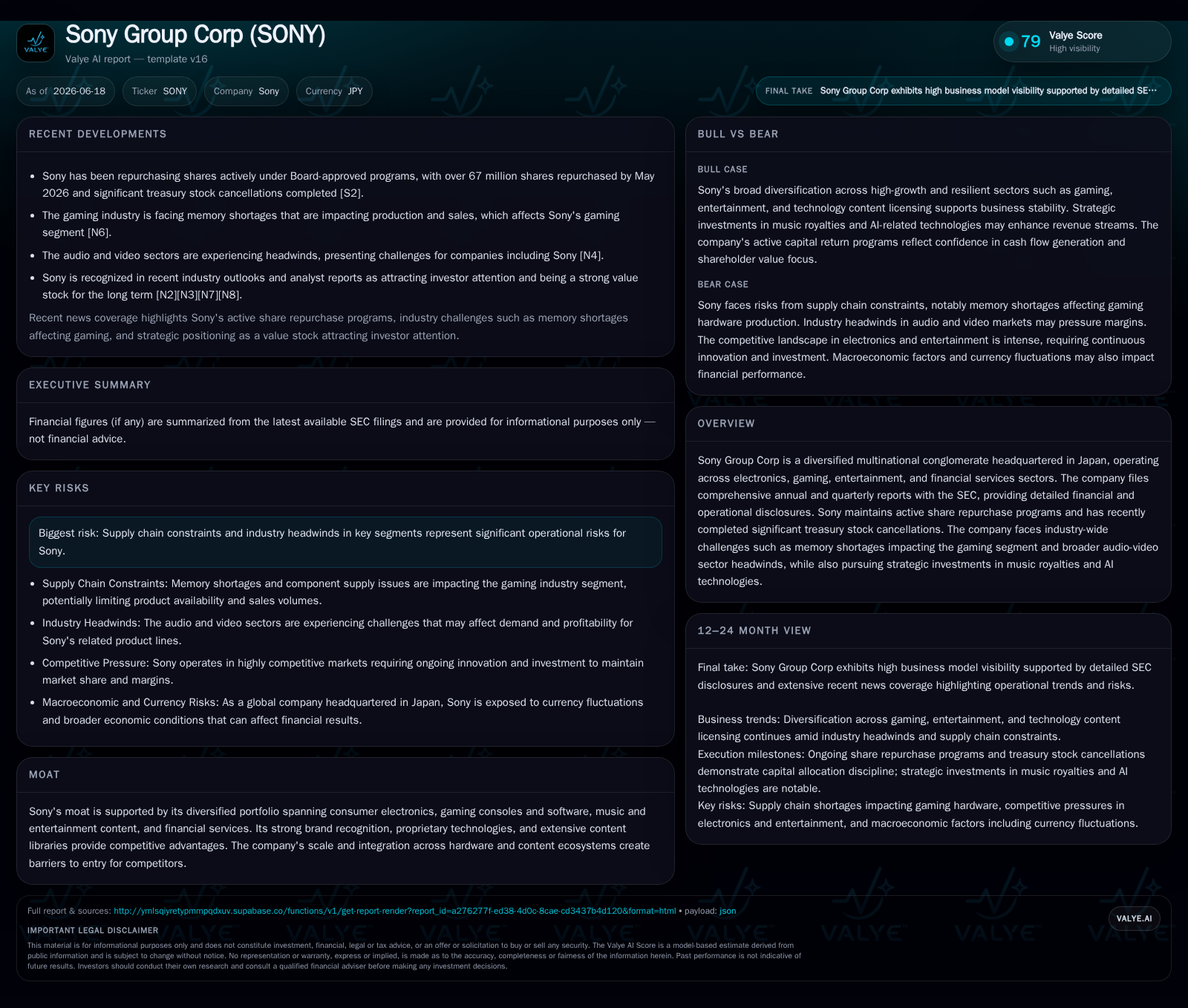
Sony Group Corp’s latest filings reveal a strategic push in share repurchases and a notable partnership with TSMC for next-generation image sensors, reinforcing its technological leadership and capital return discipline. The company posted record operating income in its gaming segment supported by network services growth, despite hardware sales softness and significant impairment charges related to Bungie’s assets. The Imaging & Sensing Solutions segment shows resilience with expanded digital camera sensor sales offsetting declining mobile sensor demand. Sony’s competitive moat remains anchored in integrated ecosystems spanning gaming, music, film, and semiconductor technologies. Supply chain constraints and selective asset impairments pose medium-term risks, but ongoing AI and content royalty investments create structural growth opportunities.
Recent Operating Update: Strategic Capital Moves and Technology Partnerships
Sony's latest quarterly disclosures up to June 2026 highlight aggressive execution on capital return initiatives alongside strategic technology partnerships. Notably, Sony repurchased nearly 70 million shares worth approximately ¥250 billion between late 2025 and mid-2026 under board resolutions approved across multiple dates (November 2025 through February 2026), culminating in the cancellation of 184 million treasury shares (3% of issued shares) as of May 29, 2026 [S2][S3][S15][S19]. This reflects disciplined capital allocation aimed at optimizing shareholder value during steady cash flow generation.
On the technology front, Sony Semiconductor Solutions inked a non-binding memorandum with TSMC to establish a majority-controlled joint venture focused on developing next-generation image sensors leveraging Sony's design expertise coupled with TSMC's semiconductor manufacturing capabilities [S10][S21]. This JV targets emerging physical AI applications such as automotive sensing and robotics—sectors expected to benefit from advanced imaging performance improvements. Planned phased investments aligned with market demand signals demonstrate prudent capacity expansion planning.
Business Model: Diversified Revenue Streams Anchored in Ecosystem Integration
Sony operates a multifaceted business model uniting hardware manufacturing (gaming consoles, image sensors, audio-video equipment) with content production (music, film) and network/service offerings. Revenue arises from device sales—driven by unit volumes and average selling prices—plus software sales including first-party and third-party game titles. Recurring revenue sources stem from network services subscriptions on PlayStation platforms, music publishing royalties through an extensive catalog ownership, digital distribution licensing fees, and intellectual property royalty streams.
The company's dual approach marries proprietary hardware innovations such as advanced stacked image sensors employing cutting-edge analog-domain technologies with exclusive content libraries enhancing customer engagement within its ecosystem [S1]. This integrated hardware-software-content synergy supports sustained pricing power and usage-based monetization via software downloads, online subscriptions, and digital media consumption.
In the Gaming & Network Services (G&NS) segment, revenues are influenced by unit sales of PlayStation consoles (notably PS5), sales mix between hardware/software/network services, user base growth measured by Monthly Active Users (125 million accounts in Q4 FY25), and monthly playtime increments [S13]. Music segment profitability depends on streaming subscription revenues balanced against lower activity in live events or merchandising [S23]. The Imaging & Sensing Solutions segment leverages superior stacking technology advancements for digital camera sensors while confronting cyclical softness in mobile sensor demand amid memory market fluctuations [S16].
Industry Structure and Competitive Position
Sony commands entrenched positioning within several highly specialized industry verticals characterized by rapid innovation cycles and platform-centric competition. Its semiconductor solutions place it among leading imaging sensor suppliers capable of fine pixel density scaling through proprietary stacking methods difficult for new entrants to replicate. In gaming consoles and network services, Sony contends with other major players differentiated by ecosystem lock-in effects fostered by exclusive titles, large user communities, and integrated online marketplaces.
In entertainment content domains such as music publishing and picture production, ownership of extensive catalogs delivers steady licensing fees even during cyclical downturns in consumer spending. Compared to peers like Apple or Microsoft who also combine hardware-software ecosystems but differ in content licensing exposure or platform strategies, Sony's balance across shifting consumer electronics cycles affords resilience.
Growth Drivers
Several structural growth drivers underpin Sony's outlook:
- Expansion of the installed base for the PlayStation 5 console increases recurring network service subscriptions while elevating software sales volumes.[S13]
- Ongoing growth in streaming music consumption elevates royalty income leveraging owned copyrights in recorded music catalogs.[S23]
- Technological innovation in image sensor designs via the new JV with TSMC optimizes performance for emerging AI-driven applications like autonomous vehicles and smart robotics.[S10]
- Incremental adoption of AI capabilities across entertainment offerings enhances personalization potential thereby driving customer retention.
- Cross-selling opportunities within the integrated hardware-software ecosystem amplify wallet share per user across devices, games, media content, and subscription services.
Risks / Watchpoints / Growth Constraints
Key operational risks surround supply chain constraints prevalent across memory components impacting the gaming segment’s hardware supply [N7], thereby limiting volume-driven growth potential despite strong demand fundamentals. Impairment losses approximating ¥120 billion recognized against Bungie's intangible assets signal challenges integrating recent acquisitions or realizing expected future cash flows from acquired studios [S1]. Continued media content performance depends on sustaining hits amidst shifting consumer preferences.
Foreign exchange volatility affects reported financials given global revenue exposure but is partially mitigated via hedging strategies [S1]. Additional risks include intensified competition in consumer electronics pricing pressure threatening ASPs (average selling prices), possible regulatory disruptions affecting financial services spun off recently [S18], potential technology obsolescence necessitating sustained R&D investment (currently stable at ~6.1% of sales), plus cybersecurity threats managed under a top-tier security governance framework featuring executives with government-level expertise [S1].
What To Watch Next
Upcoming milestones include formalization of definitive agreements surrounding the TSMC JV potentially unlocking incremental advanced capacity for image sensors [S13]. Monitoring progress against FY26 financial forecasts will be crucial—particularly operating income gains anticipated from absence of restructuring charges in Imaging & Sensing Solutions and improved G&NS profitability despite lower console unit shipments
Growth metrics such as console unit sales trends post-memory shortage easing, network service subscriber expansion rates beyond the March peak, incremental gains in streaming royalties within Music, and further content licensing deal flow will offer leading indicators reflecting execution quality. Additionally, observing capital deployment pace under the ongoing ¥500 billion share repurchase program will clarify management’s confidence stance regarding free cash flow generation amidst industry cyclicality.
Disclaimer: This analysis is based solely on publicly disclosed information as referenced without any forward-looking investment advice or research views.
Disclaimer: This is research-only, informational analysis and not investment advice. It may include AI-generated interpretation and general industry context. Always verify important details using primary sources.

Comments