
CVR Partners Advances Feedstock Flexibility With Natural Gas Shift while Maintaining Midwest Fertilizer Leadership
Q2 2026 filings disclose CVR Partners' strategic engineering to blend natural gas feedstock at Coffeyville, supporting margin stability amid commodity price volatility.
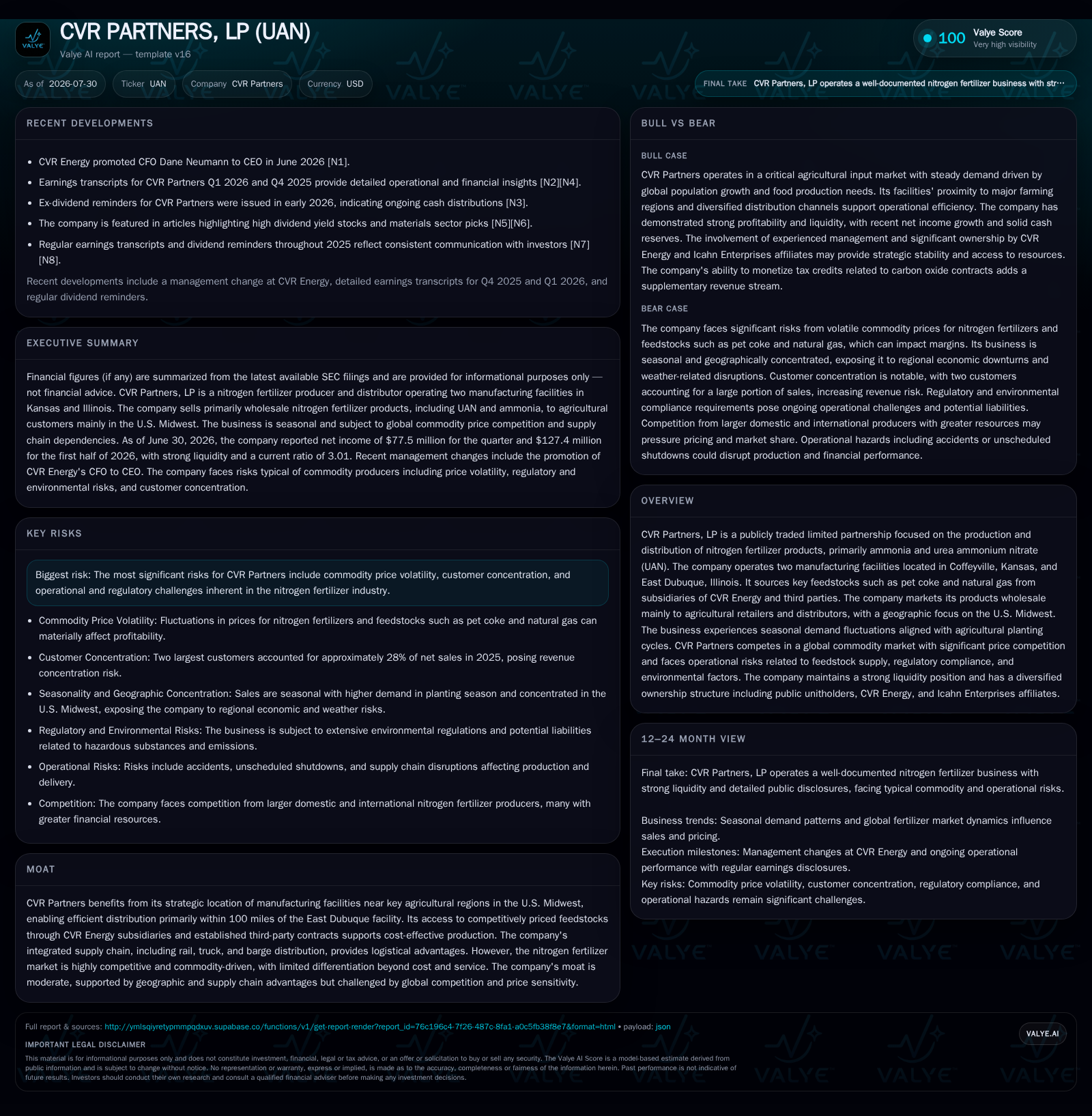
In Q2 2026, CVR Partners revealed near-term plans to incorporate natural gas alongside pet coke at its Coffeyville ammonia and UAN production facility, a move aimed at diversifying feedstock sources amid volatile pet coke pricing. This strategic pivot is expected to offer cost stabilization benefits while maintaining operational efficiency within its critical U.S. Midwest regional market. The company’s financial profile remains robust with elevated cash reserves and a strong liquidity position, underpinning capacity for capital investments during the seasonal fertilizer demand cycle. Despite cyclicality and regulatory risks, CVR Partners’ geographic placement and integrated supply chains provide a moderate moat compared to peers.
Transitioning Feedstock Sources for Cost Stabilization at Coffeyville Facility
In its latest Q2 2026 filing, CVR Partners emphasized nearing completion of detailed engineering studies enabling the use of natural gas alongside pet coke as feedstocks at its Coffeyville nitrogen fertilizer plant [S2]. This dual-feedstock capability represents a significant strategic shift for the partnership's production operations historically reliant on pet coke gasification. The move targets mitigating margin erosion risks tied to fluctuating pet coke prices—a key raw material whose cost dynamics heavily impact nitrogen fertilizer production economics.
Natural gas offers potential pricing advantages and diversification benefits relative to pet coke but requires capital investment to retrofit existing plant processes. The company expects to seek General Partner Board approval imminently before commencing construction phases spanning late 2026 into 2027 [S2]. Successful execution would allow operational flexibility by blending or switching between feedstocks in response to market conditions. This approach reflects industry best practices among nitrogen fertilizer peers seeking cost curve improvements amid globally volatile energy inputs.
Feedstock mix stability is paramount given that raw material costs typically constitute the largest portion of operating expenses in nitrogen fertilizer manufacturing. By reducing sensitivity to single commodity input pricing through engineered adaptability, CVR Partners aims to better manage unit production costs per ton of ammonia and urea ammonium nitrate (UAN). Efficiency gains here can translate directly into margin protection or expansion when global fertilizer prices experience downward pressure.
Commodity Pricing Sensitivity Within a Seasonal Demand Framework
The business remains subject to pronounced seasonal fluctuations driven by North American farmers’ planting cycles. Demand peaks during spring planting seasons align with higher sales volumes of ammonia and UAN products primarily used for corn and wheat crops [S1]. Consequently, sales volumes and revenue recognition typically ebb outside peak periods impacting quarterly profitability patterns.
Inventory management also interacts with seasonality; buildup or drawdown patterns influence reported cost of materials due to changes in inventory valuation. For example, in Q2 2026 lower feedstock prices combined with inventory builds reduced cost of materials by approximately $4.5 million versus year-ago levels [S2]. Precision in managing inventory levels around seasonal peaks supports working capital efficiency and margin capture.
Distribution Network Strength Anchored in Regional Agricultural Markets
CVR Partners operates two manufacturing facilities—one at Coffeyville, Kansas and another at East Dubuque, Illinois—with marketing focused wholesale on agricultural retailers within roughly a 100-mile radius centered on the U.S. Midwest’s key grain-producing zones [S1]. This geographic concentration facilitates efficient logistics through established rail, truck, and barge networks controlling delivery costs relative to more dispersed peers dependent on extended supply lines.
Proximity to dense agricultural demand pools underpins CVR’s competitive advantage by lowering transportation expenses that materially affect end customer pricing competitiveness in this largely commoditized industry. Additionally, strong relationships with distributors improve market penetration and support repeat orders aligned with recurring cropping needs.
While broader global markets influence commodity fertilizer prices, regional distribution advantages create a moderate moat enabling survival amid fierce international competition from integrated global chemical producers or cheaper imports.
Competitive Position Relative to Peers with Feedstock Flexibility and Logistics Edge
Relative to peers engaged solely in natural gas or pet coke-based input strategies—and those lacking access to adjacent refining subsidiaries like CVR Energy—CVR Partners benefits from diversified input contracting backed by sister company agreements providing more stable feedstock sourcing terms [S1]. This integrated supply chain reduces exposure to spot price spikes or physical shortages recurring intermittently within both pet coke and natural gas markets.
CVR's geographic footprint restricts product distribution predominantly within the Midwest corridor, which contrasts with broader multinational producers but aligns well with targeted customer bases. This concentrated strategy limits scale but deepens relationship-based resilience amid shifting trade policies or import competition.
Growth Drivers via Feedstock Innovation and Market Penetration Channels
The forthcoming integration of natural gas as a complementary feedstock promises measurable reductions in per-unit production cost when natural gas prices are favorable against contracted pet coke levels—a prospect potentially enhancing EBITDA margins once implemented fully post-2027 construction [S2]
Additionally, rising crop prices encourage farmers toward increased fertilizer application rates per acre; augmented by the ongoing expansion or modernization efforts within existing manufacturing capacity sectors across the industry could boost volume growth opportunities over time. Strategic partnerships with agricultural distributors aiming to expand footprint regionally add incremental channel-based growth avenues.
However, these growth drivers face countervailing constraints such as capital intensity required for modernization projects and mounting environmental compliance investments necessary under tightening air emission regulations affecting chemical manufacturing sites nationwide.
Operational Risks Arising from Environmental Compliance and Market Cyclicality
Regulatory risks remain substantial: compliance with Clean Air Act mandates requires periodic capital expenditures for emission control upgrades targeting sulfur dioxide (SO₂), volatile organic compounds (VOC), nitrogen oxides (NOx), among other pollutants generated during nitrogen fertilizer production [S1]. These may impose episodic discretionary capex pressures that displace optional growth spending elsewhere.
Customer concentration risk is nontrivial given majority sales flow through limited large agricultural distribution channels; disruptions or contract renegotiations could affect usage patterns or pricing structures materially. Furthermore, seasonality-induced sales variability amplified by unpredictable weather patterns complicates quarterly cash flow forecasting demanding prudent working capital management.
Global geopolitical factors influencing feedstock availability or export flows similarly raise uncertainty layers—for instance, European natural gas supply shortages have amplified global energy price volatility influencing input costs worldwide through early 2027 forecasts [S21]
What To Watch Next: Approval Milestones, Feedstock Price Trends, Quarterly Volume Metrics
Focus should be placed on governance actions regarding final board approvals advancing the Coffeyville natural gas integration construction phase scheduled for late-2026 through 2027 [S2]. Tracking progress against these engineering-to-execution timelines will be critical to validating feedstock flexibility strategy execution
Feedstock pricing trajectories—especially relative movements between contractually secured pet coke costs versus spot or long-term natural gas pricing—will serve as real-time barometers signaling margin contraction or expansion potential.
Additionally, quarterly shipments data showcasing volume recovery post–planting seasons would confirm stabilization of demand fundamentals supporting near-term revenue sustainability beside fluctuating unit prices.
Financial Profile Discussion: Liquidity Cushion Supports Execution in Volatile Cycle
CVR Partners ended Q2 2026 with cash and cash equivalents totaling approximately $137 million alongside current assets exceeding current liabilities by over threefold (current ratio ~3.01), demonstrating ample liquidity buffer to fund ongoing capital expenditure projects including the planned feedstock diversification investments [S2], [F1].
Thus far, balance sheet strength supports disciplined capital deployment focusing primarily on essential maintenance capex supplemented by targeted growth investments including environmental compliance-related upgrades.
This financial position underscores CVR's capability not only to withstand inherent commodity market cyclicality but also position strategically ahead through infrastructure enhancements aimed at long-term competitiveness within constrained Midwest nitrogen fertilizer markets.
This analysis is based exclusively on public SEC filings as of July 29–30, 2026 and relevant industry context without any proprietary inside information or forecast; it does not constitute investment advice.
Disclaimer: This is research-only, informational analysis and not investment advice. It may include AI-generated interpretation and general industry context. Always verify important details using primary sources.

Comments