
Repligen Strengthens Cell Therapy Presence with $1.5B BioLife Acquisition Amid Robust Q2 Execution
Repligen’s strategic expansion into cell therapy complements solid bioprocessing growth, with integration risks a key near-term focus.
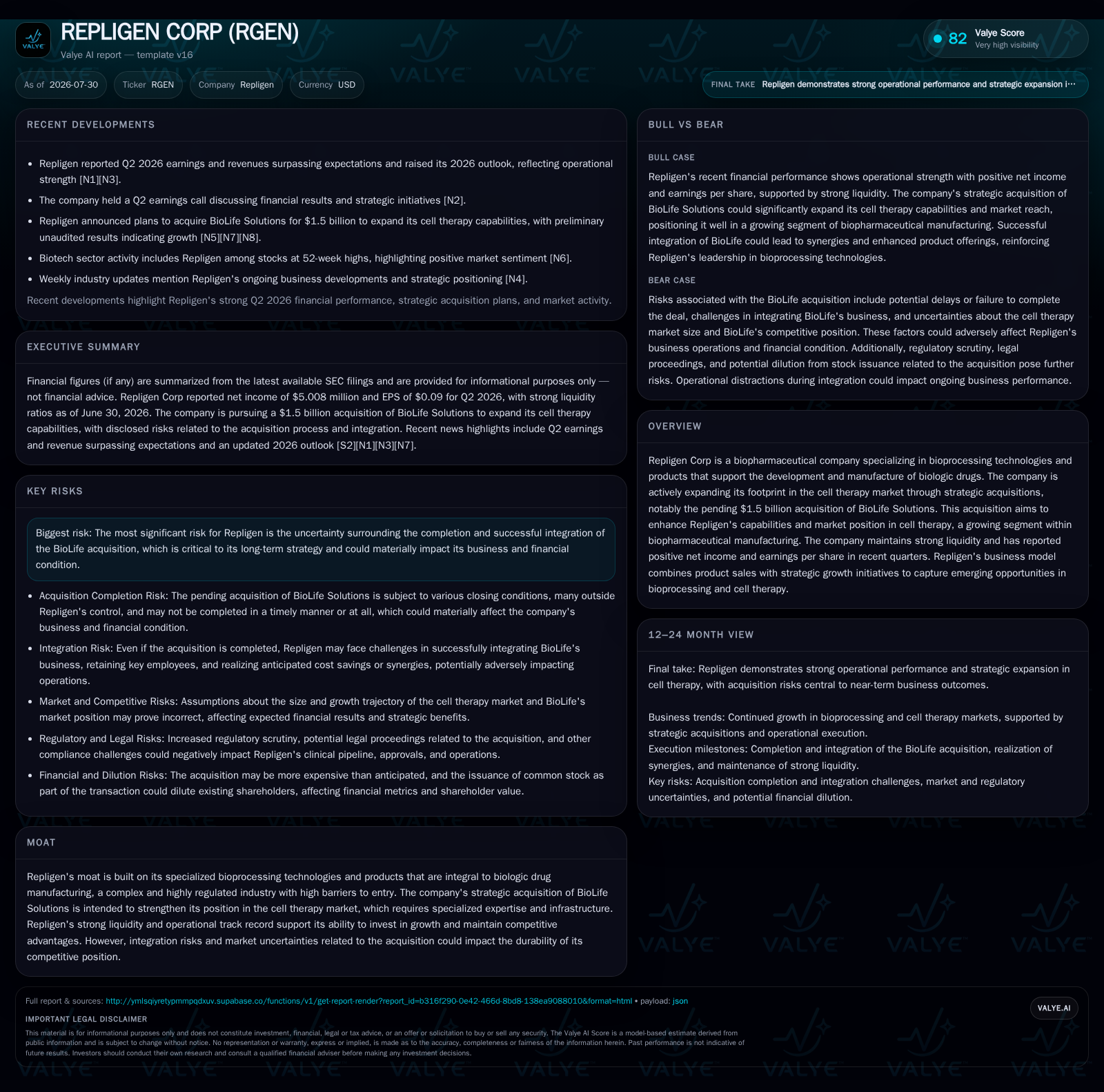
Repligen reported strong second-quarter 2026 results marked by revenue growth and margin expansion, underpinning its core bioprocessing franchise. The company announced a $1.5 billion acquisition of BioLife Solutions to broaden its cell therapy capabilities, signaling a deliberate pivot toward the higher-growth cell therapy segment. While liquidity remains robust, successful integration of BioLife represents a critical execution challenge and pivotal factor for realizing expected synergies and market expansion. Repligen’s position as an essential bioprocessing supplier is supported by increasing adoption of single-use technologies and rising biologic drug manufacturing demand.
Recent Operating Update: Q2 2026 Performance Anchored by Growth and Strategic Expansion
Repligen Corporation’s second quarter ended June 30, 2026, showcased solid operational momentum characterized by revenue increases fueled primarily through its core bioprocessing consumables portfolio and positive margin trends [S2], [N3], [N5]. Management highlighted expectations for sustained margin expansion driven by operating leverage as manufacturing scale-up in biologic drugs accelerates industry-wide.
Simultaneously, a material corporate development was announced: the execution of a merger agreement to acquire BioLife Solutions for approximately $1.5 billion in cash and stock consideration [S27], [N1]. This strategic acquisition aims to significantly broaden Repligen’s presence in the cell therapy processing space—an adjacent but rapidly evolving segment featuring distinct manufacturing workflows and regulatory requirements compared to traditional biologics production.
Business Model: Specialized Bioprocessing Products Bridging Biologics and Cell Therapies
Repligen’s business model centers on designing, manufacturing, and selling critical consumables and technologies used upstream in the biologic drug development pipeline—including filtration systems, chromatography media, single-use components, and process development tools [S1]. Customers are primarily pharmaceutical companies, biotech firms, and CDMOs that outsource manufacturing scale-up activities.
Product monetization typically involves direct sales of consumables—high-margin recurring revenue streams—complemented by licensing arrangements in some cases. Revenue growth depends heavily on volume increases tied to customer adoption during clinical-to-commercial transitions alongside broader market penetration of biologics.
With the addition of BioLife Solutions’ product suite focused on cryopreservation media, automated freezing systems, and cold chain infrastructure for cell therapies, Repligen diversifies into a segment demanding specialized solutions for viable cell handling under stringent regulatory compliance [S27], [N11]. This enhances its exposure to novel modalities like CAR-T therapies requiring unique manufacturing ecosystems, representing a high-growth runway beyond traditional monoclonal antibodies or vaccines.
Industry Structure and Competitive Position
The biopharmaceutical bioprocessing sector operates under stringent global regulations governing quality control and GMP standards across all manufacturing phases. Companies like Repligen occupy a niche supplying indispensable upstream tools enabling product consistency required by regulators.
Peers such as Thermo Fisher Scientific and Sartorius AG compete vigorously in single-use technologies and filtration media segments catering to biologics manufacturing. Repligen differentiates via targeted innovation in product efficiency, customer support infrastructure, and now through planned integration of cell therapy complementary offerings from BioLife Solutions.
Success here hinges not just on product efficacy but also on sustained customer retention through multi-year contracts—a function of switching costs related to validated process integration—and ongoing R&D investments maintaining technological relevance.
Growth Drivers: Cell Therapy Acquisition Plus Core Franchise Momentum
Several key drivers propel Repligen’s growth outlook:
- The expanding global demand for biologic drugs continues unabated due to their therapeutic advantages across oncology, immunology, and rare diseases.
- Rapid growth in the cell therapy market necessitates tailored bioprocessing platforms; the BioLife acquisition strategically positions Repligen to capitalize on this trend [N12].
- Advances in single-use technologies lower contamination risk and increase manufacturing agility—a boost for both existing product lines and incremental offerings post-acquisition.
- Outsourcing surge to CDMOs seeking integrated vendor solutions augments addressable market size.
- Customized regulatory approvals enabling new biologic indications sustain pipeline expansion potential.
- Geographic reach expansion targets emerging markets enhancing long-term volume potential.
These factors collectively support ongoing revenue growth from product sales while creating avenues for margin improvement through operational synergies derived from integrating BioLife’s operations with Repligen’s existing infrastructure [N11]
Risks and Watchpoints: Integration Complexity Underpins Near-Term Uncertainty
The foremost risk lies in timely completion and smooth integration of the BioLife acquisition [S2]. Potential obstacles include delays in satisfying closing conditions outside management control; disruption of daily operations due to management distraction; failure to retain key BioLife personnel critical for innovation continuity; or overestimated market opportunity assumptions leading to impaired benefit realization.
Regulatory scrutiny adds further uncertainty around new product launches or expanded indications within the combined entity's offerings. Competitive pressures intensify as larger diversified life sciences firms invest heavily in similar verticals, raising stakes for maintaining distinctive technical advantages.
Supply chain resilience remains critical given episodic disruptions could impair delivery schedules for time-sensitive consumables. Furthermore, fluctuations in pharmaceutical R&D budgets—as customers adjust pipelines—could impact order volumes unexpectedly.
Monitoring customer contract renewal rates post-merger will provide insight into retention strength amid organizational changes. Progression on synergy capture milestones will serve as a tangible measure of integration success moving forward.
What To Watch Next: Milestones Include Acquisition Closing and Execution Markers
Upcoming catalysts encompass satisfaction of merger closing conditions—regulatory approvals and BioLife shareholder consent—and subsequent consolidation into Repligen’s operating model [S27], [N28].
Q3 earnings releases should illustrate early financial contributions from acquired business segments alongside commentary on integration challenges or efficiencies.
Further indicators include:
- Quantifiable improvements in gross margin following cost rationalization efforts.
- Updates on new product launches or pipeline expansions enabled by combined R&D capabilities.
- Adoption metrics reflecting new customer wins within the cell therapy ecosystem.
- Any shifts in guidance referencing expected synergy timelines or revenue contributions related to the deal.
Such operating disclosures will clarify whether strategy execution aligns with stated expectations or if further adjustments are necessary.
Financial Profile Discussion
Repligen reported substantial liquidity at quarter-end June 30, 2026, with cash and cash equivalents totaling approximately $607 million—supportive of large-scale acquisitions without immediate reliance on external financing sources [F1]. The current ratio stands at a robust ~9.05, indicating strong short-term balance-sheet flexibility relative to liabilities also recorded at quarter-end [F1].
Though comprehensive latest debt figures are less recent (mid-2021), net debt computed from available data is negative due primarily to large cash holdings—providing a comfortable cushion amid acquisition-related expenses [F1]. Positive net income trends reported for fiscal year 2025 further underline profitable operations supporting internal capital reinvestment decisions.
Disclaimer: This analysis is prepared solely for informational purposes using publicly available filings as of July 30, 2026. It does not constitute investment advice or research views regarding any securities mentioned.
Disclaimer: This is research-only, informational analysis and not investment advice. It may include AI-generated interpretation and general industry context. Always verify important details using primary sources.

Comments