
Acadia Realty Trust's Retail-Focused REIT Model Balances Development Risks and Liquidity Strategy
Acadia Realty Trust’s Q2 2026 results underline its strategic focus on retail assets in supply-constrained urban markets while navigating development execution and financing risks.
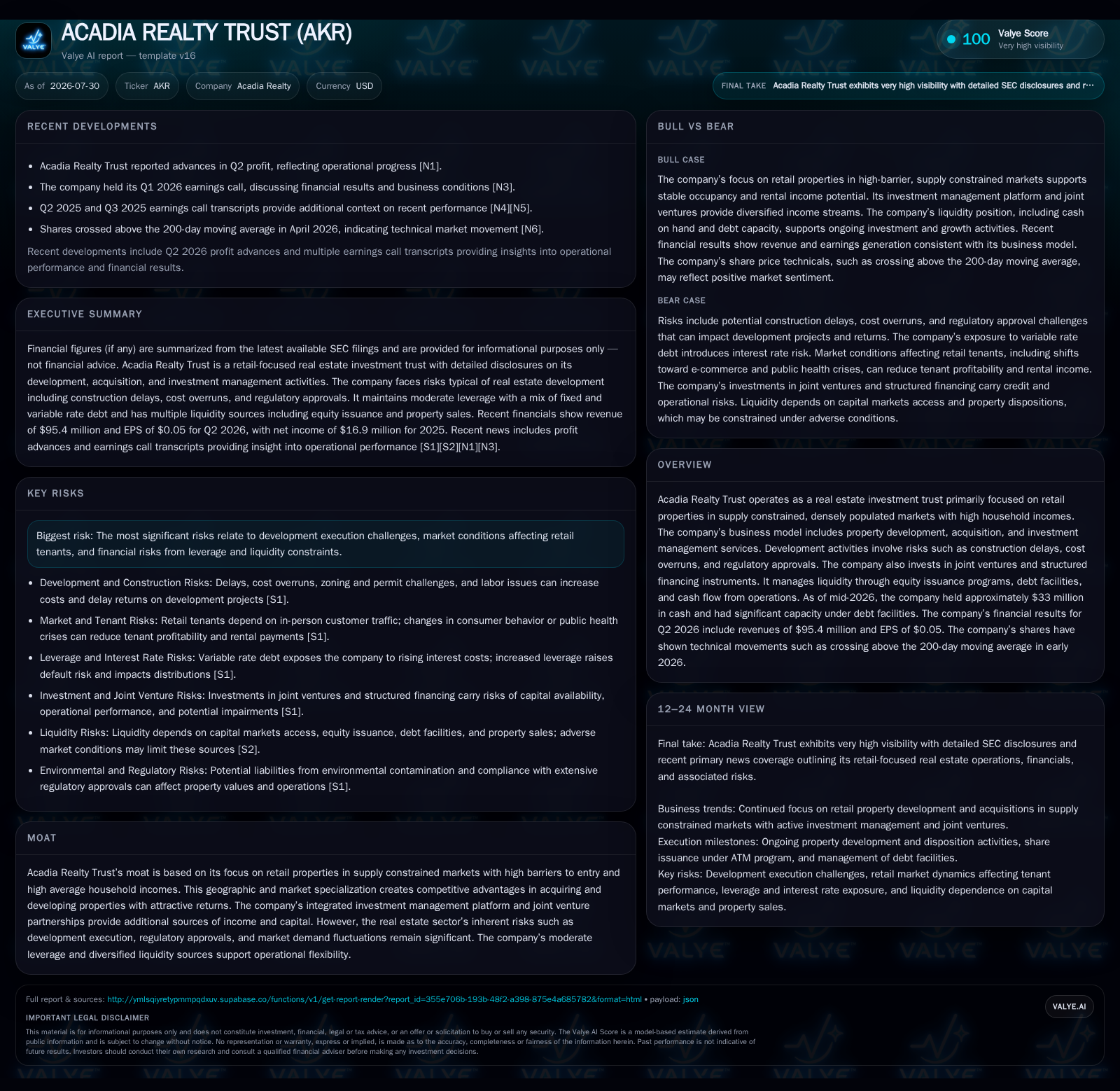
Acadia Realty Trust reported Q2 2026 revenues of $95.4 million and EPS of $0.05, reflecting solid operational performance amid a complex development pipeline and a liquidity position supported by equity issuance and debt facilities. The company’s niche focus on high-income, densely populated retail markets provides competitive advantages but also entails risks related to construction delays, leasing hurdles, and financing costs. Acadia balances these through joint ventures, structured financing, and a conservative capital structure with $33 million cash and nearly $500 million undrawn debt capacity as of June 2026. Monitoring lease-up success, development completions, and capital deployment efficiency will be key to validating growth prospects.
Recent Operating Update
At quarter-end June 30, 2026, Acadia held approximately $33 million in cash equivalents with nearly $491 million available under committed debt facilities [F1][S6]. The company recently augmented its equity base through its at-the-market (ATM) offering program with net proceeds totaling $128 million over the first half of 2026 and outstanding forward sale contracts representing an additional potential $369 million in gross proceeds scheduled for delivery by mid-2027 [S2][S3]. This dual approach using public equity issuances complemented by secured debt availability affords Acadia substantial financial flexibility to fund new developments or acquisitions.
Business Model Overview
Acadia operates as a real estate investment trust (REIT) primarily focused on owning, developing, and managing retail properties situated within supply-constrained metropolitan regions characterized by high population densities and elevated average household incomes [S1]. These geographic choices underpin Acadia’s competitive moat by limiting new supply entrants due to regulatory barriers, costly land acquisition, and zoning restrictions. The firm’s revenue streams combine rental income from leasing retail spaces — predominantly structured as triple-net leases where tenants bear property expenses — with property development gains upon project stabilization or disposition. Additionally, Acadia generates fees through its investment management platform overseeing joint ventures (JVs) that co-invest in retail real estate assets.
The monetization mechanics hinge on driving high occupancy coupled with rental rate escalations within its portfolio while strategically cycling capital through acquisitions of high-quality assets alongside selective dispositions to optimize portfolio composition. The embedded development pipeline represents both a growth vector via rent-roll expansion post-stabilization and a profitability lever through value creation if projects are executed efficiently [S1]. However, this model subjects the company to risks including construction cost inflation, permitting delays that elongate lease-up periods, volatile demand impacting tenant credit quality, and cyclical pressures inherent to retail real estate.
Industry Structure and Competitive Position
Within the competitive landscape of retail REITs, Acadia distinguishes itself via geographic specialization targeting urban corridors where consumer spending power sustains retail demand despite ebbs in broader economic cycles. Compared to national diversified REITs or those focusing on lifestyle centers or mixed-use developments, Acadia’s emphasis on dense neighborhoods allows it to capture higher average rental rates per square foot supported by affluent demographics.
Monitoring lease renewal rates and pre-leasing percentages within developments will provide early indicators of sustainable organic NOI growth.
Risks & Watchpoints
Though structurally well positioned, several risks require vigilant oversight:
Development Execution: Construction delays or cost overruns can erode expected returns given extended payback periods illustrated in previous annual disclosure [S1]. Delays also increase carrying costs potentially pressuring margins.
Regulatory & Permitting Complexity: Multi-jurisdictional approval processes inject timing uncertainty that may postpone commencements impacting projected cash flows.
Retail Tenant Credit Risk: Shifts in retail sector fundamentals such as bankruptcies or downgraded tenant credit ratings could lower occupancy rates or delay lease renewals.
Interest Rate Exposure: Rising interest rates threaten higher debt servicing costs given fixed versus variable loan mix; although hedged partially via swaps must be monitored continuously.
Geographic Concentration: Focused urban markets concentrate exposure which may magnify effects from local economic shocks or regulatory changes.
The company explicitly cites uncertainty around timely zoning approvals and presence of union labor requirements that may inflate project costs acting as additional headwinds [S1].
What To Watch Next
Key upcoming catalysts include:
The physical settlement timing of forward sale agreements that undergird part of the company’s capital plan scheduled no later than June 9, 2027; progress here affects liquidity outlook directly [S11][S14]
Progress on development completions with adherence to planned lease-up schedules; tangible rental income growth will validate investment returns.
Lease renewal outcomes coupled with tenant retention rates across key properties signaling sustained portfolio health.
Capital deployment efficiency tracking whether recent equity raises translate effectively into accretive acquisitions or developments surpassing hurdle returns.
Any shifts in regulatory environment impacting zoning or labor rules potentially complicating future development timelines or escalating costs.
By monitoring these metrics closely alongside operating KPIs such as net operating income progression per stabilized asset cohort observers can gauge whether Acadia successfully navigates execution challenges inherent in its business model.
Financial Profile Discussion
At June 30, 2026, Acadia reported approximately $33 million in cash equivalents against total debt approximating $1.65 billion resulting in net debt near $1.62 billion when adjusted for cash reserves—a moderate leverage posture for a specialty retail REIT given the size and urban concentration of its portfolio [F1]. The company benefits from robust liquidity headroom evidenced by nearly half a billion dollars ($491 million) available undrawn under secured revolving credit facilities providing ready access for working capital or investment purposes [S6][S16]. Equity funding remains actively utilized as part of the capital strategy; physical settlements of previously forward-sold shares generated $128 million proceeds in H1 2026 used both for deleveraging initiatives and reinvestment into acquisition activity demonstrating dynamic balance sheet management [S2][S3].
Operating cash flows remain stable despite swings in accounting net income inflated by sizable one-time property disposition gains illustrating sound core operational cash conversion capabilities—crucial for sustaining dividend distributions typical within REIT frameworks [S4]. Ongoing monitoring of interest coverage ratios alongside funds from operations (FFO) would yield deeper insight into sustainable profitability though these metrics are not explicitly disclosed here. Overall financial flexibility anchored by diverse funding avenues—from ATM equity offerings through moderately sized investment-grade debt tranches—supports growth while providing resilience against external market disruptions common in real estate capital markets.
This analysis reviews publicly filed data up to Q2 2026 without offering investment research views. Readers should consider filings' disclaimers regarding forward-looking statements subject to change based on market conditions or unforeseen operational developments.
Disclaimer: This is research-only, informational analysis and not investment advice. It may include AI-generated interpretation and general industry context. Always verify important details using primary sources.

Comments